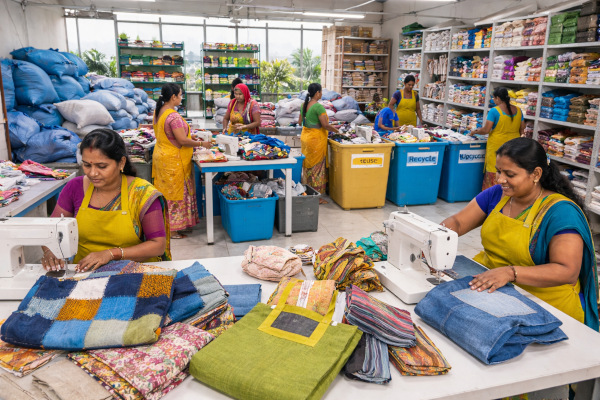
Navi Mumbai is emerging as a major example of how Indian cities can tackle textile waste through organised recovery, reuse, and recycling. According to the Ministry of Textiles, the city’s Textile Recovery Facility (TRF), developed under Swachh Bharat Mission-Urban 2.0, is cutting landfill waste, generating livelihoods, and building a replicable model for circular urban management.
India produces nearly 7.8 million metric tonnes of post-consumer textile waste every year, spanning everything from sarees and uniforms to denim and household linen. Against that backdrop, the Navi Mumbai Municipal Corporation has set up what PIB describes as India’s first municipal Textile Recovery Facility in Belapur, positioning textile waste as a recoverable resource rather than an overlooked urban burden.
The facility has been designed as a full circular system rather than a simple collection point. Textile bins have been placed across housing societies in all eight municipal wards, with 140 already installed and the current phase targeting 250. At the Belapur facility, the collected material is weighed, tagged, and sorted into reusable, recyclable, upcyclable, downcyclable, and reject categories. Fibre identification is strengthened through the KOSHA handheld scanner, which can distinguish materials such as cotton, polycotton, polyester, wool, and silk.
The project is also building digital traceability into the waste stream. A dedicated MIS platform is under development to map the journey of each item from donation to end use, improving transparency and data-based decision-making. After sorting, the textiles are sanitised and converted into products such as bags, mats, accessories, garments, and home décor items, many of them produced by women from self-help groups.
One of the strongest outcomes of the initiative has been livelihood creation. More than 300 women have completed structured eight-day Training-of-Trainers modules covering fibre identification, segregation, repair, and upcycling skills. Over 150 women are now earning between ₹9,000 and ₹15,000 per month through sorting, stitching, and product transformation, turning textile recovery into a source of green employment and local enterprise.
The scale achieved so far is already significant. The TRF has collected 30 metric tonnes of post-consumer textile waste, scientifically sorted 25.5 metric tonnes, and processed more than 41,000 items at an average of nearly 500 items a day. The initiative has also reached over 1,14,575 families, conducted more than 75 IEC workshops, onboarded over 350 society representatives, and developed more than 400 upcycled product samples, including a pilot batch of paper made from rejected textile waste.
The project has also doubled as a public awareness and market-building effort. The TRF has participated in more than 30 exhibitions and public events to promote recycling and reuse while giving women artisans a platform to showcase and sell their products. Although the programme initially faced hurdles such as resistance to bin placement, low awareness around textile segregation, and the complexity of mixed-fibre sorting, PIB says these were addressed through phased rollout, citizen engagement, inter-agency coordination, and fibre-scanning technology.
With plans now moving toward a permanent, higher-capacity facility in Koparkhairane near Nisarg Udyan, the Navi Mumbai model is being presented as proof that a waste stream once treated as residual can be converted into environmental value, community participation, and urban livelihoods. The initiative also aligns with Swachh Bharat 2.0, the Smart Cities Mission, and Sustainable Development Goal 12 on responsible consumption and production.
Reference: PIB
You may also like
-
India Introduces New CBG Pricing Framework to Strengthen Bioenergy Producers While Shielding Gas Consumers
-
Tata Power Renewables Commissions 72.5 MW Solar Project in Rajasthan to Support Tata Steel’s Decarbonisation
-
NTPC Targets 244 GW by 2037 With ₹16.86-Lakh-Crore Expansion Across India’s Energy Sector
-
UPI Completes a Decade as Transaction Value Surges More Than 4,000-Fold
-
AGNIT Semiconductors: Building India’s Gallium-Nitride Chip Capability for Radar, Communications and Power Electronics
