Rani Durgavati stands among the most formidable rulers of 16th-century India, remembered both as a warrior and as a capable sovereign. The strongest contemporary source available online, Abu’l Fazl’s Akbarnama, identifies her as the daughter of Raja Salibahan of the Chandel line, ruler of Ratha and Mahoba. The Ministry of Culture’s Indian Culture portal likewise places her birth on 5 October 1524 at Kalinjar in present-day Banda district, and links her to the illustrious Chandelas, the dynasty associated with the Khajuraho temples and older resistance to Mahmud of Ghazni. A commonly repeated tradition says she was named Durgavati because she was born on Durgashtami. The same contemporary source clearly names her father and lineage; I did not find an equally strong contemporary source naming her mother.
Her marriage carried political weight as well as dynastic significance. At about 18 years of age, she was married to Dalpat Shah, son of the Gond ruler Sangram Shah of Garha-Katanga. Indian Culture describes this as an alliance between two royal houses at a time when the Gond kingdom had become a major power in central India. Under Sangram Shah, Garha-Katanga had expanded substantially and was said to include 52 forts, spread across a region corresponding broadly to parts of present-day Madhya Pradesh and adjoining areas. This meant Durgavati entered a court that was already militarily serious, territorially ambitious, and strategically placed between north Indian and Deccan power zones.
Her life changed sharply after Dalpat Shah’s early death in the late 1540s. Indian Culture dates his death to 1548, while the Akbarnama says their son Bir Narayan was five years old when she assumed power, which points to the same late-1540s to 1550 transition. What is clear across the sources is that Durgavati placed her minor son on the throne and ruled as regent, with the help of trusted ministers including Adhar Kayastha. She soon proved far more than a caretaker. Indian Culture credits her with a prosperous administration in which taxes were paid in gold coins and elephants, while also naming specific public works associated with her reign: the reservoirs Ranital, Cherital, and Adhartal. It also notes that she patronised learning and allowed Acharya Bitthalnath to establish a seat of the Pushtimarg tradition at Garha.
The scale of the realm she held together helps explain her historical stature. Indian Culture says her kingdom stretched roughly 300 miles east to west and 160 miles north to south. Abu’l Fazl records that she held sway over 23,000 inhabited villages, of which 12,000 were under her direct officers, with the remainder under tributary chiefs. Her army, in the same tradition, was formidable: around 20,000 cavalry, 1,000 elephants, and a substantial infantry. She consolidated the kingdom’s borders, led campaigns in person, and, according to Indian Culture’s summary of the Tarikh-i-Firishta, repulsed Baz Bahadur of Malwa sometime between 1555 and 1560. Abu’l Fazl also paints a vivid personal portrait of her, saying she was an excellent shot with both bow and musket and a relentless hunter whose courage was already famous in Hindustan.
The final act of her reign began when the Mughal frontier moved closer. After Akbar defeated Baz Bahadur in 1562, Malwa became a Mughal possession, and the annexation of nearby territories like Rewa and Panna tightened the imperial ring around Garha-Katanga. Indian Culture says Asaf Khan, Mughal governor of Kara-Manikpur, first cultivated friendly and commercial contact while gathering intelligence through spies and traders. He then invaded in 1564 with a large force that included 10,000 cavalry, infantry, and artillery, advancing into her territory through Damoh. Abu’l Fazl’s account broadly matches this picture, recording the same 10,000-strong expedition and acknowledging that her troops were initially dispersed when the invasion began.
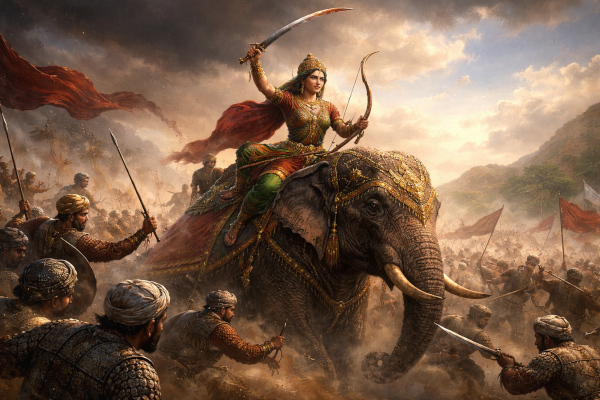
Durgavati’s response was immediate and characteristically bold. She began with barely 500 men, moved through jungle and hill country, and gathered more troops on the march until her force rose to around 5,000. She chose the terrain around Narhi/Narrai, where hills hemmed in one side and the Narmada and Gaur rivers guarded the other, making movement difficult for the invader. On the first day, her tactics worked brilliantly: she let the Mughal force enter the pass and then struck from multiple directions. Indian Culture says about 300 Mughal soldiers were killed and the rest driven back. That night she urged a further night attack to prevent Mughal artillery from entering the pass. Her generals refused. The next day proved her strategic instinct had been correct. Asaf Khan brought his guns forward, and the battle turned into a brutal contest of endurance. Mounted on her favourite elephant Sarman, and fighting alongside Bir Narayan, she pushed the Mughal army back three times before the tide shifted.
Her end came in the thick of battle, and it sealed her legend. Indian Culture says she was hit by two arrows, one in the right temple and another in the neck. Abu’l Fazl’s version agrees on the sequence: an arrow struck her temple, a second pierced her neck, and after briefly losing consciousness she realised the battle was lost. She asked her driver to kill her so that she would not fall captive. When he refused, she drew her own dagger and killed herself on 24 June 1564. Indian Culture adds that her followers cremated her in a narrow mountain pass about 12 miles from Jabalpur. The struggle did not end there: Bir Narayan later died defending Chauragarh, and Asaf Khan seized the treasury. Yet even hostile chroniclers preserved her renown. Abu’l Fazl praised her courage and liberality, while Indian Culture notes that later memory in central India turned her into a permanent symbol of sacrifice and sovereignty. Her legacy survives in Balidan Divas commemorations, Rani Durgavati University, the Rani Durgavati Museum, a 1988 postage stamp, and the naming of ICGS Rani Durgavati in her honour.
References:
- Indian Culture, Ministry of Culture, Government of India. “Rani Durgavati.”
https://www.indianculture.gov.in/stories/rani-durgavati - Abu’l Fazl. Akbar-nama Of Shaikh Abu-l Fazal.
https://ia802909.us.archive.org/34/items/in.ernet.dli.2015.115997/2015.115997.Akbar-nama-Of-Shaikh-Abu-l-Fazal_text.pdf - Department of Public Relations, Government of Madhya Pradesh. “Singrampur preserves the memories of Dalpat Shah and Rani Durgavati.”
https://www.mpinfo.org/Home/TodaysNews?LocID=32&fontname=FontEnglish&newsid=20241003N58&pubdate=10%2F03%2F2024
You may also like
-
Mekala in the Mahabharata: The Ancient Highland Kingdom of Amarkantak and the Maikal Hills
-
Anupa in the Mahabharata: The Ancient Narmada Kingdom of Mahishmati and the Maheshwar Region
-
Sarnath Joins UNESCO World Heritage List as India’s Civilisational Legacy Gains Global Recognition
-
Ancient Bazira-Barikot of Gandhara Gains UNESCO Recognition as 3,000 Years of Urban History Emerge From Swat
-
Vaidisha in the Mahabharata-Era Geography: The Ancient Vidisha Region of Central Madhya Pradesh
