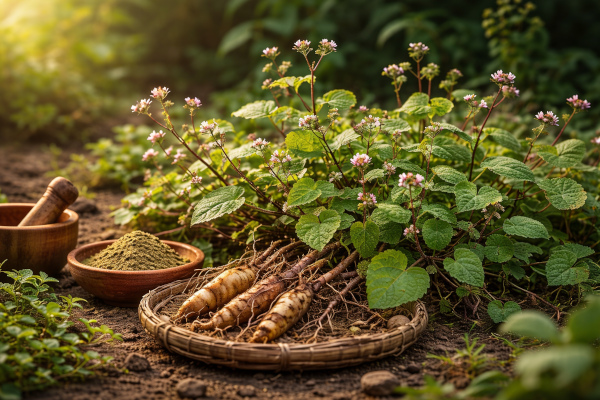
Punarnava, usually identified in Ayurveda with Boerhavia diffusa Linn. of the Nyctaginaceae family, is one of the better-known classical herbs used in traditional Indian medicine. In the Ayurvedic Pharmacopoeia of India, it is described as the dried, matured whole plant of a trailing herb found throughout India, especially after the rainy season, with many long, slender, prostrate or ascending branches arising from a stout rootstock. Ayurveda classically associates Punarnava with actions such as mutrala (promoting urine flow) and shothahara (helping with swelling/inflammation), which explains why it is so often discussed in the context of fluid balance and edema in traditional practice. Modern review literature also notes that the plant has been widely studied for its phytochemicals, including rotenoids, flavonoids, xanthones, lignans, steroids, and the alkaloid punarnavine, though that does not mean every traditional claim has been conclusively proven in large human trials.
The name itself is revealing. “Punarnava” is commonly understood as something like “becoming new again” or “renewed,” and that poetic meaning fits the herb’s place in Ayurveda as a plant linked with restoration. Traditional texts and later Ayurvedic practice value it especially in formulations meant for swelling, urinary complaints, and general support in conditions where the body seems burdened by retained fluid or sluggish metabolism. At the same time, the modern scientific literature around Boerhavia diffusa is best read carefully: there is substantial laboratory and preclinical interest, but the strength of evidence varies depending on the condition being discussed. It is safer to say that Punarnava is a classically important Ayurvedic herb with a growing research base, rather than overselling it as a universal cure.
If you want to identify Punarnava in nature, start with its overall habit. It is a low, spreading, trailing weed-like herb rather than a tall upright plant. The stems are typically greenish-purple, slender, often swollen at the nodes, and branch freely, sometimes extending well over a metre. The plant tends to hug the ground or rise only slightly, so from a distance it may look like a diffuse mat of branching stems. This prostrate, sprawling character is one of the easiest first clues.
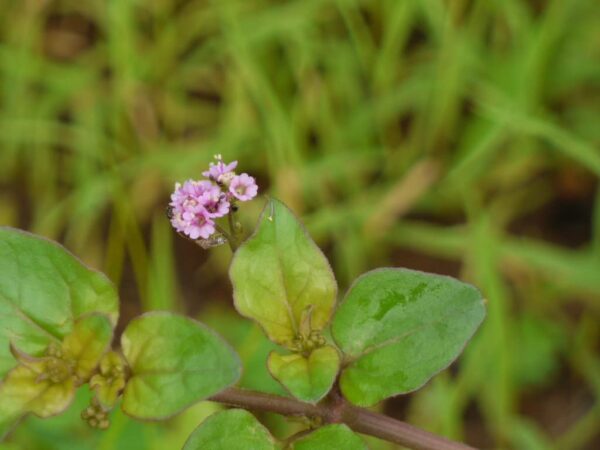
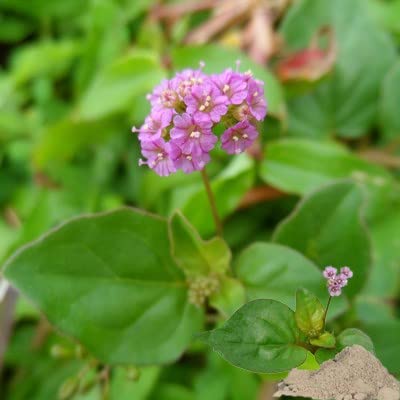
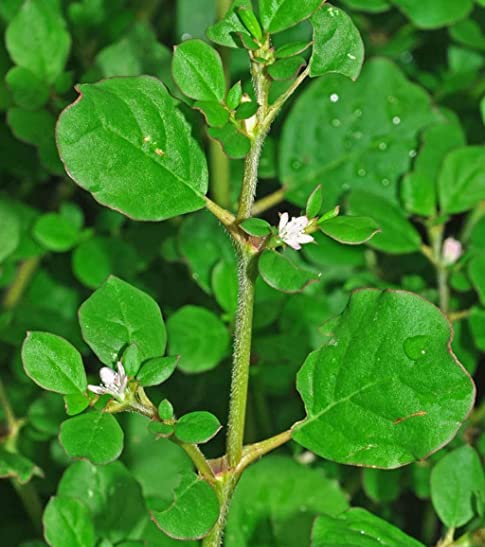
The leaves are one of the most useful identification markers. The Pharmacopoeia describes them as opposite and unequal in pairs: one leaf in the pair is usually noticeably larger than the other. They are ovate-oblong to nearly round, with a rounded or slightly pointed tip, a rounded or somewhat heart-shaped base, and an entire to slightly wavy margin. The upper surface is usually green and smoother, while the underside is whitish; in some cases the dorsal side can show a pinkish tinge. The leaves are also somewhat thick in texture, and the petiole can be nearly as long as the blade. That unequal-paired leaf arrangement is a particularly handy field clue when you are comparing it with other creeping herbs.
The flowers are small and easy to miss unless you look closely. Punarnava bears tiny pink flowers, nearly sessile or on short stalks, arranged in small umbels and terminal panicles on slender stalks. The flowers are not large or showy; they are delicate, pink, and clustered. Later, the plant develops a small one-seeded, ribbed fruit that is described as clavate and viscidly glandular. If you find a spreading herb with purple-tinged stems, unequal opposite leaves, and clusters of tiny pink flowers, you are very much in Punarnava territory.
The root is also important, especially because many traditional preparations use the root or whole plant. It is described as well developed, fairly long, somewhat tortuous, cylindrical, and yellowish-brown to brown. In the hand, the surface feels comparatively soft but roughened by fine longitudinal markings and root scars, and the taste is described as slightly bitter. For home identification, though, it is usually better to rely first on the above-ground habit, leaves, and flowers rather than uprooting the plant unnecessarily.
From an Ayurvedic point of view, Punarnava is valued less as a kitchen herb and more as a medicinal dravya, but nutritionally it is not empty. A nutritional evaluation of fresh leaves reported substantial moisture content (76.04%), along with carbohydrate (17.14%), vitamin C (40 mg/100 g), and measurable minerals including phosphorus (151.45 mg/100 g), sodium (160.21 mg/100 g), calcium (218.24 mg/100 g), and magnesium (8.93 mg/100 g). The same study also noted phytochemicals such as saponins, alkaloids, and flavonoids in the leaves. Another review cites reports of amino acids and vitamins in the plant, though nutrient figures can vary by plant part, soil, season, and whether one is analysing leaves, roots, or the whole plant. So a sensible “nutritional chart” write-up in paragraph form would be this: Punarnava leaves are predominantly water-rich, contain modest carbohydrate, contribute some vitamin C, and supply useful minerals—especially calcium and phosphorus—while also carrying bioactive phytochemicals that help explain why the plant has attracted both nutritional and medicinal interest.
In traditional use, Punarnava is most strongly associated with swelling, urinary support, and liver-related support, and modern reviews repeatedly note diuretic, anti-inflammatory, hepatoprotective, and nephroprotective interest around the plant. Much of the modern evidence comes from animal studies, in vitro work, and review-level summaries, not from large, definitive clinical trials across all these uses. That makes Punarnava an herb with credible traditional standing and promising research, but not one that should replace medical care in serious edema, kidney disease, jaundice, or heart-related fluid retention.
Punarnava is one of those plants in which Ayurveda, botany, and practical rural observation meet beautifully. It is humble in appearance, often growing like a common spreading herb, yet it carries a long medicinal reputation and a respectable nutrient-phytochemical profile.It is a plant easy to overlook underfoot, but important enough to have earned a lasting place in the Ayurvedic materia medica.
Reference:
The Ayurvedic Pharmacopoeia of India – Punarnava
https://miracledrinksclinic.com/Capsules/Renal_Support/Punarnava_Wh_Pl.pdf
PMC Review – Boerhavia diffusa Linn
https://pmc.ncbi.nlm.nih.gov/articles/PMC4053255/
Nutritional evaluation of leaves of Boerhaavia diffusa
https://www.researchgate.net/profile/Devendra-Chauhan/publication/236179275_Nutritional_evaluation_of_leaves_of_Boerhaavia_diffusa_l_and_Andrographis_paniculata_burmfWall_ex_nees_implications_for_nutraceautical_applications_International_Journal_of_Pharma_and_Bioscience_34_31/links/55856da808aef58c039d425a/Nutritional-evaluation-of-leaves-of-Boerhaavia-diffusa-l-and-Andrographis-paniculata-burmfWall-ex-nees-implications-for-nutraceautical-applications-International-Journal-of-Pharma-and-Bioscience-34-31.pdf
You may also like
-
Ayurveda on Cold Foods and Iced Drinks: Why Food Temperature Matters for Digestion
-
Serum Institute of India-Manufactured Ebola Vaccine Enters Clinical Trial in Uganda
-
Ayurveda and Hydration: How Much Water Should We Really Drink?
-
Warm Water in Ayurveda: When and Why It Is Recommended
-
Women Make Up 43% of India’s Ayush Workforce as Sector Supports 17.6 Lakh Livelihoods
