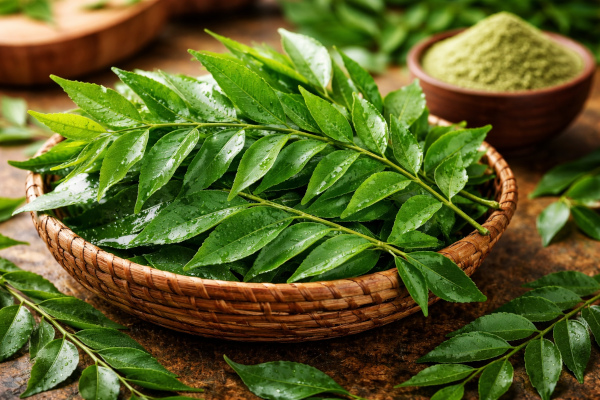
Curry leaves, known in common Indian speech as kadi patta, are among the most neglected medicinal foods in the kitchen. They perfume hot oil, uplift curries, then are pushed to the edge of the plate and discarded as though their only purpose in life were to briefly scent a tempering pan and disappear. Ayurveda, however, treats such leaves with far more seriousness. The curry leaf plant is identified botanically as Murraya koenigii, and in Ayurvedic usage it is associated with names such as Girinimba and Kaidarya. It has long been recognized in traditional Indian medicine as more than a flavoring agent: it is a functional leaf with digestive, metabolic, and restorative uses.
In Ayurvedic thinking, curry leaves are important because they sit at the fertile boundary between ahara and aushadha—between food and medicine. Ayurveda does not always separate healing from daily eating. Many substances are valued precisely because they can be used gently, regularly, and safely within ordinary food patterns. Curry leaves belong to that class. Their significance lies not in dramatic one-dose miracles but in steady support for agni (digestive fire), proper pachana (digestion and metabolic processing), and the management of everyday imbalances that arise from sluggish digestion, oily or heavy food, disturbed metabolism, and mild kapha accumulation. This general Ayurvedic framing is consistent with traditional monographs that describe the plant through rasa, guna, virya, vipaka, and dosha action.
Traditional Ayurvedic reference material describes curry leaves through rasapanchaka, the classic framework used to understand how a substance behaves in the body. The available institutional monographs I found describe it as having combinations of kashaya (astringent), katu (pungent), and sometimes madhura or tikta aspects, with laghu qualities and a katu vipaka; some sources describe its virya as sheeta. There is some variation across secondary Ayurvedic summaries, which is not unusual in traditional herb literature, so it is safer to say that curry leaves are generally understood as a light, digestive-supporting leaf with a tendency to reduce heaviness and support metabolic clarity rather than as an intensely heating, oily, or building herb.
From an Ayurvedic standpoint, curry leaves are especially valued in conditions of manda agni—low or dull digestive fire. When digestion is weak, food is not processed cleanly, and Ayurveda says this can contribute to the formation of ama, the sticky residue of incomplete digestion and metabolism. Substances with pungent, astringent, and digestive qualities are often used to prevent that drift into heaviness. This is why curry leaves fit so naturally into Indian cooking traditions: they are not there merely to please the nose. They subtly help make food easier to handle, especially meals that are oily, fermented, heavy, or rich in starch and pulses. Their culinary placement in the beginning of cooking is itself almost Ayurvedic in intelligence.
That digestive role is one of the strongest traditional reasons for their use. Ayurveda often values aromatic leaves and spices because they kindle appetite gently, improve taste perception, reduce nausea, aid downward movement of digestion, and limit the stagnation that follows heavy meals. Curry leaves have been described in traditional and review literature with actions corresponding to deepana and pachana—stimulating digestive capacity and helping the body process food more efficiently. In practical household terms, that is one reason they are so often used with lentils, buttermilk dishes, coconut-based curries, and tempered rice preparations. They help the meal behave better inside the body.
Ayurveda also connects curry leaves with kapha-related imbalances, especially when kapha shows up as sluggishness, coating, excessive heaviness after meals, mild nausea, or reduced appetite. Some traditional summaries also place the leaf in a role that can help regulate disturbed pitta in specific contexts, which may seem paradoxical until one remembers that herbs are not categorized by one dimension alone. A leaf can be digestive without being violently heating; it can improve metabolic processing without behaving like a harsh stimulant. That subtlety is precisely why curry leaves occupy such a useful middle ground. They are active enough to improve digestive function, yet familiar and food-like enough to be used frequently.
Another important Ayurvedic area is grahani—the broad field involving digestion, absorption, and bowel stability. While curry leaves are not among the most famous grahani herbs in the classical public imagination, traditional review literature associates the plant with use in diarrhea, dysentery, nausea, and vomiting-related states. In Ayurvedic logic, this makes sense: a leaf that supports appetite, reduces digestive stagnation, and carries astringent-digestive qualities may help the gut regain tone when digestion is unstable. This does not mean curry leaves alone are the master remedy for all bowel disorders; rather, they belong to the category of helpful supportive herbs in mild digestive disturbance and convalescent diet patterns.
Curry leaves also occupy an interesting place in discussions of prameha, the broad Ayurvedic disease category that includes disorders of urine, metabolism, and what modern readers often relate to diabetes-spectrum imbalance. Traditional Ayurvedic commentary around Kaidarya or Girinimba sometimes links it to metabolic support in this domain, and modern scientific reviews have also reported antidiabetic and hypolipidemic activity in experimental and review literature. That does not license careless claims that curry leaves “cure diabetes,” but it does show a meaningful bridge between Ayurvedic metabolic intuition and modern pharmacological interest. Ayurveda saw in this leaf something useful for disturbed metabolism long before laboratory language arrived.
Modern research adds another layer of respect to the Ayurvedic view. Reviews on Murraya koenigii describe it as rich in bioactive compounds, especially carbazole alkaloids, along with flavonoids and other phytochemicals that have drawn attention for antioxidant, anti-inflammatory, antidiabetic, hepatoprotective, and neuroprotective potential. Research is still uneven in strength, and much of it is preclinical or early-stage, but the broad direction is consistent: this is not an empty garnish. It is a pharmacologically interesting leaf that traditional systems had already woven into daily use.
Ayurveda also values curry leaves in the context of hair and scalp health, though here too one should be sensible rather than magical. Leaves of Murraya koenigii are commonly used in traditional oils and domestic applications for supporting the scalp and hair. This likely comes from a combination of traditional experience, antioxidant interest, and the broader Ayurvedic tendency to use aromatic and nutritive leaf substances in oils for khalitya and premature hair concerns. While modern evidence is not strong enough to make extravagant promises, the longstanding traditional use is real and widespread.
Nutritionally, curry leaves are small but dense contributors. Secondary Ayurvedic and scientific summaries note the presence of fiber, minerals, carotene, vitamin C, vitamin A-related compounds, and other nutritive elements. Ayurveda would not reduce the plant to nutrient charts alone, but these data help explain why a leaf long valued in food medicine continues to attract attention. It supports the old truth that some of the best medicinal substances are not exotic imports in expensive jars; they are humble leaves already sitting in the kitchen.
In household Ayurvedic practice, curry leaves are commonly taken in the most natural form: fresh leaves in cooked food. This method is elegant because it keeps the plant in the food-medicine zone, where its effects are mild, regular, and compatible with digestion. Fresh leaf chutneys, buttermilk infusions, tempering in ghee or sesame oil, and inclusion in soups, lentil preparations, and rice dishes are all consistent with how Ayurveda likes to work in everyday life—gently, repeatedly, and in rhythm with meals. People who remove the leaves and throw them aside are often discarding the very part that carries much of the plant’s value.
If one were to express the Ayurvedic essence of curry leaves in a single line, it would be this: they are a small leaf that helps food become less troublesome and the body become less burdened. They support digestion without drama, metabolism without noise, and nourishment without heaviness. In a medical culture increasingly addicted to spectacular claims, curry leaves offer a more classical lesson. Ayurveda often hides its intelligence in the ordinary. The leaf that most people treat as garnish has, for centuries, been quietly doing the work of a digestive companion, metabolic helper, and restorative kitchen herb.
A final caution is important. Traditional use and promising research do not make curry leaves a substitute for medical care. People with diabetes, liver disease, chronic digestive illness, pregnancy-related concerns, or those taking regular medication should avoid using herbs medicinally in concentrated forms without qualified advice. As food, curry leaves are familiar and generally well tolerated; as therapy, dosage and context still matter.
Reference:
https://nia.edu.in/herbal_garden_pdf/Murraya_koeniggi.pdf
https://www.ramch.in/wp-content/uploads/2026/01/Kadipatta.pdf
https://pmc.ncbi.nlm.nih.gov/articles/PMC7070712/
https://pubmed.ncbi.nlm.nih.gov/31991665/
https://www.easyayurveda.com/2022/12/26/curry-leaves/
You may also like
-
Karanja — Ayurveda’s Bitter Oil Tree for Skin, Wounds and Kapha-Vata Balance
-
Bengaluru’s SugarStrings.ai Develops Cheek-Swab DNA Test Screening Thousands of Genetic Disorders
-
Green Pyramid Biotech Turns Sophorolipid Research Into a Natural Food-Safety Platform
-
Ashoka — Saraca asoca: Ayurveda’s Celebrated Tree for Rakta and Women’s Health
-
New Smart Technology can Make Diagnosis of Alzheimer’s disease (AD) More Accessible
