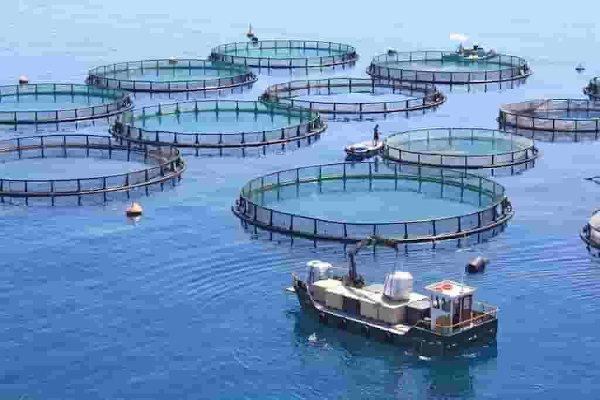
India’s fisheries sector is emerging as one of the country’s most important blue-economy growth stories, with rising production, expanding export reach and a sharper policy push toward value-added, globally compliant seafood trade. Backed by government investment of ₹39,272 crore since 2015, the sector today supports nearly 30 million fishers and fish farmers at the primary level, with livelihoods across the broader value chain running to almost twice that number. India is now the world’s second-largest aquaculture producer and contributes about 8% of global fish production.
The scale-up is visible in output numbers. Fish production has risen from 141.64 lakh tonnes in 2019-20 to 197.75 lakh tonnes in 2024-25, reflecting average annual growth of around 7%. That production growth has translated into export momentum as well. India’s marine product exports have more than doubled over the past 11 years, climbing from ₹30,213 crore in 2013-14 to ₹62,408 crore in 2024-25, with shrimp continuing to anchor the export basket at ₹43,334 crore.
India’s seafood shipment profile has also become broader and more market-oriented. The country now exports more than 350 varieties of seafood products to nearly 130 international markets. The United States remains India’s largest seafood destination, accounting for 36.42% of total export value in 2024-25, followed by China, the European Union, Southeast Asia, Japan and the Middle East. Frozen shrimp continues to dominate exports, but the basket now increasingly includes frozen fish, squid, dried products, frozen cuttlefish, surimi-based products, and live and chilled seafood. Notably, the share of value-added products in India’s seafood exports has risen from 2.5% to 11%, reaching an export value of USD 742 million.
That shift is central to the government’s strategy. Rather than remain dependent on a narrow set of commodities, India is trying to build a more diversified and premium seafood export portfolio. Under the Pradhan Mantri Matsya Sampada Yojana, support is being extended across the fisheries value chain, including fish seed quality, brackish-water aquaculture expansion, export-oriented species promotion, disease management, technology adoption, traceability and skill development. Alongside this, investments are being directed toward post-harvest infrastructure, cold-chain strengthening, modern fishing harbours and improved fish landing centres.
A major part of the next growth phase lies in high-value aquaculture. Policy support is increasingly focused on species such as tuna, seabass, cobia, pompano, mud crab, GIFT tilapia, grouper, tiger shrimp, scampi and seaweed. The underlying objective is not merely to raise export volumes, but to move Indian seafood exports up the value ladder and deepen access to premium overseas markets.
Equally important is the compliance side of the export story. India has been aligning its fisheries sector with international sustainability and regulatory requirements to protect access to major markets. One key milestone was securing a comparability finding from US authorities in 2025 under the Marine Mammal Protection Act framework, ensuring uninterrupted seafood exports to the American market beyond the December 2025 deadline. India is also moving to address restrictions affecting wild-caught shrimp exports through the installation of Turtle Excluder Devices on shrimp trawlers, with deployment progressing across coastal states.
The regulatory ecosystem is also being modernised. A national digital traceability framework has been launched to improve end-to-end tracking, food safety and export compliance. New rules governing sustainable fishing in India’s Exclusive Economic Zone are part of a broader attempt to position the country as a responsible and globally credible seafood supplier. On the trade facilitation front, the Sanitary Import Permit system has been fully digitised and integrated with the National Single Window System, cutting approval time from 30 days to 72 hours. Permit requirements have also been waived for select categories such as SPF shrimp broodstock, fish oil, certain R&D samples and wild-caught fish meant solely for value addition and re-export.
Over the next five years, India’s seafood policy direction appears clear: push higher-value exports, widen market access and tighten quality assurance. The focus will be on increasing the share of processed and value-added products, expanding presence in markets such as the UK, EU, ASEAN and West Asia, and building inland export hubs supported by freshwater supply chains, cold storage and digital compliance systems. If that strategy holds, India’s seafood sector may increasingly be judged not just by the volume it exports, but by the sophistication, traceability and premium value it brings to global markets.
Reference: PIB
You may also like
-
NTPC Targets 244 GW by 2037 With ₹16.86-Lakh-Crore Expansion Across India’s Energy Sector
-
UPI Completes a Decade as Transaction Value Surges More Than 4,000-Fold
-
AGNIT Semiconductors: Building India’s Gallium-Nitride Chip Capability for Radar, Communications and Power Electronics
-
India and Canada Target Comprehensive Trade Agreement by End of 2026
-
India’s Industrial Output Grows 6.7% in July as Manufacturing, Capital Goods and Power Drive Expansion
