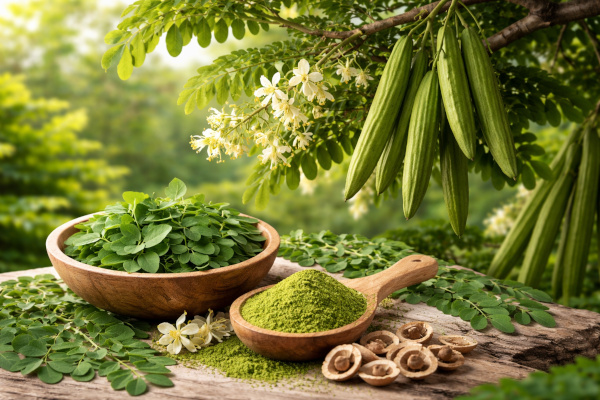
Moringa, known in Ayurveda as Shigru, is one of those rare plants that stands comfortably in both the kitchen and the clinic. For centuries in the Indian tradition, it has been valued not merely as a vegetable but as a potent medicinal plant used in different forms for strength, circulation, inflammation, swelling, digestive imbalance, and disorders associated with accumulated Kapha. The Ayurvedic Pharmacopoeia of India identifies Shigru as Moringa oleifera and records traditional therapeutic uses for its root bark, stem bark, and seeds, confirming its long-standing place in classical Ayurvedic practice.
What makes moringa especially powerful from a modern health perspective is its unusual nutrient density. Research reviews describe the leaves as rich in protein for a leafy plant, along with iron, calcium, potassium, carotenoids, polyphenols, and vitamin C, although the exact values vary with soil, climate, and whether the plant is consumed fresh or as powder. This combination helps explain why moringa is often discussed as a functional food rather than just a herb: it nourishes while also delivering bioactive compounds with measurable physiological effects.
Its strongest modern evidence lies in its antioxidant and anti-inflammatory potential. Moringa leaves contain flavonoids, phenolic compounds, glucosinolates, and other phytochemicals that help counter oxidative stress and inflammatory pathways. That matters because oxidative stress and chronic inflammation sit quietly beneath many modern disorders, from metabolic disease to vascular damage and accelerated aging. Reviews of moringa research repeatedly find that the plant shows credible antioxidant, anti-inflammatory, and protective biological activity across a range of experimental models.
Moringa also has meaningful promise in metabolic health. Human and preclinical studies suggest it may help support healthier blood sugar handling, lipid balance, and cardiometabolic resilience, especially when used as a leaf powder or whole-food supplement. The most careful reading of the evidence is that moringa is not a replacement for diabetes or cholesterol medication, but it may serve as a useful dietary adjunct for people trying to improve overall metabolic wellness. That fits remarkably well with Ayurveda’s view of Shigru as a plant that breaks through heaviness, stagnation, and obstruction.
Another reason moringa deserves respect is its role in daily nourishment. Unlike many herbs that are taken in tiny medicinal doses, moringa leaves can be eaten as food, which makes them especially valuable for long-term health support. In practical terms, moringa offers the sort of nutritional reinforcement that is useful in fatigue-prone diets, low-diversity diets, and situations where micronutrient quality matters. Its reputation as a “superfood” is often exaggerated in popular wellness language, but the underlying reason for the reputation is real: moringa is one of the more nutritionally dense traditional plants commonly available in South Asia and beyond.
From an Ayurvedic standpoint, Shigru is not merely nourishing; it is also sharp, heating, penetrating, and cleansing in action. That makes it especially valued where there is sluggishness, dampness, swelling, heaviness, and impaired movement in the system. This traditional description aligns intriguingly with modern interest in its anti-inflammatory and metabolic effects. Ayurveda, of course, uses a different language from biomedicine, but both traditions converge on one basic point: moringa is not a passive vegetable. It is an active plant with genuine physiological force.
For fresh moringa leaves, a USDA-linked nutrition entry gives the following approximate values per 100 g after scaling from its listed serving size: about 62 kcal, 9.5 g protein, 8.1 g carbohydrate, 1.4 g fat, and about 2 g fiber. The same source gives roughly 185 mg calcium, 4 mg iron, 337 mg potassium, 42 mg magnesium, 112 mg phosphorus, and about 1.05 mg manganese per 100 g.
In simple terms, that means fresh moringa leaves are notable for being:
- relatively high in protein for a leafy green,
- a useful source of iron, calcium, potassium, and magnesium, and
- low in fat.
For dried moringa leaf powder, the nutrients become much more concentrated because the water is removed. One study on dried leaves reported about 20.96 mg iron, 6.79 mg zinc, 5.80 mg manganese, and 21.42 mg beta-carotene per 100 g. That same paper noted the dried leaves had high micronutrient density and could enrich foods meaningfully.
A broader review of dried moringa leaves found protein commonly in the range of about 22.99% to 29.36%, fat about 4.03% to 9.51%, and fiber about 6.00% to 9.60%, reinforcing that dried moringa powder is nutritionally dense, especially compared with many common leafy vegetables.
WHO material from Timor-Leste shows that it has taken serious interest in moringa as a highly nutritious, locally sourced food in efforts to address malnutrition and improve community nutrition practices. In that WHO-linked programme, a nutritional mix containing dried moringa leaves was used for children and vulnerable mothers, and the document specifically notes WHO’s interest in learning more about moringa’s nutritional benefits in the context of locally available and affordable foods. This public-health interest aligns with scientific review literature describing Moringa oleifera as rich in macro- and micronutrients and bioactive compounds, with reported antioxidant, antimicrobial, anti-inflammatory, antidiabetic and other health-supportive properties. Taken together, these sources support a careful but strong conclusion: moringa is not a miracle cure, but it is a remarkably nutrient-dense traditional food with real relevance for nutrition, resilience, and preventive health.
That said, authenticity requires one note of restraint. The evidence for moringa is strongest for nutritional support, antioxidant action, and possible metabolic benefits; evidence for dramatic disease cures or guaranteed cognitive transformation is not strong enough to justify exaggerated claims. But within that honest boundary, moringa remains an extraordinary plant. Whether viewed through Ayurveda’s lens of Shigru as a channel-clearing, Kapha-reducing medicinal food, or through modern research on nutrient density and phytochemistry, moringa stands out as one of the most impressive traditional plants for supporting everyday health. Used wisely, especially in food forms such as cooked leaves, soups, dals, or leaves sautéed in ghee, it represents exactly what the best traditional nutrition should be: healing, sustaining, and deeply rooted in both experience and evidence.
Source:
https://www.ayurveda.hu/api/API-Vol-4.pdf
https://pmc.ncbi.nlm.nih.gov/articles/PMC9030530/
https://pmc.ncbi.nlm.nih.gov/articles/PMC8373516/
https://pmc.ncbi.nlm.nih.gov/articles/PMC6680322/
https://pmc.ncbi.nlm.nih.gov/articles/PMC9310029/
https://pmc.ncbi.nlm.nih.gov/articles/PMC7915875/
https://pubmed.ncbi.nlm.nih.gov/36768420/
https://pubmed.ncbi.nlm.nih.gov/35487081/
https://pmc.ncbi.nlm.nih.gov/articles/PMC10789628/
https://pmc.ncbi.nlm.nih.gov/articles/PMC9034459/
You may also like
-
Bharat Biotech’s Nucelion and VeGen Bio Partner to Manufacture Advanced Dual-Target CAR-T Cancer Therapy in India
-
Ayurveda and Anger: How Emotional Excess Affects Physical and Mental Health
-
Ayurveda and Stress: Daily Practices for Mental Balance and Emotional Well-Being
-
Ayurveda and Bowel Routine: Why Regularity Matters for Digestive Health
-
Why Ayurveda Warns Against Suppressing Hunger, Thirst and Sleep
%20in%20Health%20and%20Ayurveda)