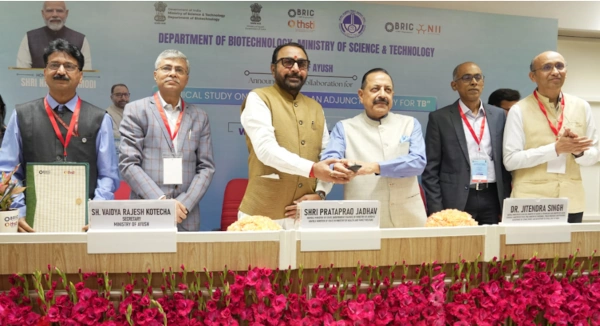
In a significant step towards integrative healthcare, the Ministry of Ayush and the Department of Biotechnology (DBT) on World Tuberculosis Day announced a collaborative clinical study to examine the role of Ayurveda as an adjunct therapy in anti-tuberculosis treatment. The initiative reflects India’s growing emphasis on combining traditional knowledge systems with modern biomedical research to improve patient outcomes in the fight against TB.
The study, titled Clinical Study on Ayurveda as an Adjunct Therapy for Tuberculosis, was formally announced at a high-level event held at Vigyan Bhawan in New Delhi. The programme brought together ministers, senior officials, scientists, researchers, clinicians and policy stakeholders, underlining the government’s push for evidence-based healthcare solutions that go beyond conventional treatment alone.
Speaking at the event, Union Minister of State (Independent Charge) for Science and Technology Dr. Jitendra Singh said India’s fight against tuberculosis is moving in the right direction, driven by innovation and sustained efforts under the leadership of Prime Minister Narendra Modi. He said the new clinical study demonstrates the government’s commitment to science-led and evidence-based innovation by bringing together modern biomedical research and validated traditional medicine systems. He also noted that DBT-led initiatives are helping strengthen research, global partnerships and patient-centric solutions to tackle challenges such as drug resistance, undernutrition and the long-term health impacts of tuberculosis.
Minister of State (Independent Charge) for Ayush Shri Prataprao Jadhav said tuberculosis care must go beyond eliminating infection and should focus on restoring the patient’s overall health, strength and dignity. He stressed that Ayurveda and other Ayush systems can play a supportive role not only during treatment but also in improving recovery, nutrition and quality of life for TB patients.
Officials from both ministries highlighted that the initiative builds on the Memorandum of Understanding signed in May 2022 between the Ministry of Ayush and DBT to advance integrative and evidence-based healthcare. The study will be led by the Central Council for Research in Ayurvedic Sciences (CCRAS) in partnership with DBT and will assess the efficacy, safety and tolerability of an Ayurveda regimen alongside standard anti-tuberculosis treatment and nutritional support.
According to the presentation made during the event, the multi-centre study will be conducted at leading institutions including AIIMS, JIPMER and NEIGRIHMS. Over a period of 24 months, researchers will examine whether Ayurveda-based supportive care can help improve nutritional outcomes, speed up recovery and enhance the quality of life of TB patients receiving standard treatment. The study is expected to generate robust scientific evidence on the value of integrative approaches in TB care.
A major highlight of the event was the exchange of a separate MoU between BRIC-Translational Health Science and Technology Institute (THSTI) and CCRAS, formalising collaboration at the institutional level. The agreement was exchanged between Prof. G. Karthikeyan, Executive Director of BRIC-THSTI, and Prof. Vaidya Rabinarayan Acharya, Director General of CCRAS.
The event concluded with a strong message that India’s TB elimination strategy is increasingly focusing on patient-centric and evidence-backed innovation. By exploring the potential of Ayurveda as a supportive therapy in tuberculosis care, the Ayush-DBT collaboration aims to open new scientific pathways while reinforcing India’s broader effort to combine traditional medical knowledge with modern research for better public health outcomes.
Reference: PIB
You may also like
-
Karanja — Ayurveda’s Bitter Oil Tree for Skin, Wounds and Kapha-Vata Balance
-
Bengaluru’s SugarStrings.ai Develops Cheek-Swab DNA Test Screening Thousands of Genetic Disorders
-
Green Pyramid Biotech Turns Sophorolipid Research Into a Natural Food-Safety Platform
-
Ashoka — Saraca asoca: Ayurveda’s Celebrated Tree for Rakta and Women’s Health
-
New Smart Technology can Make Diagnosis of Alzheimer’s disease (AD) More Accessible
