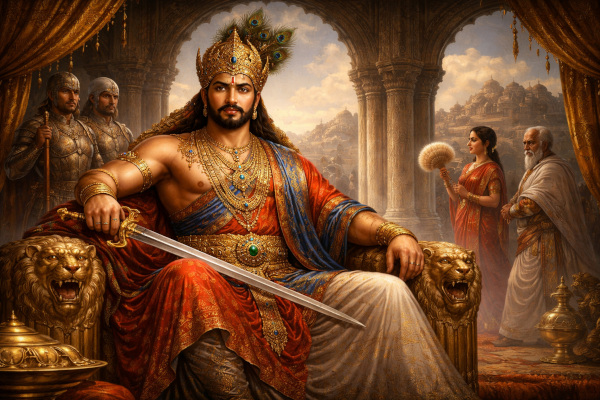
Rudradaman I is one of those ancient Indian kings who deserves to be far better known than he is. He was not the founder of a vast pan-Indian empire like Ashoka, nor is he remembered in popular memory as vividly as Chandragupta Maurya or Samudragupta. Yet in the 2nd century CE he emerged as the greatest ruler of the Western Kshatrapas, turned western India into a formidable political zone, defeated powerful rivals, restored a massive public reservoir after a natural disaster, and left behind one of the most important inscriptions in early Indian history. His fame rests above all on the Junagadh inscription, dated to about 150 CE, which is celebrated as the earliest major royal praise inscription in polished classical Sanskrit prose. Through it, Rudradaman appears not just as a conqueror, but as a king who wanted to be remembered as cultured, learned, generous, and magnificently self-controlled.
He belonged to the Western Kshatrapas, often called the Western Satraps, a Shaka ruling house that controlled important parts of western India for generations. Rudradaman was the grandson of Chastana, the dynasty’s major early ruler, and the son of Jayadaman. Modern reference works place Rudradaman’s reign roughly around 130 to 150 CE, though exact year-by-year chronology remains difficult, as it often does for this period. What is clearer is that he inherited a political world full of pressure points: the legacy of earlier Shaka power, the recovery of Satavahana strength in the Deccan, and the strategic wealth of western India’s trade-bearing routes and fertile zones. By the time Rudradaman reached the height of his power, he had become the first truly great ruler of his line.
To understand why Rudradaman mattered, one has to picture western India in the early centuries of the Common Era not as a quiet frontier, but as one of the most dynamic regions of the subcontinent. Gujarat, Kathiawar, Malwa, Kutch, and the western coastal belt were deeply tied to inland trade and to maritime exchange across the Arabian Sea. Whoever ruled these lands controlled not just territory but movement: caravans, tolls, ports, routes, tribute, and the prestige that came from commanding prosperous crossroads. The Junagadh inscription presents Rudradaman as lord over a strikingly wide zone, naming regions such as Anarta, Surashtra, Kaccha, Akaravanti, Anupa, Aparanta, and Sindhu-Sauvira, among others. Even allowing for royal exaggeration, the range is impressive and suggests a ruler whose authority stretched across much of western India and into adjoining areas.
That inscription is the beating heart of Rudradaman’s legacy. Cut on the rock at Junagadh in present-day Gujarat, near the Girnar hills, it was engraved on the same celebrated rock that also bears Ashokan edicts and, centuries later, an inscription of Skandagupta. Rudradaman’s text is dated to Saka year 72, corresponding to about 150–151 CE. It is not merely a notice or a dry administrative order. It is a fully developed royal eulogy, elegant and ambitious, designed to immortalize both a practical act of governance and the king’s own qualities. Historians regard it as the first major prasasti in classical Sanskrit prose, which makes it a landmark in the political and literary history of India. It signals a moment when royal power in post-Mauryan India began speaking in a new, self-conscious literary register.
The practical act at the center of the inscription was the restoration of the Sudarshana lake and dam system. This was no minor pond. The inscription remembers the reservoir as an old and prestigious public work whose history reached back to the Mauryan age. It says the lake had originally been constructed under Chandragupta Maurya by Pushyagupta, a Vaishya governor, and later embellished with channels under Ashoka by the Yavana official Tushaspha. Then, in Rudradaman’s own time, a violent storm lashed the region. Floodwaters from streams flowing down mount Urajayat, identified with Girnar, caused catastrophic damage. The text vividly describes the violence of the event and states that a breach measuring 420 cubits in length and width and 75 cubits in depth was torn into the embankment. The waters rushed out, and the once-beautiful reservoir was reduced to something like a sandy wasteland. Ancient India rarely speaks to us in such cinematic prose, and here the inscription almost lets you hear the storm.
What followed is what made Rudradaman more than a warlord. Faced with severe damage to an essential irrigation structure, his counselors reportedly despaired of repair. Rudradaman, he entrusted the work to his provincial governor Suvishakha, identified as a Pahlava . The restoration was carried out swiftly, and the inscription says the embankment was rebuilt stronger than before, “three times as strong” in length and breadth on all sides. Most significantly, the work was done, the text insists, without oppressing the surrounding towns and villages through extra taxes, forced labor, or arbitrary impositions. Whether one takes this literally or as royal self-advertisement, the claim is important: Rudradaman wanted posterity to see him as a king of public benefit, not merely conquest. In a dry region like Gujarat, irrigation was power made visible. To restore water was to restore legitimacy.
And yet Rudradaman was certainly a conqueror. The same inscription lays out a portrait of a ruler hardened by battle. It states that he twice defeated Satakarni, the “lord of the Deccan,” but did not destroy him because of nearness of relation. Scholars connect this with the Satavahana ruler Vashishthiputra Satakarni, who is known from another inscriptional context to have married the daughter of a Mahakshatrapa whose name begins with “Ru…,” plausibly Rudradaman. If that identification is right, then we glimpse one of the most human moments in early Indian statecraft: a king crushing his rival twice in war and then withholding annihilation because the rival was family by marriage. Power here is not abstract. It is political, dynastic, and intimate.
His campaigns seem to have rolled back Satavahana gains and restored territories once contested or lost. The Junagadh text, as interpreted by historians, suggests that regions previously associated with Satavahana control came under Rudradaman’s authority. It also describes him as a “restorer of kings deprived of their kingdoms,” implying that he not only conquered but rearranged the map through reinstatement and patronage. That phrase is revealing. It suggests a king who understood that stable power in early historic India did not always mean direct rule everywhere; it could also mean overlordship, political arbitration, and the redistribution of subordinate authority. He appears, in other words, not simply as a destroyer of rival houses but as a broker of sovereignty.
The inscription also boasts of his victory over the Yaudheyas, a warrior people famous enough in ancient India to be named with respect. Their conquest was not a casual aside. The text presents them as proud fighters, reluctant to submit, men who cherished their kshatriya valor. That Rudradaman highlighted their defeat shows that overcoming them was considered a notable feat. In a world where martial reputation traveled faster than maps, beating famous warriors was a kind of political currency.
But if Rudradaman’s sword gave him dominion, his inscription wanted to show that he possessed something more refined than force. He is praised there for knowledge and practice of grammar, music, logic, and other sciences. He is said to have been skilled in handling horses, elephants, chariots, swords, and shields, but also in composition itself. The text presents him as a composer of Sanskrit kāvya in both prose and verse, with lucidity, sweetness, vividness, and brilliance. This is an extraordinary self-image for a 2nd-century ruler: not just a battlefield king, but a cultivated intellectual sovereign. The inscription’s message is unmistakable. Rudradaman did not want to be remembered merely as feared. He wanted to be admired.
That blend of steel and style is part of what makes him so fascinating. Ancient kings often claimed learning, but in Rudradaman’s case the literary evidence is unusually direct and consequential. The very language of his inscription helps prove the point. Earlier inscriptions in India, especially the most famous Mauryan ones, had largely favored Prakrits. Rudradaman’s choice of ornate classical Sanskrit for a public royal record marks a turning point. It shows Sanskrit emerging decisively as a language of political prestige in epigraphy. In that sense, Rudradaman was not only using culture; he was helping shift the cultural grammar of kingship itself. A foreign-origin Shaka ruler, ruling in western India, chose to proclaim himself in exquisite Sanskrit. Few facts better capture the extraordinary absorptive power of Indian civilization.
His wealth, too, is drawn in lavish colors. The inscription says his treasury overflowed with gold, silver, diamonds, lapis lazuli, and other precious things, acquired through rightful tribute, tolls, and shares. Royal inscriptions flatter by nature, but this boast was not made in a vacuum. The territories associated with the Western Kshatrapas were commercially important, linked to inland circulation and wider networks of exchange. A strong ruler in such a zone could indeed build formidable revenues. Rudradaman’s power was not only military; it was fiscal. He ruled a geography where roads, ports, agrarian zones, and mineral wealth met. The inscription turns that material success into a moral claim by emphasizing lawful acquisition and public utility, but behind the rhetoric one can still sense the machinery of a prosperous state.
Even his physical description is theatrical. He is portrayed as a man marked by excellent bodily signs, impressive in voice, gait, complexion, vigor, and strength. He is handsome enough, the inscription suggests, to have been chosen in many royal svayamvaras. This is courtly exaggeration, of course, but it tells us something about ideals of kingship in the period. The perfect ruler was expected to embody beauty, learning, generosity, ferocity, and restraint all at once. Rudradaman’s inscription reads almost like a sculptor’s brief for an ideal king: broad of chest, master of words, undefeated in battle, overflowing in treasure, and gracious in conduct.
Numismatic evidence reinforces his stature. Museum records identify Rudradaman I as ruler of the Western Satraps and preserve coins issued in his name; these coin series, together with inscriptional evidence, are central to reconstructing the chronology of his reign and that of his dynasty. Coinage may seem dry beside the drama of a storm-torn dam and battlefield victories, but coins matter because they are the daily texture of sovereignty. They carry titles, circulate authority, and outlast palaces. In Rudradaman’s case, they help anchor him not in legend but in the hard evidence of rule.
Why, then, is Rudradaman I so important in the longer arc of Indian history? Because he stands at a crossroads. Politically, he represents the peak of Western Kshatrapa power in the 2nd century CE. Militarily, he checked and reversed Satavahana fortunes in important regions. Administratively, he turned a hydraulic disaster into a durable act of statecraft. Culturally, he presided over one of the earliest and most influential assertions of Sanskrit as the voice of royal self-representation. Historically, he shows how so-called “foreign” dynasties in India did not remain outsiders in any simple sense; they adapted, patronized, fought, married, ruled, and wrote themselves into the Indian past. Rudradaman is proof that ancient India was never static. It was layered, multilingual, politically competitive, and astonishingly open to reinvention.
In the end, what lingers about Rudradaman is not one single achievement but the texture of his kingship. He seems to stride out of the inscriptional record with unusual vividness: a ruler who could break enemies and rebuild embankments, who could advertise mercy without surrendering grandeur, and who believed power should sound beautiful when carved into stone. In him, the frontier energy of the Shakas met the literary ambition of Sanskrit court culture and the practical demands of ruling a hard, prosperous, contested landscape. That is why he remains memorable. Rudradaman I was not merely a king who ruled. He was a king who understood that to endure in history, one had to turn rule itself into narrative.
References:
Encyclopaedia Britannica. “Rudradaman.” Britannica. Accessed March 20, 2026.
https://www.britannica.com/biography/Rudradaman
British Museum. “Rudradaman I.” British Museum Collection Online. Accessed March 20, 2026.
https://www.britishmuseum.org/collection/term/BIOG183411
INFLIBNET / e-PG Pathshala. “Junagadh Inscription of Rudradaman.” PDF. Accessed March 20, 2026.
https://epgp.inflibnet.ac.in/epgpdata/uploads/epgp_content/S000829IC/P001689/M022045/ET/1504072596P08-M29-JunagadhInscriptionofRudradaman-ET.pdf
Encyclopaedia Britannica. “Shaka satrap.” Britannica. Accessed March 20, 2026.
https://www.britannica.com/topic/Shaka-satrap
British Museum. “Coin associated with the Western Satraps.” British Museum Collection Online. Accessed March 20, 2026.
https://www.britishmuseum.org/collection/object/C_1889-0105-98
You may also like
-
Mekala in the Mahabharata: The Ancient Highland Kingdom of Amarkantak and the Maikal Hills
-
Anupa in the Mahabharata: The Ancient Narmada Kingdom of Mahishmati and the Maheshwar Region
-
Sarnath Joins UNESCO World Heritage List as India’s Civilisational Legacy Gains Global Recognition
-
Ancient Bazira-Barikot of Gandhara Gains UNESCO Recognition as 3,000 Years of Urban History Emerge From Swat
-
Vaidisha in the Mahabharata-Era Geography: The Ancient Vidisha Region of Central Madhya Pradesh
