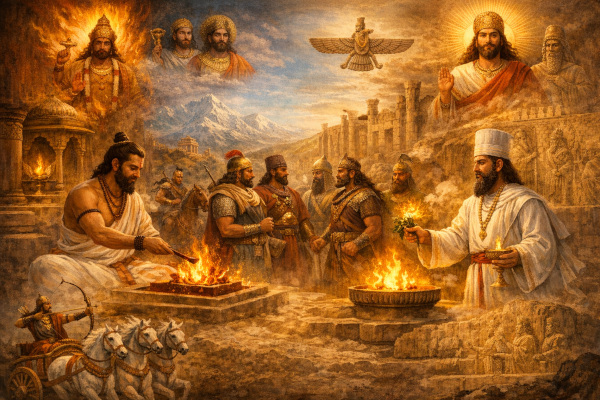
The historical relationship between ancient Iran and the Indic world represents one of the deepest civilizational connections in Eurasian history. Long before modern political borders emerged, the peoples of the Iranian plateau and the Indian subcontinent shared linguistic roots, religious ideas, mythologies, and cultural traditions that stemmed from a common Indo-Iranian heritage.
This shared past is preserved most clearly in the sacred texts of the two civilizations—the Rig Veda of the Vedic tradition and the Avesta of ancient Iranian religion. These texts reveal striking parallels in language, ritual, cosmology, and social organization. The later evolution of Zoroastrianism in Iran and Hinduism (Sanātana Dharma) in India represents not two unrelated traditions, but rather two branches of a once-shared spiritual heritage.
Even the great Indian epic, the Mahabharata, preserves references to tribes and kingdoms located beyond the northwestern frontiers of India—regions that correspond to ancient Afghanistan, Central Asia, and parts of Iran. These references suggest that the cultural memory of Indo-Iranian connections survived deep into classical Indian literature.
Understanding these connections offers insight not only into ancient history but also into the deep cultural currents that shaped two of Asia’s most influential civilizations.
1. The Indo-Iranian Civilizational Foundation
The origins of the Indo-Iranian world lie within the broader expansion of the Indo-European language family, whose speakers spread across Eurasia during the late Bronze Age. Scholars believe that a distinct Indo-Iranian cultural community emerged between roughly 2000 BCE and 1500 BCE across the Eurasian steppes and Central Asia.
Archaeological evidence from cultures such as the Andronovo Culture and the Bactria–Margiana Archaeological Complex suggests that these early communities practiced elaborate rituals centered around fire, sacrifice, and sacred chants. Excavations in Central Asia have uncovered ritual platforms and fire altars that resemble descriptions found in both Vedic and Iranian religious texts.
From this cultural matrix emerged two major branches:
- Indo-Aryans, who migrated toward the Indian subcontinent and composed the hymns of the Rig Veda
- Iranian peoples, who settled across the Iranian plateau and eventually produced the sacred literature of the Avesta
Before this separation, both groups shared a common cosmology, mythology, and ritual tradition.
2. Linguistic Links: Sanskrit and Avestan
One of the strongest pieces of evidence for Indo-Iranian unity lies in language. The sacred language of Zoroastrian scripture, Avestan, is closely related to Vedic Sanskrit, the language of the earliest Vedic hymns.
Both languages share similar grammatical structures, phonetic patterns, and vocabulary. Linguists often describe them as sister languages within the Indo-European family.
For instance:
| Sanskrit | Avestan | Meaning |
|---|---|---|
| Mitra | Mithra | Guardian of covenants |
| Soma | Haoma | Sacred ritual drink |
| Asura | Ahura | Divine being |
| Yajna | Yasna | Sacrificial ritual |
The similarity between Yajna and Yasna is especially significant. In Vedic religion, Yajna refers to the ritual offering performed through sacred fire. In Iranian religion, Yasna refers to the central liturgical ceremony described in the Avesta.
Such parallels suggest that both traditions inherited their religious vocabulary from a shared ancestral culture.
3. Shared Religious Concepts
Sacred Fire
Fire occupies a central place in both Vedic and Iranian religious traditions. In the Vedic tradition, fire is personified as Agni, one of the most frequently invoked deities in the Rig Veda. Agni acts as the divine messenger who carries offerings from humans to the gods.
In Iranian religion, sacred fire represents purity, divine illumination, and cosmic truth. Fire temples became central to Zoroastrian worship, where an eternal flame symbolized the presence of the divine.
The shared reverence for fire suggests that fire rituals were already deeply embedded in the religious practices of the proto-Indo-Iranian community.
Soma and Haoma
Another striking similarity between the two traditions is the ritual drink used in sacred ceremonies.
In Vedic religion, Soma was a sacred plant-based drink used during ritual sacrifices. It was believed to confer divine inspiration, vitality, and spiritual insight.
In Iranian religion, the equivalent ritual drink was Haoma, which played a similar role in ceremonies described in the Avesta.
Both rituals involved pressing the sacred plant, mixing it with water or milk, offering it to the gods, and then consuming it as part of the sacred rite.
Cosmic Order: Ṛta and Asha
Both civilizations believed that the universe was governed by a moral and cosmic order.
In the Vedic tradition, this principle is called Ṛta, the universal law that regulates cosmic harmony and moral righteousness.
In Zoroastrian philosophy, the equivalent concept is Asha, which represents truth, order, and righteousness.
Both concepts emphasize that human beings must live in alignment with cosmic truth. This shared philosophical idea later influenced the development of Dharma within Sanātana Dharma.
4. The Deva–Daeva and Asura–Ahura Reversal
One of the most fascinating developments in Indo-Iranian religious history is the reversal of divine terminology.
In Vedic tradition:
- Devas represent divine beings
- Asuras gradually acquire demonic associations in later texts
In Iranian religion the meanings reversed:
- Ahuras represent divine beings
- Daevas are condemned as malevolent spirits
This transformation occurred during the religious reforms associated with the Iranian prophet Zarathustra.
Zarathustra elevated Ahura Mazda as the supreme deity and rejected the worship of many earlier Indo-Iranian gods. His teachings eventually formed the foundation of Zoroastrianism, one of the world’s earliest monotheistic traditions.
5. Shared Deities and Mythological Parallels
Several deities appear in both Indo-Iranian traditions.
Mitra / Mithra
The Vedic deity Mitra appears in the Rig Veda as a guardian of contracts and social harmony.
In Iranian religion, Mithra plays a nearly identical role as the protector of covenants and the overseer of justice.
Varuna
The Vedic deity Varuna represents cosmic order and moral authority. Scholars believe that similar cosmic figures may have existed in early Iranian religion before the reforms of Zarathustra.
Indo-Aryan Gods in the Mitanni Treaty
One of the most remarkable pieces of historical evidence linking Indo-Iranian religion with the ancient Near East is a treaty from the Mitanni kingdom dating to around 1400 BCE.
This treaty invokes the gods Mitra, Varuna, Indra, and the Nasatyas as divine witnesses—names clearly derived from Vedic tradition. The presence of these gods in a Near Eastern diplomatic document demonstrates how widely Indo-Iranian religious ideas once spread.
6. Cultural Exchanges Between India and Persia
Interaction between India and Persia continued long after the Indo-Iranian cultural split.
During the reign of Darius I, ruler of the Achaemenid Empire, parts of northwestern India were incorporated into the Persian imperial system. Persian inscriptions refer to these regions as Hindush, confirming political and cultural contact between the two civilizations.
Trade routes connected the Indus Valley with the Iranian plateau through Afghanistan and Central Asia. These routes facilitated the exchange of goods such as textiles, spices, precious stones, and horses.
Centuries later, Persian culture profoundly influenced the Indian subcontinent during the Mughal era, shaping architecture, literature, and courtly traditions.
7. Iran in the Mahābhārata World
The epic universe of the Mahabharata extends far beyond the boundaries of the Indian subcontinent. The text frequently mentions tribes and kingdoms located to the northwest of India, many of which correspond to regions historically associated with ancient Iran and Central Asia.
Among these are the Kambojas, Shakas, Paradas, and Yavanas.
The Kambojas are often associated with regions around Afghanistan and possibly eastern Iran. The epic describes them as skilled horsemen and formidable warriors. During the imperial ceremony known as the Rajasuya, the Pandava king Yudhishthira receives tribute from many distant tribes, including western peoples.
The epic also recounts the military expeditions of Arjuna, who encounters several western tribes during his conquests.
The Shakas, widely identified with Iranian-speaking Scythian tribes, are listed among the warriors participating in the Kurukshetra War.
Such references demonstrate that the epic tradition preserved knowledge of the broader Indo-Iranian frontier.
8. Timeline of Cultural Transformation
3000–2000 BCE
Proto-Indo-Iranian culture develops across Central Asia.
2000–1500 BCE
Indo-Aryan and Iranian peoples begin to diverge.
1500–1000 BCE
Composition of the Rig Veda and early portions of the Avesta.
1000–600 BCE
Religious reforms introduced by Zarathustra reshape Iranian spirituality.
550–330 BCE
Expansion of the Achaemenid Empire connects Persia with northwestern India.
651 CE
Islamic conquest of Persia transforms the religious landscape.
8th century CE
Zoroastrians migrate to India and form the Parsi community.
The relationship between Iran and Sanātana Dharma represents one of the oldest civilizational connections in human history. From shared linguistic roots and religious rituals to common mythological figures and philosophical ideas, the evidence of Indo-Iranian unity is preserved across texts, archaeology, and cultural traditions.
Even the epic memory of the Mahabharata reflects awareness of western tribes inhabiting the Indo-Iranian frontier, suggesting that ancient Indians viewed their world as part of a broader cultural landscape extending into Central Asia and Persia.
Though history eventually led Iran and India along different spiritual and political paths, the echoes of their shared past continue to resonate through language, ritual, and philosophy—reminding us that these two great civilizations once emerged from the same ancient cultural horizon.
Epilogue
The Transformation of Iran After the Islamic Conquest
The arrival of Islam in the 7th century marked one of the most profound turning points in the history of the Iranian plateau. The fall of the Sasanian Empire in 651 CE during the Muslim Conquest of Persia ended centuries of Zoroastrian state patronage and gradually reshaped the religious and cultural landscape of Iran. The once-dominant faith of Zoroastrianism, which had been closely tied to Persian identity, steadily declined as political authority shifted to Islamic rulers. Over time, economic pressures such as the jizya tax, social restrictions placed on non-Muslims, and the loss of state institutions supporting Zoroastrian clergy contributed to widespread conversion to Islam and the marginalization of older traditions.
Many fire temples were abandoned, destroyed, or converted into mosques, and Zoroastrian communities gradually retreated to remote regions such as Yazd and Kerman in order to preserve their faith. The upheavals of this era also led to the migration of many Zoroastrians to India, where their descendants became known as the Parsi community. Although Persian culture eventually reasserted itself within the Islamic world—reviving the Persian language and producing great literary works like the Shahnameh—the spiritual traditions that had once connected Iran with the broader Indo-Iranian world were profoundly transformed. What remained were fragments of an older civilizational memory—festivals like Nowruz, reverence for fire symbolism, and echoes of ancient philosophical ideas—subtle reminders of Iran’s deep cultural kinship with the Vedic world and the heritage of Sanātana Dharma.
References
- Rig Veda
- Avesta
- Mahabharata
- The Geography of the Mahabharata
- Ancient Indian Historical Tradition
- The Scythians
- Early History of India
- Encyclopaedia Britannica – Ancient Iranian Religion
- Encyclopaedia Britannica – Zoroastrianism
You may also like
-
PM Vishwakarma Reaches 30-Lakh Artisan Registration Target as Scheme Completes Three Years
-
Mahishaka in the Mahabharata: The Ancient Southern Country of the Upper Kaveri
-
Vanavasi in the Mahabharata: The Ancient Forest Kingdom of Karnataka
-
Kuntala in the Mahabharata: The Ancient Country of Northern Karnataka and Southern Maharashtra
-
Ashmaka or Assaka in the Mahabharata: The Ancient Kingdom of the Godavari Valley
