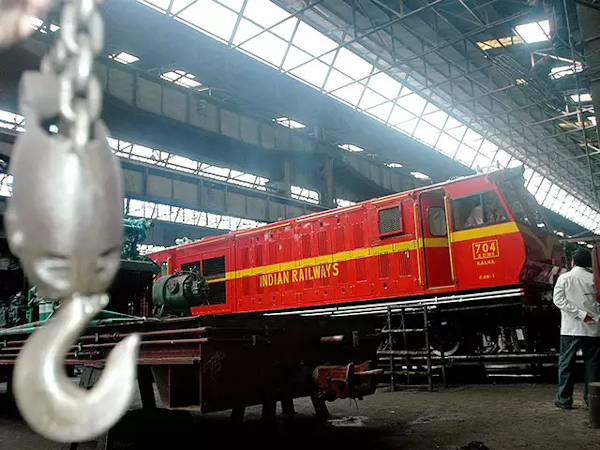
Titagarh Wagons (TWL), flagship company of the Titagarh Group, has entered into an exclusive cooperation agreement with ABB to address growing business of propulsion equipment (traction converters) for the Indian Railways EMU/MEMU market.
As per the agreement, TWL and ABB will work together to design, develop and manufacture state-of-the-art three phase IGBT-based propulsion systems for EMU/MEMU which will be manufactured in Titagarh’s plant at Uttarpara, Kolkata in West Bengal with certain components being supplied by ABB.
The agreement goes into effect immediately with the first units to be put into revenue service in less than two years.The agreement goes into effect immediately with the first units to be put into revenue service in less than two years.
TWL has manufactured and supplied more than 300 EMU/MEMU coaches to the Indian Railways and is now executing an order for design, manufacture and supply of 102 state-of-the-art Metro coaches for the Pune Metro ordered by the Maharashtra Metro Rail Corporation (MMRC).
It will be the first time that aluminium coaches will be manufactured and supplied to any Indian Metro, which is a landmark in the Make in India policy of the government.
These trains have a design speed of 180 km per hour and an operating speed of 160 km per hour. TWL, in cooperation with its Italian subsidiary, had bagged a developmental order for propulsion systems required in the EMU/MEMUtrains (local and suburban trains of the Indian Railways) for an approximate order value of Rs 65 crore from the Indian Railways
Source: Construction Week Daily
Image Courtesy: The Economic Times
You may also like
-
EON Space Labs and Dhruva Space Advance Indian Space Hardware on Transporter-18 Mission
-
SatLeo Labs’ TAPAS-1 Reaches Orbit, Advancing India’s Private Thermal-Imaging Capability
-
TakeMe2Space’s MOI-1A Reaches Space on Falcon 9 Transporter-18 Mission
-
Bank of Baroda Enters Pension Fund Management After PFRDA Appointment
-
SCI and India’s Push for a Larger Indigenous Maritime Fleet
