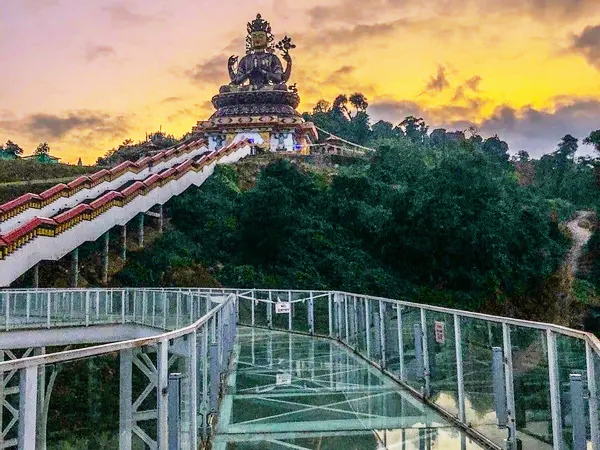
Pelling: Ever wondered what it feels to be walking on a transparent bridge suspended hundreds of feet above the ground? The internet is littered with videos of people freaking out while walking over glass bridges at foreign locations.
You don’t need a visa and a plane ticket to experience the same as India’s first glass skywalk is located right in the northeastern state of Sikkim. It is located in Sikkim’s Pelling and situated right opposite to the 137-feet statue of Chenrezig.
Nestled amidst the magnificent Himalayas, the glass skywalk provides a beautiful view of the Buddhist pilgrimage site. The whole complex is located at a height of 7,200 feet above sea level.
The glass skywalk adds to the allure of the scenic religious site which doubles up as a popular tourist location. Chenrezig or Avalokiteshvara, as per local folk tales, is the earthly incarnation of Lord Buddha, Amitabha. The statue at Choeling area in Pelling was constructed at a cost of Rs 46.65 crore.
Launched in 2018, the pilgrim site houses the world’s tallest Chenrezig statue along with and the accompanying glass skywalk, a cafe and a gallery.
The skywalk was built with an intention to give tourists and pilgrims a panoramic view of the Chenrezig statue, the stairs leading upto it and the golden prayer wheels. The glass skywalk is not for the weak-hearted as it allows visitors to look thousands of feet below.
The project was funded and constructed under the supervision of the Sikkim’s Department of Culture and the Department of Housing Buildings and Housing.
Source: TNN
You may also like
-
CG Power Strengthens India’s Semiconductor Manufacturing Ecosystem with ₹7,600 Crore Sanand Investment
-
Kargil Gets Its First Heat-Pump Dehydration and Cold Storage Facility to Boost Ladakh’s Agricultural Economy
-
India Explores 3,000 km Power Corridor to Supply 2,000 MW of Clean Electricity to Singapore
-
ONGC Explores Three Advanced Oilfield Technologies to Improve Mumbai High Well Operations
-
Kabra Extrusiontechnik’s GEON Commissions 20 MWh Battery Storage Project in Rajasthan
