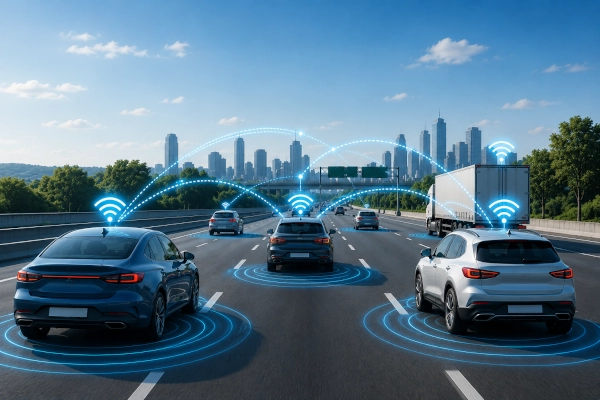
India is preparing for a major shift in the way vehicle safety is regulated, with the Ministry of Road Transport and Highways (MoRTH) proposing mandatory Vehicle-to-Vehicle (V2V) communication systems in newly manufactured vehicles across Categories L, M and N from October 1, 2028. If the proposal is finalised in its current form, motorcycles and scooters, passenger cars and SUVs, buses, trucks and other covered vehicles will gradually become part of a connected road-safety ecosystem in which vehicles can communicate critical information to one another.
The proposal moves the country’s vehicle-safety framework beyond technologies that primarily protect occupants during a crash or rely on sensors within an individual vehicle. V2V communication introduces a networked layer of safety in which vehicles can exchange information about their position, speed, direction and braking activity. This information can then be used by receiving vehicles to identify potential hazards and warn drivers before those hazards become visible through conventional cameras, radar or human observation.
The proposed framework is based on Automotive Industry Standard AIS-230. The draft rules envisage an initial phase from October 1, 2027, under which vehicles in the relevant categories that are equipped with V2V systems would have to comply with the applicable AIS-230 requirements. The broader requirement is proposed to take effect from October 1, 2028, when newly manufactured vehicles in Categories L, M and N would be required to have compliant V2V systems. It is important to note that these provisions are part of a draft regulatory proposal and are therefore subject to the government’s consultation and final notification process.
At its core, V2V is designed to allow vehicles to exchange safety-related information wirelessly. A connected vehicle can transmit information such as its location, speed, direction of travel and braking status, while nearby vehicles can receive and process that information in real time. The receiving vehicle can then compare the information with its own movement and determine whether there is a potential collision risk.
The key advantage of V2V is that it can provide information beyond the direct field of view of a vehicle’s driver and onboard sensors. A camera cannot see through a truck, a radar system has a finite sensing range and a driver may not be aware of an approaching vehicle hidden behind a building or around a blind curve. A V2V message, however, can originate from a vehicle that has already encountered the hazard and can therefore give other road users an earlier indication of what is happening ahead.
This capability could be particularly useful on Indian roads, where traffic is highly diverse and road conditions can change quickly. Consider a highway where a vehicle several positions ahead suddenly brakes because of an accident or traffic obstruction. Drivers behind may not immediately see the braking event because larger vehicles block their view. A connected vehicle could transmit an emergency-braking message, allowing vehicles farther behind to receive an early warning and potentially slow down before the danger becomes visible.
A similar application could emerge at blind intersections. Two vehicles approaching an intersection from different directions may be unable to see each other because of buildings, parked vehicles or other obstructions. By exchanging information about their position and movement, connected vehicles could identify a potential collision trajectory and alert their drivers before the vehicles enter the intersection. Such applications demonstrate why V2V is fundamentally different from conventional driver-assistance technology: it allows a vehicle to receive information about another road user even when that road user is outside its immediate visual environment.
The technology could also be used to support warnings involving wrong-way driving, unsafe lane changes, approaching emergency vehicles and hazards around blind curves. An emergency vehicle, for example, could potentially transmit an authenticated priority message to nearby connected vehicles, allowing drivers to receive an alert before they can hear a siren or see the vehicle. Similarly, a vehicle travelling in the wrong direction on a highway could potentially trigger warnings for approaching connected vehicles before the two become visually aware of each other.
However, V2V should not be viewed as a replacement for cameras, radar, Advanced Driver-Assistance Systems or human drivers. Instead, it is designed to add another layer of information to the vehicle’s existing safety architecture. This distinction will be especially important in India, where millions of older vehicles will continue operating without V2V capabilities for many years after the proposed mandate begins. Connected vehicles will still need conventional sensors to identify pedestrians, animals, cyclists, road debris and non-connected vehicles.
The proposed policy also needs to be understood in the context of India’s broader Vehicle-to-Everything, or V2X, ambitions. V2V represents only one part of the wider connected mobility ecosystem. V2X can also include communication between vehicles and roadside infrastructure, pedestrians and cellular networks. Vehicle-to-Infrastructure systems could eventually allow vehicles to communicate with traffic signals, road sensors, tolling systems and work-zone equipment, while Vehicle-to-Network applications could connect vehicles to cloud platforms for traffic information, navigation and other services.
Starting with V2V provides a relatively practical route into this larger ecosystem because it does not require every road and traffic signal to be equipped with connected infrastructure before the technology can begin providing benefits. Once a sufficiently large number of vehicles become connected, India could gradually expand the system toward infrastructure-based applications and a more comprehensive intelligent transportation network.
The choice of communication technology and the final technical specifications will be crucial to the success of the programme. The proposed framework is associated with Cellular Vehicle-to-Everything, or C-V2X, technology, which is designed to support direct communication between nearby connected devices as well as broader network connectivity. The communication ecosystem must be interoperable across manufacturers so that a motorcycle from one company can communicate with a car, bus or truck produced by another manufacturer.
Interoperability is particularly important because the value of V2V depends on the size and diversity of the connected network. If different manufacturers use incompatible systems, the safety benefits could become fragmented. A connected motorcycle must be able to communicate with a passenger car, and a commercial truck must be able to exchange safety information with vehicles from multiple manufacturers. The final AIS-230 framework will therefore have an important role in establishing common technical requirements covering communication, message formats, performance, testing and safety applications.
The inclusion of Category L vehicles makes India’s proposal particularly significant. Motorcycles, scooters and three-wheelers account for a substantial part of the country’s road traffic, and their interaction with larger vehicles creates unique safety challenges. A connected motorcycle could potentially alert a nearby car or truck to its presence when it is hidden by another vehicle or approaching from an unexpected direction. Similarly, a truck could potentially receive information about a two-wheeler travelling nearby in circumstances where conventional visibility is limited.
The proposed mandate could also create a substantial opportunity for India’s automotive software and engineering industry. Although V2V initially appears to be a hardware requirement, much of its value will come from software. Vehicles must be able to receive messages, authenticate them, interpret the information, calculate potential collision risks and determine whether a driver warning is necessary. The system must also interact with the vehicle’s electronic architecture, ADAS functions, instrument cluster, telematics platform and diagnostic systems.
This creates potential opportunities for companies involved in automotive software, embedded systems, connected mobility, middleware, cybersecurity, testing and engineering services. Companies such as KPIT Technologies, Tata Elxsi and other automotive technology providers could potentially participate in the resulting design and integration programmes. However, the proposed mandate should not be interpreted as an automatic revenue opportunity for any individual company. Actual commercial benefits will depend on OEM contracts, design wins, project scope, pricing, competitive positioning and the extent to which manufacturers choose to outsource development.
For vehicle manufacturers, the regulation could require considerable engineering work. OEMs may need to integrate communication modules with existing electronic architectures, update driver-information systems, validate performance under different operating conditions and establish new diagnostic and service procedures. Manufacturers will also have to ensure that the systems comply with the final regulatory requirements before vehicles receive the necessary approvals.
Cost will inevitably be one of the central issues. Mandatory V2V systems could increase vehicle manufacturing costs through additional electronics, communication hardware, software development, testing and certification. The impact will vary between vehicle segments. Premium vehicles that already have sophisticated telematics and electronic architectures may require relatively limited incremental integration, while entry-level cars, motorcycles and commercial vehicles could face a greater proportional burden.
The long-term cost of the technology could decline as production volumes increase and domestic manufacturing expands. Localisation of communication modules, semiconductor components, antennas and other electronics could help reduce costs. Vehicle manufacturers may also be able to spread development expenses across multiple models by adopting common platforms and architectures.
Cybersecurity will become equally important as vehicles become increasingly connected. A V2V system must be able to distinguish legitimate messages from fraudulent or manipulated information. A malicious device transmitting a false emergency-braking message, for example, could create unnecessary warnings or potentially dangerous situations. Connected vehicles will therefore require strong authentication mechanisms, secure communications, certificate management, protection of encryption keys, threat monitoring and secure software-update processes.
The policy could consequently have implications far beyond road safety. It could stimulate demand for automotive semiconductors, communication modules, embedded software, telematics, cybersecurity, testing and validation services. It could also encourage greater localisation of vehicle electronics and create new opportunities for Indian engineering companies that support global and domestic OEMs.
For companies such as KPIT Technologies, the opportunity could be particularly relevant because the broader connected-vehicle ecosystem requires software integration rather than simply hardware supply. The potential demand could extend into middleware, diagnostics, electronic architecture, connected mobility, ADAS integration, cybersecurity and vehicle software engineering. The extent of the financial benefit, however, will ultimately depend on how much of the resulting development work is outsourced by Indian OEMs and which technology suppliers secure the programmes.
The government’s proposal also has a wider strategic significance. India is gradually building the foundations of a connected transportation system that could eventually link vehicles with roads, traffic infrastructure, emergency services and telecommunications networks. V2V can serve as the first major layer of that ecosystem because it allows safety applications to begin without waiting for every road and traffic signal to become connected.
If implemented effectively, the long-term impact could be considerable. A vehicle approaching a blind intersection could receive information about another vehicle that its camera cannot see. A car several vehicles behind a sudden braking event could receive an early warning. A motorcycle hidden beside a truck could make its presence known through a connected safety message. An ambulance could alert nearby vehicles before entering a junction.
These applications illustrate the fundamental change V2V could bring to road safety. Traditional safety systems largely ask an individual vehicle to understand its surroundings using its own sensors. Connected safety allows vehicles to share information so that each vehicle can understand more about what is happening around it.
India’s proposed October 2028 mandate is therefore more than a requirement to install another piece of electronic equipment in new vehicles. It could mark the beginning of a broader transition from individually aware vehicles to connected road users operating within a shared safety network.
The success of that transition will depend on how carefully the government and industry address affordability, interoperability, cybersecurity, privacy, testing and legacy vehicles. If those challenges are managed effectively, V2V could become an important new layer of protection on Indian roads while simultaneously accelerating the country’s automotive software and connected-mobility ecosystem.
The ultimate objective that a vehicle should not have to wait until a danger becomes visible before it can respond. By allowing vehicles to communicate what they know, India has the opportunity to move toward a road-safety system in which connected vehicles can warn one another about hazards before those hazards turn into accidents.
You may also like
-
India and Singapore Review Eight-Pillar Strategic Partnership at 19th Foreign Office Consultations in New Delhi
-
Chakr Innovation: India’s Indigenous Retrofit Technology for Cleaner Diesel Generators
-
BIS to Expand Silver Hallmarking Network as Demand for Certified Jewellery Surges
-
PMAY-Urban Crosses Major Milestone: 1.25 Crore Homes Sanctioned, Over 1 Crore Delivered
-
India Crosses 300 GW Non-Fossil Power Capacity, Surpasses 60% of 2030 Clean Energy Target
