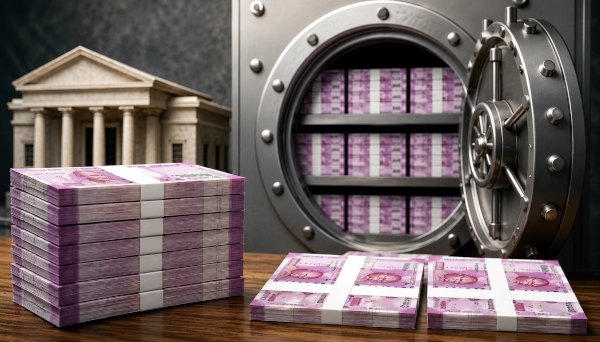
The Reserve Bank of India has successfully withdrawn almost the entire stock of ₹2,000 banknotes from active circulation through a carefully phased currency-management exercise. By April 30, 2026, 98.47 per cent of the ₹2,000 notes that were circulating when the withdrawal was announced had returned to the banking system.
The value of ₹2,000 notes in circulation fell from ₹3.56 lakh crore on May 19, 2023, to only ₹5,451 crore by April 30, 2026. This means that around ₹3.51 lakh crore worth of the high-value notes flowed back through bank branches, RBI offices and the formal banking network in less than three years.
The achievement came through a combination of advance preparation, continued legal-tender status, easy deposit facilities, gradual restrictions on recirculation and a nationwide banking infrastructure capable of collecting and processing the notes.
The Withdrawal Began Long Before the 2023 Announcement
The ₹2,000 note was introduced in November 2016 to meet India’s immediate currency requirements following the withdrawal of the older ₹500 and ₹1,000 notes.
As adequate quantities of other denominations became available, the requirement for the ₹2,000 note gradually declined. The RBI stopped printing the denomination during 2018–19, several years before formally announcing its withdrawal from circulation.
The value of ₹2,000 notes in circulation had already fallen from a peak of ₹6.73 lakh crore in March 2018, when they represented 37.3 per cent of the total value of notes in circulation, to ₹3.62 lakh crore by March 2023. Their share had fallen to 10.8 per cent by then.
This gradual reduction laid the foundation for the later withdrawal. Fresh ₹2,000 notes were no longer entering the economy in large quantities, while worn notes steadily returned to banks through normal transactions.
A Withdrawal Rather Than Demonetisation
The most important feature of the exercise was the continued legal-tender status of the ₹2,000 note.
The RBI announced on May 19, 2023, that the notes would be withdrawn from circulation while retaining their full monetary value. People could continue using them for transactions, deposit them into bank accounts or exchange them for smaller denominations.
This approach differed fundamentally from the 2016 demonetisation exercise. Holders of ₹2,000 notes retained the assurance that each note remained worth its full face value. This reduced public anxiety, prevented a sudden rush for cash and allowed the banking system to manage the process over an extended period.
The policy gave people a strong incentive to return the notes while preserving confidence in the currency.
Banks Stopped Issuing ₹2,000 Notes
The RBI instructed banks to stop issuing ₹2,000 notes immediately after announcing the withdrawal.
This created a one-way movement of the denomination. Notes deposited or exchanged at banks stopped flowing back into the hands of customers. Each returned note therefore moved out of regular commercial circulation.
A ₹2,000 note received by a bank branch could be retained within the banking and currency-management system instead of being supplied again through the counter or an ATM.
This one-directional process steadily reduced the number of notes available in shops, homes and businesses. As their presence declined, the remaining holders gained an additional practical reason to deposit them.
A Nationwide Deposit and Exchange Network
The RBI used India’s extensive bank-branch network as the main collection mechanism.
From May 23, 2023, individuals could deposit ₹2,000 notes into their bank accounts through ordinary banking procedures. Deposits were permitted without a monetary ceiling, subject to existing Know Your Customer requirements and other legal provisions.
People seeking cash in another denomination could exchange up to ₹20,000 at a time at a bank branch. The exchange facility was provided free of charge, and customers could use it even at banks where they held no account.
This arrangement offered several convenient routes:
- Large amounts could be deposited directly into bank accounts.
- Smaller holdings could be exchanged for usable denominations.
- Non-account holders could obtain exchange services.
- Businesses could deposit daily cash collections through normal banking channels.
The broad availability of these facilities allowed the RBI to collect a substantial share of the notes within the opening months of the exercise.
A Long Window Reduced Pressure on the Public
The RBI initially gave the public more than four months to deposit or exchange the notes at ordinary bank branches. The banking deadline was later extended until October 7, 2023.
This extended period allowed households, businesses, charitable institutions and other entities to return the currency at their convenience. It also enabled banks to spread the operational workload over several months.
A sudden deadline could have created queues, cash-handling congestion and pressure on branch staff. The phased approach allowed each returned note to be verified, recorded and processed through normal banking systems.
The continuation of legal-tender status further encouraged an orderly response.
RBI Offices Continued the Collection Process
After the general facility at commercial bank branches ended, the RBI continued accepting ₹2,000 notes at its 19 Issue Offices across India.
Individuals and entities can exchange the notes at these offices up to ₹20,000 at a time. They can also tender any amount for credit to an Indian bank account, subject to identity verification and applicable regulations.
The Issue Offices are located in cities including Ahmedabad, Bengaluru, Bhopal, Chennai, Hyderabad, Kolkata, Mumbai, New Delhi, Patna and Thiruvananthapuram.
The RBI has stated that this facility will remain available until further advice. The continuing arrangement helps collect notes discovered after the main banking window, including currency held in old files, household storage, institutional cash boxes and forgotten personal holdings.
India Post Expanded Access Beyond RBI Cities
People living far from an RBI Issue Office were also given a postal option.
Individuals within India can send ₹2,000 notes through India Post to one of the designated RBI offices for credit to their bank accounts. This route requires the prescribed documentation and account details.
The postal facility expanded the geographical reach of the exercise and helped people return small quantities without travelling to a major city.
It also supported the gradual recovery of the final portion of notes remaining outside the banking network.
The High Value of Each Note Encouraged Its Return
The denomination itself contributed to the speed of the process.
A single ₹2,000 note represented a substantial amount for everyday cash transactions. Holding several such notes outside the banking system tied up significant purchasing power in a denomination that had become increasingly difficult to use.
As banks stopped issuing the notes and their availability declined, many retailers, service providers and individuals became less willing to accept them during ordinary transactions. Holders therefore found deposit or exchange more practical than continued storage.
The withdrawal became partly self-reinforcing: declining acceptance encouraged deposits, while growing deposits reduced circulation further.
Adequate Supplies of Other Notes Prevented a Cash Shortage
The RBI had already ensured adequate availability of other denominations before beginning the exercise.
The central bank stated that ₹2,000 notes were no longer commonly used for ordinary transactions and that sufficient quantities of other banknotes were available to meet public demand. Around 89 per cent of the ₹2,000 notes had also been issued before March 2017 and had reached or approached their estimated operational lifespan of four to five years.
The ₹500 denomination had become the principal high-value transactional note, while ₹200, ₹100 and smaller denominations supported regular retail activity.
India’s expanding digital-payment ecosystem also reduced dependence on very high-value banknotes for transferring large sums. Payments that once required bundles of cash could increasingly be completed through bank transfers, cards and mobile platforms.
What Happened to the Returned Notes?
The expression “returned to RBI vaults” describes the broad outcome, though the actual process involves several stages.
Customers first deposited or exchanged the notes at bank branches. Banks counted and authenticated them before transferring surplus currency through currency chests and the RBI’s Issue Offices.
Currency-processing equipment sorts notes according to authenticity and physical condition. Under the RBI’s Clean Note Policy, damaged and unfit banknotes are removed from usable stocks. The RBI uses high-speed Currency Verification and Processing Systems capable of processing tens of thousands of notes per hour, with unfit notes shredded and compressed into briquettes.
Returned ₹2,000 notes therefore enter the formal currency-management system. They cease circulating among the public and are processed according to RBI procedures rather than simply remaining indefinitely in storage.
Around 175 Crore Notes May Have Returned
Based on the reduction from ₹3.56 lakh crore to ₹5,451 crore, approximately ₹3,50,549 crore in ₹2,000 notes had returned by April 30, 2026.
At a face value of ₹2,000 per note, this is equivalent to roughly 175.3 crore individual banknotes. Around 2.73 crore notes, worth ₹5,451 crore, remained outside the banking system at that stage. These figures are arithmetic estimates based on the RBI-reported values.
Some of the remaining notes may be held by collectors, households, institutions or people living outside India. Others may have been lost, damaged or stored without the holder being aware of the continuing exchange facility.
A Carefully Managed Currency Exercise
The return of 98.47 per cent of the ₹2,000 notes demonstrates how a high-value denomination can be withdrawn through a gradual and low-disruption process.
The RBI combined several mutually reinforcing measures: printing had ended years earlier, banks stopped issuing the notes, legal-tender status remained intact, nationwide deposits were permitted, exchanges were kept free, the main deadline was extended, RBI offices continued accepting the notes and India Post provided an additional route.
The result was a steady transfer of approximately ₹3.51 lakh crore from public circulation into the formal banking and currency-management system.
The exercise succeeded because returning the notes remained safe, convenient and financially neutral for the public. At the same time, the denomination’s usefulness in daily transactions steadily diminished. Together, these conditions allowed the RBI to remove almost the entire ₹2,000 note stock from active circulation while maintaining stability across India’s banking and payments system.
REFERENCES
- Reserve Bank of India. “₹2000 Denomination Banknotes — Withdrawal from Circulation; Will Continue as Legal Tender.” May 19, 2023.
https://www.rbi.org.in/commonperson/english/scripts/PressReleases.aspx?Id=3449 - Reserve Bank of India. “₹2000 Denomination Banknotes — Withdrawal from Circulation: Frequently Asked Questions.” Updated September 30, 2023.
https://www.rbi.org.in/commonperson/english/Scripts/FAQs.aspx?Id=3443 - News On AIR. “RBI Says 98.47 Per Cent of ₹2,000 Banknotes Have Been Returned.” May 2, 2026.
https://newsonair.gov.in/rbi-says-98-47-per-cent-of-%E2%82%B92000-banknotes-have-been-returned/ - Reserve Bank of India. “Indian Currency — Frequently Asked Questions.”
https://www.rbi.org.in/commonperson/english/scripts/FAQs.aspx?Id=3158 - Reserve Bank of India. “Know Your Banknotes — ₹2,000 Denomination.”
https://paisaboltahai.rbi.org.in/rupees-two-thousand.aspx
You may also like
-
Government Guarantees Zero Charges on UPI Payments Up to ₹2,000 Under New Notification
-
India Remains World’s Largest Remittance Recipient as Inflows Reach $151 Billion: IFAD
-
CarbonCraft Design Turns Industrial Carbon and Construction Waste Into Building Materials
-
India and MERCOSUR Move Toward Paperless Trade With Electronic Certificates of Origin
-
Inbound Aerospace Turns to Australia to Test India’s Recoverable Re-Entry Spacecraft
