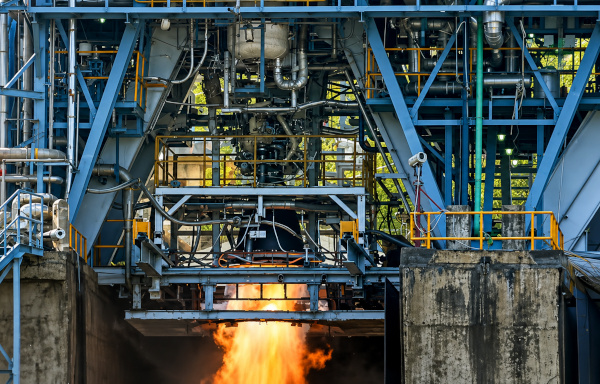
India’s heavy-lift space programme has received another important boost with ISRO successfully completing the flight acceptance hot test of the indigenous CE20 cryogenic engine meant for the next LVM3 mission, designated LVM3-M7. The test was conducted on 6 July 2026 at the ISRO Propulsion Complex in Mahendragiri, one of India’s key propulsion testing centres.
The CE20 engine powers the cryogenic upper stage of the LVM3 launch vehicle, India’s heaviest operational rocket. LVM3 is the vehicle that carried landmark missions such as Chandrayaan-2 and Chandrayaan-3, and it has also supported commercial satellite launches. The engine has now successfully flown on eight consecutive LVM3 missions, giving it a strong operational record in India’s launch vehicle fleet.
During the latest acceptance test, ISRO operated the engine at a thrust level of 19.5 tonnes for 45 seconds, followed by a ramp-up to 22 tonnes for another 25 seconds. The results confirmed satisfactory performance of both the engine systems and the newly introduced Nozzle Protection System. After this test, the engine will be refurbished and assembled with the C32 flight stage being prepared for the LVM3-M7 vehicle.
The highlight of this test was the use of the Nozzle Protection System, or NPS, for the first time in a CE20 flight acceptance test. This system allows the CE20 engine to be tested with its full area-ratio 100 nozzle under sea-level conditions. Cryogenic upper-stage engines normally operate in near-vacuum conditions after the rocket has already climbed high into the atmosphere. Testing such engines on the ground usually requires complex high-altitude simulation facilities.
The NPS simplifies this process by reducing the dependence on High Altitude Test conditions. It cuts down resource requirements and allows longer-duration engine testing. For a launch programme that is expected to support heavier missions, commercial launches and Gaganyaan-related requirements, easier and more efficient engine acceptance testing is a major technological gain.
The CE20 engine is one of India’s most important propulsion achievements. It is indigenously developed and qualified to operate across a thrust range of 19 to 22 tonnes. Its performance is central to the LVM3’s ability to place heavy payloads into orbit. ISRO’s LVM3 configuration includes two S200 solid strap-on boosters, an L110 liquid core stage and a high-thrust cryogenic upper stage powered by the CE20 engine.
Cryogenic technology is among the most demanding areas of rocket propulsion. It involves the use of extremely cold liquid hydrogen and liquid oxygen, precision turbomachinery, high-energy combustion and strict thermal management. Mastering this technology has given India independent heavy-lift launch capability and reduced dependence on foreign propulsion systems for high-value missions.
The latest test is also significant because the CE20 engine has completed human-rating qualification requirements for use in the Gaganyaan programme. Human-rating demands higher confidence in reliability, safety margins, repeatability and performance consistency. The same engine family supporting both heavy satellite launches and future human spaceflight shows how India’s launch vehicle ecosystem is becoming more mature and mission-flexible.
LVM3 has become a strategic vehicle for India’s space ambitions. It supports lunar missions, commercial launches and future crewed missions. Its ability to carry heavier payloads to Low Earth Orbit and Geosynchronous Transfer Orbit makes it central to India’s next phase of space infrastructure, including communication satellites, scientific payloads and advanced national missions.
The successful CE20 flight acceptance hot test for LVM3-M7 shows that ISRO is steadily strengthening the reliability chain behind every major launch. Before a mission reaches the launch pad, each engine, stage and subsystem must pass strict ground validation. This test confirms that the cryogenic engine earmarked for the next LVM3 mission has met its required performance targets.
ISRO has not yet announced the launch date for LVM3-M7, but the successful engine test is a clear step toward mission readiness. The engine will now move into the next phase of refurbishment and integration with the C32 flight stage. Once integrated, it will become part of the upper-stage system that provides the final high-energy push needed to place payloads into orbit.
The CE20 test is therefore more than a routine engine firing. It reflects India’s growing command over advanced propulsion, launch vehicle preparation and mission assurance. With the Nozzle Protection System now demonstrated in a flight acceptance test, ISRO gains a more efficient pathway for future CE20 testing. This can help accelerate readiness for upcoming LVM3 missions, including those linked to India’s human spaceflight roadmap.
The LVM3 programme is becoming stronger, more reliable and more adaptable. The successful CE20 test at Mahendragiri adds another layer of confidence to India’s heavy-lift launch capability and brings the next LVM3 mission one step closer to flight.
You may also like
-
Self-assembly of Organic Molecules Opens a New Path to Green Hydrogen Production
-
Bi-layered Single-piece Dental Implant Reduces the Need for Surgical Unterventions
-
NASA Invites ISRO Into Moon Base Programme as US Opens Door Wider to Indian Space Startups
-
ISRO Successfully Completes Final EOS-05 Orbit-Raising Manoeuvre
-
Scientists Uncover A Way to Outsmart Quantum Entanglement Loss with A Single Move
