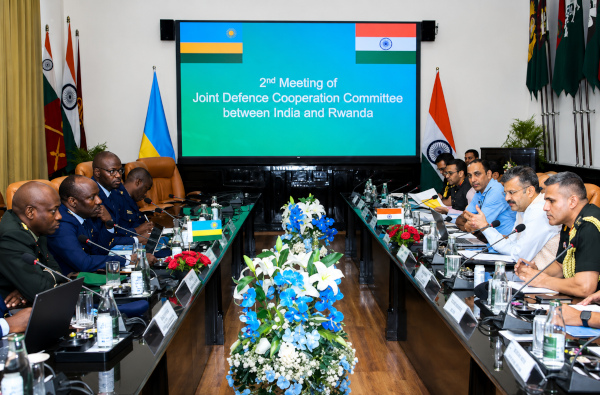
India and Rwanda have taken another important step in strengthening their defence partnership with the successful conduct of the 2nd Joint Defence Cooperation Committee meeting in New Delhi on 6 and 7 July 2026. The meeting reflected the growing defence trust between the two countries and opened new pathways for cooperation in military training, exercises, defence industry, medical support and institutional engagement.
The meeting was co-chaired by Shri Amitabh Prasad, Joint Secretary in India’s Ministry of Defence, and Brigadier General Louis Kanobayier, Chief for Joint Force Development, Training and Doctrine at Rwanda Defence Force Headquarters. The presence of representatives from India’s Department of Defence, Department of Defence Production, Defence Research and Development Organisation, Ministry of External Affairs, Armed Forces Medical Services, Headquarters Integrated Defence Staff and the three Services gave the engagement a comprehensive defence character.
The key outcome of the meeting was the decision to expand bilateral defence cooperation in four major areas: military training, military exercises, medical cooperation and defence industries. This makes the India–Rwanda defence partnership more practical and capability-oriented. Training builds professional military capacity, exercises create operational familiarity, medical cooperation strengthens battlefield and institutional health systems, and defence industry engagement opens possibilities for technology, equipment and long-term capability building.
A major feature of the meeting was the agreement on an implementation plan with timelines for the action points emerging from the discussions. This is important because defence cooperation becomes meaningful only when dialogue is converted into measurable projects. By attaching timelines to the agreed areas, both sides have signalled that the partnership will move from general understanding to structured execution.
On the sidelines of the JDCC meeting, the Rwandan delegation called on Defence Secretary Shri Rajesh Kumar Singh. During the interaction, Brigadier General Kanobayier briefed the Defence Secretary on new areas of bilateral defence cooperation aimed at further strengthening the ongoing partnership. This high-level engagement gave the meeting additional strategic weight and underlined the seriousness with which both countries view the defence relationship.
The Rwandan delegation also interacted with the Indian defence industry and received an update on India’s expanding defence industrial ecosystem. This included India’s indigenous capabilities, technological progress and growing capacity to design, develop and manufacture defence systems. The two sides identified potential areas of cooperation in the defence industrial sector and committed to accelerating future collaboration.
This industry interaction is especially significant. India’s defence manufacturing base has expanded rapidly under the Aatmanirbhar Bharat vision, creating new opportunities for friendly countries to partner with Indian industry. For Rwanda, such engagement can support capability development, maintenance ecosystems and access to cost-effective defence solutions. For India, it strengthens defence diplomacy and creates deeper defence-industrial links with an important African partner.
The visit to Army Hospital (Referral and Research) added another important dimension to the engagement. The Rwandan delegation was given a first-hand view of India’s military medical capabilities, advanced healthcare infrastructure and comprehensive medical support system for the Armed Forces. Military medicine is a crucial part of defence readiness, covering trauma care, evacuation systems, specialist treatment, rehabilitation and long-term medical support for personnel. Cooperation in this field can provide Rwanda with valuable exposure to India’s experience in military healthcare management.
The India–Rwanda defence relationship has a formal foundation in the MoU on Defence Cooperation signed in July 2018 during Prime Minister Narendra Modi’s visit to Rwanda. The 2nd JDCC meeting builds on that foundation and gives the partnership renewed direction. Since defence cooperation works best through steady institutional mechanisms, the JDCC provides a structured platform for both sides to review progress, identify new opportunities and maintain continuity.
For India, the engagement with Rwanda is part of a wider defence outreach to Africa based on capacity building, training, institutional cooperation and defence-industrial partnership. India has long shared strong ties with African nations through education, development cooperation, peacekeeping experience, technical training and people-to-people links. Defence cooperation now adds a strategic layer to this relationship.
For Rwanda, partnership with India offers access to a professional military training ecosystem, advanced medical institutions, defence manufacturing capabilities and a trusted development partner. Rwanda’s focus on disciplined institutions, modernisation and national security makes defence cooperation with India a natural area of growth.
The expansion of India–Rwanda defence ties also reflects the changing nature of India’s defence diplomacy. India is no longer limiting its defence partnerships to major powers or immediate neighbours. It is building wider networks with friendly countries across Africa, Southeast Asia, the Indian Ocean Region and the Global South. These partnerships are based on mutual respect, capacity building, practical cooperation and long-term strategic trust.
The 2nd JDCC meeting therefore represents more than a routine bilateral engagement. It is a step toward a stronger institutional defence relationship between India and Rwanda. With military training, exercises, defence industry, medical cooperation and time-bound implementation now at the centre of the roadmap, the partnership is moving into a more action-oriented phase.
As both countries work to implement the agreed outcomes, India–Rwanda defence cooperation can become a model of practical South-South defence partnership. It brings together India’s growing defence capabilities and Rwanda’s commitment to modern military development, creating a relationship that supports security, capability building and deeper strategic confidence between the two nations.
Source: PIB
You may also like
-
Indian Army Special Forces Depart for Indonesia for Exercise Garuda Shakti 2026
-
India Strengthens Trade Ties with Netherlands as Piyush Goyal Visits Port of Rotterdam
-
India to Train 600 Nigerian Army Soldiers in Specialised Jungle and Mountain Warfare
-
India and Russia Strengthen Parliamentary Diplomacy as Om Birla Meets State Duma Chairman Vyacheslav Volodin
-
India Seeks South Korean Shipbuilding Partnerships as Sarbananda Sonowal Begins Four-Day Visit to Busan
