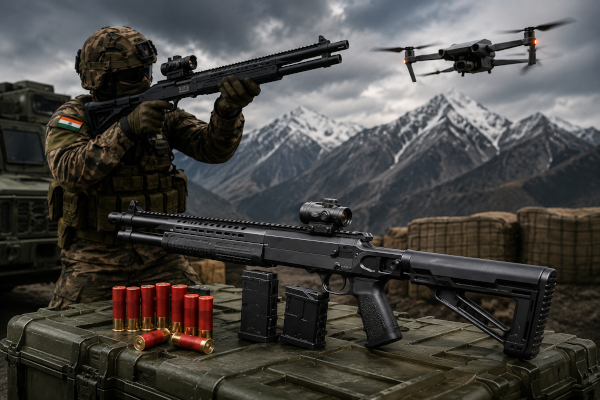
The Indian Army’s move to induct the SSS Defence T-12 semi-automatic shotgun marks an important shift in India’s battlefield response to the rapid rise of low-flying drones, FPV platforms and small unmanned aerial threats. The T-12 is emerging as a close-range counter-drone weapon designed for the most difficult layer of air defence: the final few seconds when a small drone has already crossed the outer surveillance, jamming and air-defence screens and is approaching troops, vehicles, bunkers or forward posts.
SSS Defence, the Bengaluru-based private small-arms manufacturer, has secured multiple Indian Army orders for its T-12 semi-automatic shotgun, with deliveries reported to begin in 2026. ThePrint reported that this will be the first time the Indian Army uses a weapon system from SSS Defence, while BharatShakti described the T-12 as India’s first domestically designed and manufactured counter-drone shotgun to enter Army service.
The military significance of the T-12 lies in its role as a last-line defence weapon. Modern drone warfare has shown that small UAVs are difficult to defeat with conventional rifles because they are compact, agile, low-flying and often visible for only a short engagement window. A shotgun offers a different solution: instead of relying on a single bullet to hit a small moving aerial target, it fires a spread of pellets, increasing the probability of damaging rotors, control surfaces, batteries, sensors or exposed electronics. This makes the shotgun especially relevant against quadcopters and FPV drones operating close to infantry positions.
The need for such systems has grown sharply after recent battlefield lessons from Ukraine, West Asia and the India–Pakistan confrontation of May 2025. Reuters reported that India and Pakistan used unmanned aerial vehicles at scale during the May 2025 fighting, with Pakistan sending hundreds of drones across multiple locations to probe Indian air defences. Reuters also reported that Pakistan used Turkish-origin YIHA-III and Asisguard Songar drones, among other UAVs, while Indian air defence relied on layered systems including older anti-aircraft guns linked with modern radar and communication networks.
For India, this has reinforced a clear operational lesson: air defence now has to be layered from strategic systems down to the infantry section. Long-range surface-to-air missiles, gun systems, jammers, directed-energy weapons and radar-linked air-defence networks can cover the larger battle area, but a small FPV drone diving into a trench, vehicle column or forward bunker demands a close-range, soldier-portable response. The T-12 is designed to fill that last tactical layer.
According to SSS Defence’s official product page, the T12 is a 12 Gauge, gas-operated, semi-automatic shotgun with a 508 mm barrel, 991 mm overall length, 3.80 kg empty weight and a five-round magazine capacity. The company lists key features including compatibility with 12 Gauge 2¾-inch and 3-inch shells, a pistol-grip folding buttstock, a full Picatinny top rail, M-LOK handguard and quick-detach sling mounts.
These specifications matter in a military counter-drone context. A gas-operated semi-automatic mechanism allows faster follow-up shots than pump-action shotguns. A detachable magazine supports quicker reloading in high-pressure engagements. A Picatinny rail allows the mounting of mission-specific sights or optics. The 3.8 kg weight keeps the weapon within the range of a field-carried small arm rather than a crew-served system. Together, these features make the T-12 suitable for close-quarter infantry use, forward post defence, convoy protection and tactical security roles.
The T-12’s counter-drone value also comes from the weapon-ammunition pairing. BharatShakti reported that SSS Defence developed its own barrel profile, counter-UAS choke and proprietary ammunition using hardened steel pellets in a specially engineered wad to maintain pellet energy and dispersion against drones at longer shotgun engagement distances. The same report said the design approach treats the weapon and ammunition as a complete ecosystem rather than a modified civilian-style shotgun.
Public reporting places the T-12’s counter-drone engagement range around 80–100 metres with specialised ammunition. ThePrint reported that the T-12 has an effective range of about 50 metres and can reach up to 100 metres, while BharatShakti reported that specialised counter-drone ammunition allows engagement at significantly greater distances than the conventional shotgun role. Chakra Newz reported that SSS Defence demonstrated the T-12 taking down a drone target at 90 metres during field trials.
The induction is also important for India’s defence industrial base. SSS Defence describes itself as an integrated OEM that designs, develops and serial-produces small arms and precision weapon systems in-house. The company says it was established in 2017 as the defence division of Stumpp Schuele & Somappa, with around seven decades of precision manufacturing heritage behind it.
This makes the T-12 more than a single weapon procurement. It reflects the growing maturity of India’s private-sector small-arms ecosystem. India’s armed forces have historically depended on imported or licence-produced infantry weapons in several categories. A domestically designed shotgun entering the counter-UAS role shows that Indian private manufacturers are now moving into mission-specific battlefield niches rather than simply producing generic rifles or carbines.
The T-12 also fits into SSS Defence’s wider counter-drone architecture. The company’s Varaha system is described as a passive, acoustic-first counter-UAV system that can detect, track and neutralise small UAVs without emitting radio frequency, radar or laser signals. SSS Defence lists Varaha’s features as passive detection, continuous 360-degree coverage, mandatory thermal confirmation, autonomous closed-loop engagement, multi-target tracking and layered effectors including fixed weapon stations and interceptor drones.
This is important because the future of counter-drone warfare will not depend on a single weapon. It will depend on a layered chain of detection, identification, tracking, decision and neutralisation. Acoustic sensors, RF detectors, radars, thermal imagers, jammers, lasers, missiles, guns and soldier-carried weapons will have to work as a defensive grid. In that grid, a shotgun such as the T-12 sits at the final hard-kill layer, giving soldiers a practical response when a drone is already inside the close-protection envelope.
From a tactical perspective, the T-12 strengthens infantry survivability. FPV drones are now used to strike trenches, bunkers, vehicles, logistics nodes, artillery positions and small troop concentrations. Their low cost allows adversaries to launch repeated attacks, while their small size makes them hard to detect and intercept. A section-level counter-drone shotgun gives troops a direct, immediate tool for emergency engagements without waiting for a heavier air-defence asset.
The system also has value in high-altitude and border environments. Along India’s western and northern frontiers, small drones can be used for reconnaissance, target marking, supply drops, ammunition delivery and direct attacks. A portable counter-drone shotgun can support forward posts, patrol bases, logistics convoys and quick-reaction teams operating in terrain where large counter-UAS systems may not always be immediately available.
The T-12’s arrival should be seen as part of a broader Indian adaptation after Operation Sindoor and the drone lessons of recent conflicts. Reuters reported that the May 2025 India–Pakistan clashes triggered an accelerated drone race in South Asia, with both sides expected to invest heavily in UAVs and counter-UAV capabilities. In this environment, India’s answer cannot be limited to big-ticket air-defence platforms. It must include cheap, rugged, decentralised and soldier-carried systems that can defeat low-cost aerial threats at the tactical edge.
The T-12 does not replace jammers, radars, air-defence guns, missiles or directed-energy weapons. Its strength lies in complementing them. It gives infantry and special operations units a hard-kill tool for the shortest engagement range, where electronic warfare may fail, missiles may be too expensive, and heavier gun systems may be unavailable. This is exactly the layer that modern FPV drone warfare has made urgent.
The Indian Army’s procurement of the SSS Defence T-12 therefore represents a practical response to a changing battlefield. It is indigenous, soldier-portable, semi-automatic, ammunition-integrated and designed for the low-altitude drone threat. In the new age of drone-saturated warfare, the T-12 brings air defence down to the infantryman’s shoulder, turning the humble shotgun into a specialised weapon for the modern aerial battlefield.
Key Defence Takeaway
The SSS Defence T-12 is India’s first indigenous infantry-level counter-drone shotgun solution. Its importance lies in giving frontline soldiers a close-range hard-kill answer against FPV drones and quadcopters, while strengthening India’s private-sector defence manufacturing ecosystem. As drones become cheaper, faster and more numerous, such last-mile defensive weapons will become essential for every modern army.
You may also like
-
Indian Army Special Forces Depart for Indonesia for Exercise Garuda Shakti 2026
-
India to Train 600 Nigerian Army Soldiers in Specialised Jungle and Mountain Warfare
-
India Moves Towards Five-Year Assured Orders for Defence Startups Under New Procurement Reforms
-
Zen Technologies Introduces Indigenous Hyper-Strike Falcon AI-Guided Counter-Drone Interceptor
-
L&T and Germany’s SCHOTTEL Expand Partnership for Controllable Pitch Propeller Systems in Indian Shipbuilding
