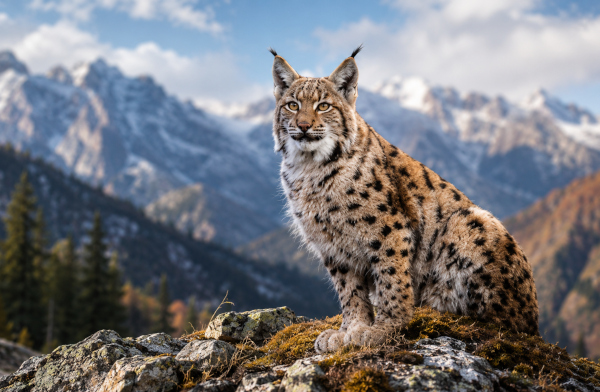
Sikkim has recorded a major wildlife milestone with the first confirmed photograph of the Eurasian lynx in the state. The rare wild cat was captured by a camera trap in January 2026 on the Tso Lhamo plateau in Mangan district, at an altitude of around 17,224 feet. The discovery marks only the second confirmed photographic record of the species in the entire Eastern Himalayan region.
The finding is significant because the Eurasian lynx has long remained one of the least documented carnivores in the Eastern Himalayas. Local herders and forest officials had spoken about occasional sightings over the years, but the new camera-trap image provides firm photographic evidence that the species continues to inhabit Sikkim’s trans-Himalayan landscape.
The record emerged during a long-term snow leopard and rangeland monitoring programme jointly carried out by the Sikkim Forest and Environment Department and WWF-India. The programme began after Sikkim’s first comprehensive snow leopard population assessment in 2022 and is aimed at tracking snow leopards, documenting associated wildlife and understanding the ecological health of high-altitude grasslands.
The camera trap was installed on the Tso Lhamo plateau near Gurudongmar Lake, an area selected because of its rocky terrain, mountain passes and signs of carnivore movement. While the equipment was primarily placed to monitor snow leopards, it captured a remarkable range of wildlife, including the Eurasian lynx.
The discovery follows the first-ever photographic record of the Eurasian lynx in Arunachal Pradesh in 2025. Together, the records strengthen scientific understanding of the species’ presence in the Eastern Himalayas, a region where its distribution has remained uncertain.
The Tso Lhamo plateau is one of India’s highest cold desert ecosystems. It experiences severe winters, low rainfall and a very short growing season. Despite these harsh conditions, the landscape supports an impressive range of high-altitude species. The survey documented snow leopard, Pallas’s cat, Tibetan wolf, Tibetan sand fox, Tibetan gazelle, Tibetan argali, blue sheep and southern kiang, making the plateau one of the most important wildlife habitats in the Indian trans-Himalaya.
The Eurasian lynx is a medium-sized wild cat known for its tufted ears, short tail and dense winter coat. These features help it survive in cold mountainous regions. In Sikkim’s high-altitude grasslands, it may find prey such as woolly hares, Himalayan marmots, blue sheep, Tibetan gazelles and other small to medium-sized animals.
The new record has also revived older accounts of the species in Sikkim. After the discovery was shared, retired conservationist Usha Lachungpa informed researchers that physical remains of a Eurasian lynx had reportedly been recovered from the same region in 2004. Local Drokpa herders have also long described a cat smaller than the snow leopard, with a short tail, known to them by a local name. However, they noted that sightings have become much rarer in recent years.
Scientists are now trying to understand whether the photographed lynx is part of a resident population or an animal moving through the landscape. More camera-trap studies and field research will be needed to determine its population status, habitat use, prey base and relationship with other carnivores such as the snow leopard, Tibetan wolf and Pallas’s cat.
The finding also highlights the conservation value of Sikkim’s high-altitude grasslands. These grasslands support wild herbivores, livestock and predators, forming the foundation of the region’s fragile mountain ecosystem. Protecting them is essential for the survival of rare species such as the Eurasian lynx and snow leopard.
At the same time, conservation in such landscapes must work closely with local communities. Pastoral groups depend on these grasslands for livestock grazing, and carnivores may occasionally prey on domestic animals. A balanced approach that protects biodiversity while supporting local livelihoods will be central to long-term conservation success.
The first photographic record of the Eurasian lynx in Sikkim is therefore more than a wildlife sighting. It is a reminder that the remote Himalayan frontier still holds many ecological secrets. As scientific research expands into these difficult landscapes, Sikkim’s role as a high-altitude biodiversity stronghold is becoming clearer, offering new hope for the protection of some of the Himalayas’ most elusive species.
You may also like
-
Indian Scientists Discover How Rapidly Spinning Black Holes Produce High-Frequency X-Ray Oscillations
-
ISRO Completes Historic SPADEX Mission as Both Satellites Re-enter Earth’s Atmosphere After Successful Space Docking Experiments
-
Indian Scientists Discover Rare Accretion Disk Around Neutron Star 24,000 Light-Years Away
-
BARC Scientists Develop Indigenous Technology to Recover 90% of Lithium from Seawater
-
How Indigenous Indian Technologies Are Helping Aircraft and Trains Navigate Safely Through Dense Fog
