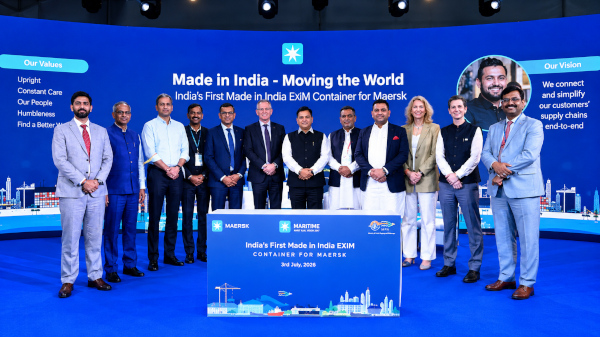
India has achieved a major milestone in its maritime and manufacturing journey with the unveiling of the first export-import shipping container manufactured in the country for global shipping major A.P. Moller–Maersk. The container was unveiled by Union Minister of Ports, Shipping and Waterways Sarbananda Sonowal at the Maersk-CONCOR Inland Container Depot in Dadri, Uttar Pradesh.
The development marks a significant step towards strengthening India’s maritime manufacturing capabilities under the national vision of Atmanirbhar Bharat, Make in India and Maritime Amrit Kaal Vision 2047. It reflects India’s growing ability to build critical logistics infrastructure for global trade using domestic industrial capacity.
In a major endorsement of India’s emerging container manufacturing ecosystem, Maersk placed an order for 1,000 additional Made-in-India shipping containers with the DCM Shriram Group during the event. The order is expected to open the way for a long-term commercial partnership and deepen India’s participation in the global maritime value chain.
The milestone follows Prime Minister Narendra Modi’s interaction with Robert Maersk Uggla, Chairman of the Supervisory Board of A.P. Moller–Maersk, in February 2025. During that meeting, the Prime Minister encouraged the company to support the development of world-class container manufacturing in India. Within sixteen months, the vision has resulted in the successful rollout of India’s first internationally procured, domestically manufactured EXIM shipping container.
Speaking on the occasion, Union Minister Sarbananda Sonowal said that India is rapidly emerging as a trusted global manufacturing and maritime powerhouse under the leadership of Prime Minister Modi. He described the unveiling of the first India-manufactured EXIM container for a leading global shipping line as a defining milestone in the country’s journey towards self-reliance.
The first container has been manufactured in line with internationally accepted quality and safety standards, including ISO specifications and the International Convention for Safe Containers. This makes it suitable for deployment in global shipping operations.
The Minister said the achievement shows how policy support, industry partnership and timely execution can create new opportunities in manufacturing, employment, skill development and international competitiveness. He added that the Government is committed to building a resilient and self-reliant maritime ecosystem that supports India’s rise as a leading global trading nation.
The development is also closely aligned with the Government’s policy push for domestic container manufacturing. The ₹10,000 crore Container Manufacturing Promotion Scheme announced in the Union Budget 2026 aims to reduce India’s dependence on imported containers, improve supply-chain resilience and create a globally competitive manufacturing base.
The scheme provides support for greenfield container manufacturing projects, expansion of existing brownfield facilities, operational assistance to bridge cost gaps and research and development support for testing, skilling, technology development and capacity building.
According to Sarbananda Sonowal, the scheme aims to increase India’s annual container manufacturing capacity nearly tenfold, up to 7.5 lakh TEUs. This expansion is expected to generate employment, encourage technology transfer, strengthen domestic manufacturing and position India as a global export hub for high-quality shipping containers.
The Government sees this milestone as the beginning of a broader transformation in India’s maritime manufacturing landscape. With rising participation from global shipping companies, strong policy support and expanding domestic capabilities, India is positioning itself as a major global centre for shipping container production.
The container manufacturing push forms part of a wider maritime reform agenda. The Government has enacted key legislations including the Merchant Shipping Act, 2025, the Coastal Shipping Act, 2025 and the Indian Ports Act, 2025. It has also introduced digital initiatives such as One Nation One Port Process, the Maritime Single Window and e-Samudra to improve ease of doing business across the sector.
India’s maritime ambitions are further supported by a ₹70,000 crore Shipbuilding Financial Assistance Package, the proposed Bharat Container Shipping Line, and major infrastructure projects such as Vadhavan Port, the International Container Transshipment Port at Galathea Bay, Tuna Tekra Container Terminal and the Outer Harbour Container Terminal.
With India emerging as the world’s leading ship recycling nation and three Indian ports now ranked among the global top 30 in the Container Port Performance Index 2025, the Government is working to build a world-class maritime ecosystem that can drive trade, industrial growth and global competitiveness.
The event was attended by H.E. Marisa Gerards, Ambassador of the Kingdom of the Netherlands, Gopal Krishna Aggarwal, National Spokesperson of the BJP, Thomas Theeuwes, Managing Director of A.P. Moller–Maersk, Ahmad Hasan, Senior Vice President at Maersk, and senior representatives from the Ministry of Ports, Shipping and Waterways, Maersk, DCM Shriram Group, CONCOR and the maritime industry.
The unveiling of India’s first Made-in-India EXIM shipping container signals a new chapter in the country’s maritime self-reliance. It strengthens India’s role in global logistics, supports domestic manufacturing and advances the larger goal of building a competitive maritime economy for a Viksit Bharat.
Source: PIB
You may also like
-
ICAR Scientists Develop Indigenous Protective Gloves for Cotton Farmers, Sign Commercial Manufacturing Agreement
-
BHEL–Coal India Joint Venture Begins Construction of ₹25,016 Crore Indigenous Coal Gasification Project in Odisha
-
PM Modi to Inaugurate RBI’s Tier IV Data Centre and Cybersecurity Training Institute in Bhubaneswar
-
India Creates 11 Crore Digital Farmer IDs Five Months Ahead of Target, Strengthening AgriStack Infrastructure
-
Chak-Hao Black Rice of Manipur and Nagaland: The Aromatic Purple Heritage Grain with GI Recognition
