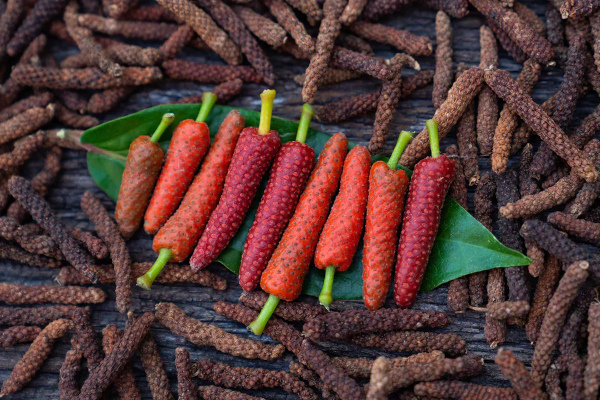
Pippali, commonly known as Long Pepper, is one of the most celebrated herbs in Ayurveda. Botanically known as Piper longum L., it is a close relative of black pepper but has a deeper, warmer and more rejuvenative action. In Ayurvedic medicine, Pippali is valued for improving digestion, clearing respiratory channels, supporting metabolism and acting as a gentle Rasayana when used in the proper way.
The word Pippali refers mainly to the dried fruit spike of the plant. It has a slender, elongated shape and a pungent taste. Though it is sharp and warming, Ayurveda gives it a special place because it combines digestive stimulation with nourishing and rejuvenative potential. This makes it different from many other hot spices.
Sanskrit and Common Names
In Sanskrit, Pippali is also known as Magadhi, Krishna, Vaidehi, Chapalaa and Kana. The name Magadhi indicates its ancient association with the Magadha region. In Hindi, it is called Pipli or Pippal. In Malayalam, it is known as Thippali. In Tamil, it is called Thippili. In English, it is known as Long Pepper.
Its botanical name is Piper longum L. The fruit is the most commonly used part, though the root, known as Pippali Moola, is also used in Ayurveda.
Ayurvedic Properties
Pippali is one of the finest herbs for kindling digestive fire without being harsh when used correctly. It enters deep channels and supports the proper movement of Vata and Kapha.
Rasa: Katu — pungent
Guna: Laghu and Snigdha — light and mildly unctuous
Virya: Anushna-shita in some classical interpretations, but functionally warming in action
Vipaka: Madhura — sweet after digestion
Dosha action: Balances Vata and Kapha when used properly; may increase Pitta in excess
Main actions: Deepana, Pachana, Rasayana, Kapha-hara, Vata-hara, Shwasahara, Kasahara and Agnivardhaka
Pippali’s special quality lies in its Madhura Vipaka, or sweet post-digestive effect. Though it tastes pungent, its final effect is more nourishing than many other sharp spices. This is why it is used in rejuvenative preparations, respiratory formulations and digestive medicines.
Pippali and Digestive Fire
Ayurveda gives great importance to Agni, the digestive fire. When Agni becomes weak, food is not properly digested and Ama, or toxic metabolic residue, begins to accumulate. This leads to heaviness, bloating, dullness, coating on the tongue, poor appetite and sluggish metabolism.
Pippali is a powerful Deepana-Pachana herb. It stimulates appetite and helps digest Ama. It is especially useful when Kapha causes heaviness and when Vata causes irregular digestion, gas and abdominal discomfort.
Unlike very dry and harsh spices, Pippali has a subtle unctuous quality. This makes it suitable in many Vata-Kapha conditions when used with the right anupana, or vehicle, such as honey, ghee, warm water, buttermilk or milk depending on the condition.
Pippali in Respiratory Health
Pippali is highly respected in Ayurveda for Kasa and Shwasa, meaning cough and breathing difficulty. It helps clear Kapha from the respiratory passages and supports normal breathing. It is used in many classical formulations for cough, asthma-like conditions, throat congestion and chronic respiratory weakness.
Its action is warming, channel-opening and expectorant. It helps loosen thick Kapha and supports the downward and outward movement of obstructed Vata. This is why Pippali appears in many preparations with honey, ginger, black pepper, licorice and other respiratory herbs.
Pippali as a Rasayana
Pippali is not only a spice. It is also used as a Rasayana in carefully designed regimens. In Ayurveda, Rasayana means a method or substance that supports rejuvenation, tissue strength, vitality and long-term health.
Pippali Rasayana is a classical concept in which Pippali is administered in a graduated and carefully controlled manner under expert supervision. This is traditionally used to support respiratory strength, digestion, immunity and vitality. Such practices should not be attempted without a qualified Ayurvedic physician because Pippali is potent and heating.
Pippali and Trikatu
Pippali is one of the three ingredients of the famous Ayurvedic combination Trikatu. Trikatu consists of:
Shunthi — dry ginger
Maricha — black pepper
Pippali — long pepper
This combination is used to kindle Agni, digest Ama, clear Kapha, improve metabolism and enhance the bioavailability of other herbs. Pippali gives depth and subtlety to Trikatu, while ginger and black pepper add strong digestive and Kapha-reducing action.
Classical Recipe: Vyoshadi Takra or Honey-Based Trikatu Buttermilk
A classical preparation known as Vyoshadi Takra uses Pippali as part of a honey-based Trikatu buttermilk. This preparation belongs to the category of Pana, or drinkable preparations. It is designed as a light, sharp, digestive and Kapha-reducing drink.
The main base is Takra, or buttermilk. Fine powders of Shunthi, Maricha, Pippali and Sauvarchala Lavana are prepared and mixed thoroughly with Takra. After proper mixing, Madhu, or honey, is added.
The ingredients are:
Takra — buttermilk
Maricha — black pepper, Piper nigrum fruit
Shunthi — dry ginger, Zingiber officinale rhizome
Pippali — long pepper, Piper longum fruit
Sauvarchala Lavana — black salt
Madhu — honey
This preparation is described as Amla, Tikta, Katu, Ushna and Laghu. It is sour, bitter, pungent, warming and light for digestion. These qualities make it useful in conditions where Kapha, heaviness, poor digestion and swelling are present.
The preparation is traditionally indicated in Gurubhinnavarcha, referring to heavy and poorly formed or disintegrating stools, and Shotha, meaning inflammation or swelling. Its combination of buttermilk, Trikatu, black salt and honey makes it a sharp digestive drink that supports Agni and helps clear Kapha-related stagnation.
Importance of the Manuscript Tradition
The recipe of Vyoshadi Takra is recorded in Charaka Chikitsasthana, one of the most important sections of the Charaka Samhita dealing with treatment principles and formulations. This shows the refined Ayurvedic use of food-based medicines. Buttermilk was not seen merely as a household drink; it was used as a therapeutic base that could carry herbs deep into the digestive system. The inclusion of Pippali with dry ginger, black pepper, black salt and honey reflects the classical understanding of Trikatu as a digestive and Kapha-clearing combination. Such manuscript traditions reveal how Ayurveda carefully joined taste, potency, vehicle and disease condition into one balanced preparation.
Medicinal Logic of the Ingredients
The ingredients of Vyoshadi Takra are chosen with clear Ayurvedic reasoning. Takra is light, digestive and especially useful in Vata-Kapha conditions. It supports the gut and reduces heaviness.
Pippali kindles Agni, clears Kapha and supports the respiratory and digestive channels. Shunthi digests Ama and reduces gas. Maricha stimulates metabolism and clears mucus-like stagnation. Sauvarchala Lavana improves taste, supports digestion and helps relieve abdominal heaviness. Madhu acts as a Yogavahi, helping carry the effects of the herbs while reducing Kapha.
Together, these ingredients create a preparation that is light, warming, penetrating and digestive. It is especially suited to Kapha-dominant sluggishness, heaviness and weak Agni.
Pippali for Vata and Kapha
Pippali is especially useful when Vata and Kapha are disturbed together. Kapha creates heaviness, mucus, swelling and sluggishness. Vata creates gas, irregular digestion, pain and disturbed movement. Pippali helps by clearing Kapha while supporting the proper movement of Vata.
In Vyoshadi Takra, Pippali becomes even more effective because it is supported by buttermilk, ginger, black pepper, black salt and honey. This combination reduces heaviness and improves digestive strength.
Pippali and Shotha
The recipe is traditionally mentioned as useful in Shotha, or swelling. In Ayurveda, Shotha may arise from Kapha accumulation, Ama, poor metabolism, impaired circulation or disturbed fluid movement. Pippali helps by stimulating Agni and clearing channels.
When combined with Trikatu and Takra, it helps reduce Kapha and supports the body’s natural cleansing process. However, swelling due to serious conditions of the heart, kidney, liver or infection must be evaluated by a qualified doctor.
Pippali in Classical Formulations
Pippali appears in many famous Ayurvedic medicines. It is used in Trikatu Churna, Sitopaladi Churna, Talisadi Churna, Pippalyasava, Chyavanaprasha, Agastya Rasayana and several respiratory and digestive formulations.
Its ability to support Agni and improve the movement of other herbs makes it a valuable ingredient in compound preparations. In many formulations, it acts both as medicine and as an enhancer of absorption.
Pippali and Honey
Pippali is often combined with honey in respiratory and Kapha conditions. Honey has scraping and Kapha-reducing qualities. Pippali adds warmth and channel-opening action. Together, they are traditionally used for cough, congestion and sluggish digestion.
A key Ayurvedic rule is that honey should never be heated. In preparations like Vyoshadi Takra, honey should be added only when the mixture is at room temperature. Heated honey is considered unsuitable in Ayurveda.
Pippali as Food and Spice
Though Pippali is a medicine, it also has a place as a spice. In ancient India, long pepper was widely used before black pepper became more common in everyday cooking. It gives a warm, deep and slightly sweet pungency.
Small quantities may be used in digestive spice mixtures, soups and medicinal gruels. However, because it is potent, it should be used with moderation.
Benefits of Pippali
Pippali supports digestive fire and improves appetite. It helps digest Ama and reduce heaviness. It supports respiratory health and helps clear Kapha. It is useful in Vata-Kapha digestive disorders. It acts as a Rasayana when used properly. It supports metabolism and enhances the action of other herbs. It is valuable in classical buttermilk preparations, powders, avalehas and asavas.
Precautions
Pippali is a strong herb and should be used carefully. Excess use may increase heat, acidity, burning sensation, mouth ulcers, bleeding tendency or Pitta aggravation. People with gastritis, ulcers, severe acidity, high Pitta symptoms or active bleeding disorders should avoid self-medication.
Pregnant women should not use Pippali medicinally without medical guidance. People taking regular medicines, those with chronic illness, children and elderly persons should use it only under supervision.
Vyoshadi Takra is warming and sharp. It may not suit people with severe acidity, burning urination, loose motions with burning, high fever or strong Pitta aggravation. Honey should always be added without heating.
Conclusion
Pippali is one of Ayurveda’s most important herbs for digestion, respiration and rejuvenation. It is sharp yet subtly nourishing, warming yet capable of supporting strength when used correctly. Its presence in Trikatu and many classical formulations shows its deep importance in Ayurvedic medicine.
The classical Vyoshadi Takra preparation highlights Pippali’s role in food-based healing. By combining long pepper with buttermilk, dry ginger, black pepper, black salt and honey, Ayurveda created a drink that stimulates Agni, reduces Kapha, supports digestion and helps relieve heaviness and swelling.
Pippali teaches an important Ayurvedic lesson: a small herb can have deep action when used with the right vehicle, combination and intention. In proper hands, it becomes a medicine for renewal, warmth, clarity and strength.
You may also like
-
Why Fatty Liver Is Appearing Earlier — And What Lifestyle Has to Do With It
-
Before the Heart Falls Ill: The Ayurvedic Way of Protecting Hridaya Through Daily Living
-
Why Ayurveda Begins the Morning by Looking at the Tongue
-
High Blood Pressure Through an Ayurvedic Lens: Stress, Diet and Dosha Imbalance
-
IISc Develops Engineered Nanobody Antivenom With Broad Protection Against Indian Cobra Venoms
