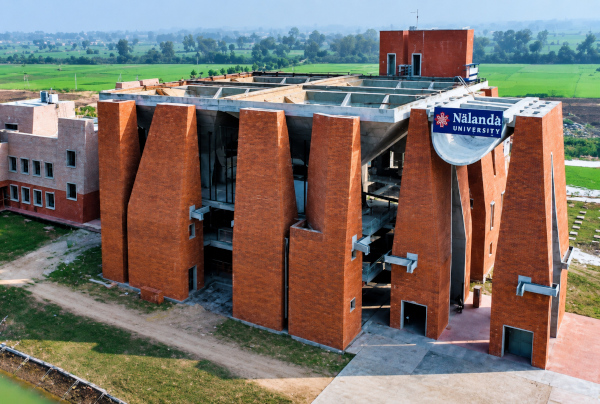
Prime Minister Narendra Modi has praised Nalanda University for reviving the ancient Indian tradition of Shastrarth, calling it a meaningful step in connecting India’s civilisational wisdom with modern education, intellectual inquiry and technological progress.
Speaking during the 135th edition of Mann Ki Baat, the Prime Minister highlighted Nalanda University’s effort to bring back Shastrarth as a disciplined form of scholarly dialogue. In India’s knowledge tradition, Shastrarth was a respected method of debate where scholars presented ideas through logic, evidence, reflection and reasoned discussion.
PM Modi said that Shastrarth was more than a platform for expressing opinions. It represented a culture of patient listening, thoughtful response and deep contemplation. The tradition encouraged participants to understand different viewpoints, examine ideas carefully and arrive at knowledge through disciplined discussion.
The Prime Minister linked Nalanda’s initiative with India’s larger educational heritage. Ancient Nalanda was one of the world’s great centres of learning, attracting scholars and students from different regions of Asia and beyond. Its academic culture was built around inquiry, philosophy, debate, literature, science, spirituality and intellectual openness.
The revived Nalanda University, located close to the ancient ruins in Bihar, now carries forward that legacy in a contemporary setting. By introducing Shastrarth into its academic and ceremonial life, the university is presenting an Indian model of debate that combines tradition with modern scholarship.
PM Modi also noted that Nalanda University had incorporated Shastrarth into its convocation ceremony, with nearly half of the participating students coming from other countries. This international participation gave the initiative a wider cultural and academic significance, showing how Indian knowledge traditions can speak to a global audience.
The Prime Minister congratulated Nalanda University for this effort and encouraged other higher educational institutions in the country to consider similar practices. Such initiatives can strengthen critical thinking, respectful disagreement and research-based dialogue among students.
The revival of Shastrarth is especially relevant in the present age of rapid technological change. PM Modi referred to the rise of new technologies, including Artificial Intelligence, and raised the larger question of how society can preserve human creativity while advancing with innovation.
Nalanda’s example offers one answer to that challenge. It shows that modern education can grow stronger when it remains connected to its cultural roots. Technology can support learning, while ancient traditions like Shastrarth can cultivate clarity of thought, ethical reasoning and disciplined expression.
The Prime Minister’s remarks place Nalanda University at the centre of India’s effort to revive its knowledge heritage in a modern form. The institution is emerging as a bridge between ancient learning and contemporary education, between Indian civilisational memory and global academic exchange.
By reviving Shastrarth, Nalanda University has strengthened the idea that education is not only about information and degrees. It is also about debate, inquiry, humility, listening, reasoning and the pursuit of truth. In that sense, the return of Shastrarth marks an important cultural and educational moment for modern India.
You may also like
-
DRDO CASDIC Opens 30 Paid Internships for Engineering and Science Students
-
Duryodhana Wins Shalya Through Hospitality: Gifts, Obligation and Political Leverage Before the Kurukshetra War
-
Krishna’s Private Meeting With Karna: Back-Channel Diplomacy Before the Kurukshetra War
-
One Voice – One Resolve – One India: Namami Bharatam Marks 150 Years of Vande Mataram Across the Nation
-
Drupada’s Priest at Hastinapura: The Mahabharata’s First Formal Diplomatic Attempt to Prevent the Kurukshetra War
