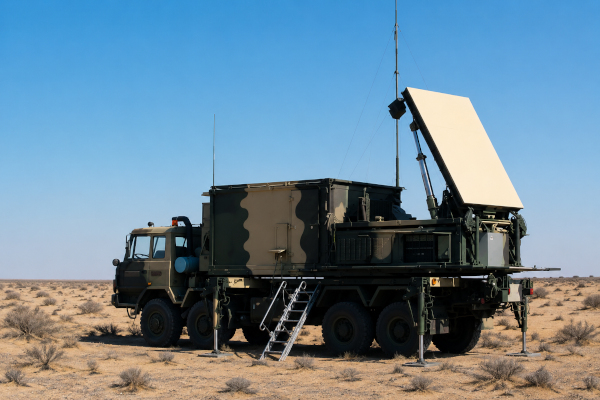
SWATHI Weapon Locating Radar is one of India’s most important indigenous battlefield surveillance systems. Developed by DRDO’s Electronics and Radar Development Establishment and produced by Bharat Electronics Limited, SWATHI gives the Indian Army the ability to detect hostile artillery, mortar and rocket fire, track the projectile in flight, calculate the firing point and pass target data for counter-battery action.
In modern land warfare, artillery remains one of the most destructive forces on the battlefield. Guns, rocket launchers and mortars can fire from concealed positions and move quickly before retaliation arrives. This “shoot and scoot” threat makes weapon-locating radars essential. SWATHI addresses this challenge by turning the enemy’s own projectile into a clue. Once a shell or rocket is fired, the radar tracks its flight path and mathematically works backwards to locate the weapon that launched it.
Why SWATHI Matters
The battlefield is no longer defined only by visible targets. Modern artillery operates from beyond visual range, from camouflaged positions, behind ridges, in valleys, across borders and from temporary launch points. A commander needs rapid information on where the hostile fire is coming from. Without such information, counter-battery fire becomes slow, uncertain and dependent on observation posts, sound ranging or manual reports.
SWATHI changes this equation. It gives artillery units a real-time sensor that can locate hostile guns, mortars and rocket launchers automatically. It also supports friendly artillery by tracking the fall of own rounds and helping issue firing corrections. This dual role makes it both a defensive shield and an offensive enabler.
For the Indian Army, SWATHI is especially valuable in artillery-heavy environments such as plains, deserts, semi-urban battle zones, riverine sectors and mountain approaches. Its mountain version, SWATHI Mountains or WLR-M, expands this capability into high-altitude and difficult terrain.
Indigenous Development
SWATHI is a product of India’s long push for self-reliance in battlefield radars. The system was developed by DRDO’s LRDE, Bengaluru, and manufactured by BEL. It belongs to the same broad radar ecosystem that made India capable of building phased-array military radars for air defence, battlefield surveillance and artillery support.
The importance of such a system became sharper after conflicts where hostile artillery caused heavy battlefield pressure. India needed a radar that could rapidly identify firing positions, work in cluttered environments, survive field conditions and integrate with artillery command networks. SWATHI was designed around exactly these requirements.
The radar has entered service in both plains and mountain variants. The plains version is mounted on a high-mobility vehicle platform, while the mountain version is more compact and suited for difficult terrain. BEL has delivered multiple systems to the Indian Army, and the radar has also attracted export interest, reflecting India’s rise as a supplier of advanced land-warfare electronics.
Core Technical Profile
SWATHI is an electronically scanned phased-array weapon-locating radar. In simple terms, this means the radar can steer its beam electronically across a selected sector instead of mechanically rotating the entire antenna for every scan. This gives it speed, precision and the ability to track multiple fast-moving projectiles.
The system operates in the C-band and uses a coherent transmitter. Its phased-array antenna is slewable, allowing the radar to shift its surveillance sector rapidly. It is designed for all-weather and all-terrain operation, with digital processing, automatic projectile acquisition, classification, tracking, trajectory estimation and data transmission.
The plains version’s public performance figures include detection ranges of around 4–20 km for 81 mm mortars, 4–30 km for guns above 105 mm, and 6–40 km for free-flight rockets. Its instrumented range is listed as 50 km. The radar can electronically scan ±45 degrees around a selected bearing and slew ±135 degrees within about 30 seconds. It can track up to seven targets simultaneously and handle both high-angle and low-angle firing profiles.
The system also includes digital map support, automatic height correction, target storage, networking with battle surveillance systems and ruggedised operator consoles. Publicly listed environmental specifications include operation from -20°C to +55°C and use at altitudes up to about 16,000 feet. The radar can be brought into action in about 30 minutes and moved out in about 15 minutes, allowing survival through mobility.
How SWATHI Operates
SWATHI’s operation begins with deployment. The radar vehicle moves into a suitable position, the antenna is oriented toward the expected threat sector, and the system begins scanning the battlefield horizon. The operator can select a surveillance sector based on tactical requirement. Once active, the radar emits pulses and scans for small, fast-moving objects such as artillery shells, mortar bombs and rockets.
A projectile in flight has a short radar signature and moves rapidly along a ballistic path. SWATHI’s receiver detects the return signal and passes it to its signal processing chain. The radar must separate real projectiles from battlefield clutter, weather echoes, birds, aircraft, terrain reflections and electronic interference. This is where its algorithms become critical.
Once a projectile is detected, the radar automatically acquires it and begins tracking. Multiple detections are used to estimate the object’s velocity, direction, elevation and ballistic curve. The system then classifies the track as a mortar round, gun shell, rocket or unwanted object. Non-projectile targets are rejected so that the radar crew and artillery command chain receive useful fire-location data instead of raw clutter.
The main weapon-locating function happens through trajectory computation. Since artillery shells and rockets follow predictable ballistic paths after launch, the radar uses the observed portion of the projectile’s flight to calculate the rest of the trajectory. By extrapolating backward, it estimates the launch point. By extrapolating forward, it estimates the impact point. Environmental and height corrections improve the accuracy of this calculation.
Once the launch point is calculated, the radar displays the location on its digital map and can transmit the target data to higher echelons or counter-fire units. This allows artillery commanders to order retaliatory fire before the enemy weapon can relocate. In a fast-moving artillery duel, this speed is decisive.
Backtracking the Enemy Round
The most important idea behind SWATHI is backtracking. The radar does not need to see the enemy gun directly. It only needs to see the projectile fired by that gun. When the shell rises into the radar’s field of view, SWATHI captures a small part of its flight path. From that short track, the radar estimates the full curve and traces it backward to the likely firing point.
This is extremely useful because enemy guns often remain hidden behind ridges, tree cover, buildings, camouflage nets or prepared firing positions. The projectile exposes them. Every fired round becomes a temporary line pointing back toward the source. SWATHI turns that line into coordinates.
This process also works for different firing modes. Mortars usually follow high-angle trajectories. Guns may fire at flatter or medium trajectories. Rockets have different flight behaviour depending on type and launch profile. SWATHI is designed to handle high-angle and low-angle firing and aspect angles across 0–180 degrees, giving it flexibility against varied artillery threats.
Fire Correction for Own Artillery
SWATHI is not limited to locating enemy weapons. In its secondary role, it helps observe the fall of friendly artillery fire. When own artillery fires, the radar can track the outgoing or falling projectile and estimate the impact point. If the round falls short, long, left or right of the target, correction data can be passed back to the fire control chain.
This makes SWATHI useful for artillery registration and adjustment of fire. In earlier eras, forward observers had to visually observe impacts and call corrections. That remains important, but radar adds speed and objectivity, especially in poor visibility, difficult terrain, night conditions or heavy battlefield smoke.
Radar Architecture and Battlefield Survivability
SWATHI is built as a mobile system. The plains version uses a two-vehicle configuration with a radar vehicle and support/power vehicle. The radar vehicle carries the antenna, shelter, processing systems, operator consoles and associated cooling equipment. Mobility is essential because weapon-locating radars themselves become high-value targets once they start transmitting.
The antenna is mounted on a slewable platform. This allows the radar to shift its coverage sector quickly without relocating the entire vehicle. Electronic beam steering handles rapid search and track functions inside the selected sector, while mechanical slewing gives wider orientation flexibility.
The radar is designed to work in battlefield clutter. Artillery environments produce heavy radar confusion because many things move at once: shells, rockets, aircraft, drones, birds, dust, weather formations and ground reflections. SWATHI’s processing chain uses filtering, track logic and target classification to isolate projectiles from unwanted returns. This is vital because false targets can waste counter-fire resources.
The radar also has to survive the electronic warfare environment. Jamming, interference and electromagnetic noise are expected on a modern battlefield. SWATHI’s design includes signal processing and frequency-diversity features to maintain performance in such conditions.
SWATHI Plains and SWATHI Mountains
The SWATHI family includes a plains version and a mountain version. The plains variant is suited for conventional deployment in open and semi-open terrain where mobility, range and sector coverage are priorities. The mountain version is compact and designed for the challenges of high-altitude operations.
Mountain warfare presents special radar problems. Terrain masking, steep slopes, valley channels, sudden height variations and limited road mobility all complicate weapon location. The mountain version addresses these conditions by offering a more compact configuration and features such as automatic height correction for launch and impact point calculations. This is important because a firing point may be above or below the radar’s own altitude, and mountain trajectories can be distorted by terrain geometry.
For India, this matters deeply. Northern borders and high-altitude sectors require artillery surveillance systems that can move through difficult terrain, deploy quickly and provide accurate target information despite mountains blocking line-of-sight coverage.
Role in the Sensor-to-Shooter Chain
SWATHI’s real value lies in its place inside the sensor-to-shooter chain. A radar by itself detects. A command network decides. Artillery fires. SWATHI becomes powerful when it feeds accurate coordinates into the artillery command system quickly.
The operational sequence is clear: hostile weapon fires, SWATHI detects the projectile, the system computes launch coordinates, data moves to the command chain, counter-battery assets receive target information, and retaliatory fire is executed. The shorter this chain becomes, the harder it is for enemy artillery to survive.
This is why weapon-locating radars are central to modern artillery doctrine. They reduce response time, improve target accuracy, protect friendly troops and impose pressure on enemy batteries. An enemy that knows its firing point can be detected after the first few rounds is forced to fire less, move more and operate under constant threat.
Tactical Benefits
SWATHI gives commanders several advantages. It improves battlefield transparency by revealing hidden firing points. It protects troops by reducing the time enemy artillery can remain active. It supports counter-battery warfare by providing target coordinates. It improves own artillery accuracy by observing friendly fire. It works day and night and in poor visibility. It reduces dependence on visual observation alone. It strengthens artillery intelligence and target acquisition.
The radar also supports deterrence. When deployed along sensitive sectors, it signals that hostile shelling can be traced and answered. This can influence enemy firing behaviour. In a limited conflict environment, fast and accurate counter-battery capability can help control escalation by allowing precise response against firing units instead of broad area retaliation.
Limitations and Operational Considerations
Like every radar, SWATHI depends on line-of-sight geometry, terrain, projectile size, atmospheric conditions and electronic environment. Mountains, deep valleys and urban structures can create shadow zones. Very short-range fire may reduce track time. Enemy forces may attempt movement, camouflage, emission targeting or electronic interference. These realities make tactics, deployment discipline and networking important.
For survivability, a weapon-locating radar must avoid remaining in one place for too long. Its mobility and quick decamp capability are therefore part of its combat design. The radar supports counter-battery fire, but it also needs protection from enemy counter-detection and retaliatory strikes.
Strategic Significance for India
SWATHI represents a major step in India’s defence electronics ecosystem. It is not only a radar; it is proof that India can design, manufacture and field sophisticated battlefield sensors. It strengthens the Indian Army’s artillery arm and reduces dependence on foreign firefinder radars.
The system also shows how indigenous defence technology matures through operational demand. India needed a radar suited to its borders, terrain, weather, logistics and artillery doctrine. SWATHI was built around those needs. The plains and mountain variants show that the system family can adapt to different theatres.
Its export potential is equally important. Weapon-locating radars are high-value defence systems. A country that can supply them enters a serious category of military electronics manufacturing. SWATHI therefore supports both battlefield readiness and India’s ambition to become a reliable defence exporter.
Conclusion
SWATHI Weapon Locating Radar is one of India’s most valuable indigenous artillery-support systems. It detects hostile mortars, guns and rockets, tracks projectiles in flight, calculates launch and impact points, supports counter-battery fire and helps correct friendly artillery fire. Its phased-array architecture, real-time processing, digital mapping, mobility and all-weather design make it a major force multiplier for the Indian Army.
In the age of long-range artillery, rockets and rapid shoot-and-scoot tactics, battlefield survival depends on speed of detection and speed of response. SWATHI gives India that ability. It turns hostile fire into intelligence, intelligence into coordinates, and coordinates into counter-battery action.
For Indian artillery, SWATHI is the silent hunter behind the guns — watching the sky, reading the trajectory and finding the enemy before the enemy can disappear.
You may also like
-
Indian Navy Vice Chief Inspects Japan’s Mogami-Class Stealth Frigate as India-Japan Shipbuilding Cooperation Expands
-
Philippine Marine Wargames Reportedly Show BrahMos Can Penetrate Chinese Destroyer Air Defences
-
Safran Signs 18 Agreements with Indian Aerospace Suppliers, Expanding Make in India Manufacturing Partnerships
-
Indian Army’s Vajra Corps Certifies First Batch of Drone Operators, Strengthens Battlefield Surveillance
-
India to Seek 35% Increase in Defence Modernisation Budget for FY 2027–28
