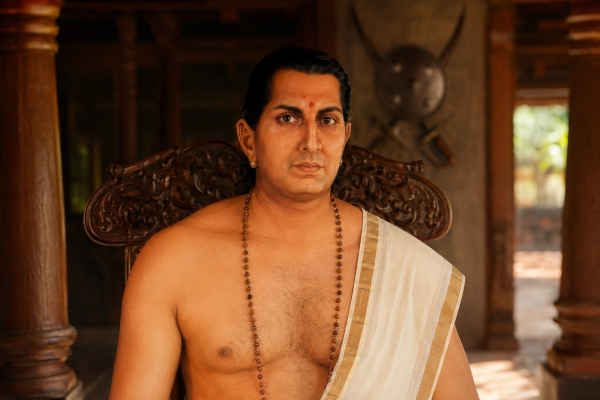
Kerala Varma Pazhassi Raja stands among the greatest resistance figures in the history of Kerala. Remembered with the proud title Kerala Simham, or Lion of Kerala, he belonged to the Kottayam royal house of Malabar and rose to prominence at a time when South India was being reshaped by the power struggles between local kingdoms, Mysore and the British East India Company. Though often described as a prince of the Kottayam royal family, he functioned as a ruler, military commander and political leader who defended his land with courage, intelligence and remarkable strategic vision.
Pazhassi Raja’s greatness came from the way he understood power. He knew that the British East India Company possessed disciplined troops, firearms, revenue machinery and political cunning. He also knew that the people of Malabar possessed something equally powerful: knowledge of the land, loyalty to local authority, control over forest routes and the will to resist outside domination. He converted this strength into one of the earliest and most memorable armed struggles against colonial power in India.
The Royal House of Kottayam and the World of Malabar
Kerala Varma Pazhassi Raja was born into the western branch of the Kottayam royal family, also known as the Padinjare Kovilakam. This Kottayam kingdom belonged to the Malabar region and should be understood separately from the modern Kottayam district of southern Kerala. Its sphere of influence covered parts of present-day Kannur and Wayanad, with deep connections to the hills, forests, temples, agrarian communities and trading networks of northern Kerala.
The 18th century was a period of great turbulence in Malabar. The Mysorean expansion under Hyder Ali and later Tipu Sultan brought military pressure into the region. Local rulers were forced to make difficult decisions, and many royal families sought refuge elsewhere. In this situation, Pazhassi Raja emerged as a leader who stayed close to the land and the people. His authority grew because he remained present during crisis. He did not lead from a distant palace alone; he led from the field, from the forests and from the heart of his people’s struggle.
Resistance Against Mysore
Before his famous conflict with the British, Pazhassi Raja resisted the forces of Mysore. The Mysorean campaigns into Malabar had placed enormous strain on local rulers and communities. Pazhassi Raja used the difficult terrain of Wayanad and Malabar to his advantage. The hills, rivers, thick forests and narrow passes became natural allies in his military strategy.
This early phase shaped him into a master of mobile warfare. He learned that a smaller force could resist a larger power by avoiding open-field confrontation and choosing the ground of battle carefully. Instead of depending only on conventional palace armies, he relied on local fighters, forest communities and loyal commanders. This experience later became crucial in his struggle against the British East India Company.
From Ally to Adversary of the British
The British East India Company initially appeared in Malabar as a political force that opposed Mysore. But after the fall of Mysorean authority in the region, the Company began asserting its own control. Its interest was not limited to military security. It wanted revenue, pepper, territorial influence and administrative command. The fertile and strategically placed regions of Malabar and Wayanad became highly valuable to the Company.
Pazhassi Raja’s conflict with the British sharpened when the Company tried to interfere in the internal affairs of Kottayam and introduced revenue arrangements that placed heavy pressure on the people. The Company’s decision to work through rival claimants and revenue contractors created anger among Pazhassi Raja and his supporters. For him, this was not only a question of personal royal rights. It was a question of sovereignty, dignity and the protection of the people from exploitative revenue demands.
He responded with political defiance. Revenue collection was resisted. British authority was challenged. The Company soon realised that Pazhassi Raja was not a symbolic royal figure who could be sidelined easily. He had popular support, military courage and intimate command over the terrain.
The Cotiote War and the Rise of Guerrilla Resistance
The British referred to his struggle as part of the Cotiote War, using the anglicised name for Kottayam. This resistance unfolded in phases, with periods of confrontation, temporary settlement and renewed conflict. The most powerful phase came when Pazhassi Raja moved his base into the forests and hills of Wayanad.
Wayanad became the heart of his resistance. Its thick forests, mountain routes, tribal settlements and hidden paths provided the perfect theatre for guerrilla warfare. Pazhassi Raja understood that the British army was strongest on roads, in forts and in predictable formations. He therefore made the forest itself his fortress.
His fighters struck suddenly and disappeared quickly. They attacked supply lines, disrupted movement, created fear among Company detachments and denied the British the comfort of a stable battlefield. This was a war of patience, knowledge and mobility. Every valley, stream, hill path and forest cover became part of the strategy.
The Role of Kurichiya and Kuruma Warriors
One of the most important aspects of Pazhassi Raja’s resistance was his alliance with the tribal communities of Wayanad, especially the Kurichiya and Kuruma warriors. These communities knew the forests with extraordinary precision. They were skilled in archery, ambush tactics and movement through difficult terrain. Their support gave Pazhassi Raja’s struggle a powerful local foundation.
The Kurichiya warriors, in particular, became famous for their disciplined archery and night attacks. Their participation showed that this was a broad resistance rooted in the people of the region. Pazhassi Raja’s leadership brought together royal authority, local chieftains, forest communities, peasant support and warrior groups into a common struggle.
Among his celebrated commanders was Thalakkal Chanthu, remembered as a brave leader associated with the Kurichiya resistance. His role symbolises the strength of indigenous military traditions in Kerala’s anti-colonial history. Pazhassi Raja’s army was therefore not merely a royal force; it was a people’s resistance shaped by land, loyalty and shared purpose.
Military Genius of Pazhassi Raja
Pazhassi Raja’s military importance lies in his practical understanding of asymmetric warfare. He recognised that victory against a stronger power required intelligence, timing and terrain control. His methods included ambushes, sudden raids, dispersal after attack, use of forest shelters, denial of supplies and mobilisation of local intelligence.
He knew that the British depended on communication lines and organised movement. By targeting these weak points, he made the Company’s military operations costly and uncertain. British forces had to pursue him through forests where their conventional strengths became limited. The psychological pressure of invisible resistance became a major weapon.
His warfare anticipated many principles that later became associated with modern guerrilla campaigns. He used terrain as protection, mobility as strength, local networks as intelligence, and public support as the base of endurance. His struggle proved that a determined regional force could challenge an empire through flexible tactics and moral courage.
Wayanad: The Forest Capital of Resistance
For Pazhassi Raja, Wayanad was more than a hiding place. It became the operational centre of his campaign. The forests gave him shelter, but they also gave him strategic depth. From Wayanad, he could move toward Malabar, threaten British posts, maintain contact with supporters and keep the flame of resistance alive.
The landscape itself shaped the struggle. The Western Ghats provided natural cover. The forest communities provided intelligence and manpower. The rivers and hill tracks created routes for movement. The climate and terrain made British pursuit difficult. This made Wayanad one of the earliest great theatres of anti-colonial forest warfare in India.
Political Meaning of His Struggle
Pazhassi Raja fought as a ruler defending his kingdom, but the meaning of his resistance became larger than dynastic politics. His struggle represented the refusal of Malabar society to accept outside control over land, revenue and traditional authority. He stood for the rights of the people, the dignity of local rule and the freedom of the region from colonial interference.
His resistance also showed that India’s freedom struggle did not begin only in cities or legislative halls. It began in forests, hills, villages and small kingdoms where local leaders resisted the expanding power of the Company. Pazhassi Raja’s war belongs to this early chapter of Indian resistance, where sovereignty was defended through arms, alliances and sacrifice.
Final Phase and Martyrdom
The British eventually intensified their campaign against him. They expanded military pressure, improved road access, built outposts and used intelligence networks to weaken his base. Betrayal, exhaustion, loss of commanders and continuous pursuit made the final phase extremely difficult.
In 1805, Pazhassi Raja’s resistance reached its tragic end near Mavilanthodu in the Pulpally-Mananthavady region of Wayanad. His death marked the fall of a warrior who had defied the British for years from the forests of Malabar. Yet his death did not erase his legacy. It transformed him into a symbol of courage and sacrifice.
His memorial at Mananthavady remains one of the most important heritage sites connected with Kerala’s anti-colonial history. It reminds visitors that the freedom of a land is often defended first by those who know its soil, forests, rivers and people intimately.
Legacy of the Lion of Kerala
Kerala Varma Pazhassi Raja’s legacy is immense. He is remembered as a ruler who chose resistance over submission, as a commander who mastered guerrilla warfare, and as a leader who united different sections of society against colonial power. He gave Wayanad and Malabar a heroic place in India’s history of freedom.
His life also carries a deeper lesson in leadership. He combined royal dignity with field command. He valued local knowledge. He trusted the courage of ordinary people. He understood the importance of terrain, intelligence and morale. He fought with the mind of a strategist and the heart of a patriot.
Today, Pazhassi Raja stands as one of Kerala’s greatest historical figures because his struggle was rooted in both political principle and personal bravery. He defended his homeland against powerful forces and proved that resistance could rise from the forests as strongly as from any capital city.
Conclusion
Kerala Varma Pazhassi Raja was more than a prince of the Kottayam royal house. He was a ruler in action, a military innovator and one of India’s earliest champions of armed resistance against British colonial expansion. By turning the forests of Wayanad into a battlefield of freedom, he created a legacy that still inspires Kerala.
His story belongs to the mountains, rivers and forests of Malabar. It belongs to the Kurichiya and Kuruma warriors who stood with him. It belongs to every village that resisted unjust authority. Above all, it belongs to the long history of India’s fight for dignity and freedom.
Pazhassi Raja remains the Lion of Kerala because he roared from the forests when empire tried to silence a land.
You may also like
-
Sindhu: The Indus Kingdom of Jayadratha in the Mahabharata
-
Kuninda or Kulinda: The Himalayan Realm of the Mahabharata in Uttarakhand and Himachal Pradesh
-
Durga versus Mahishasura: Weapons, Battlefield Tactics and the Triumph of Shakti
-
Kuluta: The Kullu Valley Kingdom of the Mahabharata
-
Israel to Honour Indian Pilot Smit Machchhar with Highest Civilian Bravery Award for Saving Flydubai Flight
