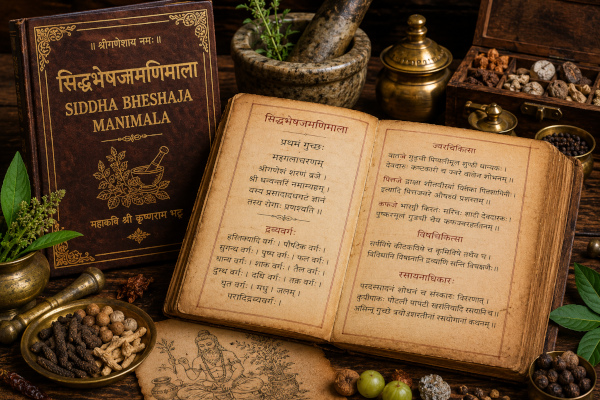
Siddha Bheshaja Manimala is one of the valuable Sanskrit works in the later Ayurvedic tradition, especially respected in the fields of Rasashastra and Bhaishajya Kalpana. The title itself gives a beautiful idea of the text. “Siddha” means proven or accomplished, “Bheshaja” means medicine, “Mani” means jewel, and “Mala” means garland. The name therefore suggests a garland of medicinal jewels, a carefully arranged collection of useful formulations meant for practical healing.
The work is traditionally associated with Mahakavi Shri Krishnaram Bhatta, a scholar-physician known for combining Ayurvedic knowledge with poetic expression. He belonged to a learned Ayurvedic family tradition and is remembered as a physician, teacher and literary figure. His strength lay in presenting medical knowledge in a memorable and refined style, making difficult ideas easier for students and practitioners to understand.
Siddha Bheshaja Manimala is especially important because it brings together two major streams of Ayurveda. The first is herbal medicine, which uses plants, roots, leaves, fruits, seeds, oils, decoctions, powders and medicated preparations. The second is Rasashastra, the specialised Ayurvedic branch dealing with purified metals, minerals, mercury-based preparations and herbo-mineral formulations. The text treats both traditions with respect, showing that Ayurveda developed a broad pharmaceutical system with many levels of preparation.
The book is divided into five chapters, known as Guchchas. The word Guchcha means a bunch or cluster. This is an elegant literary choice. Just as flowers are gathered into a garland, the author arranges medicinal ideas, formulations and treatment methods into meaningful clusters. The structure gives the book both beauty and practical order.
The first Guchcha begins with Mangalacharana, the traditional invocation. It expresses reverence towards deities, teachers and the lineage of knowledge. This opening reflects a classic feature of Indian medical literature: healing is treated as a sacred responsibility. The physician is expected to approach medicine with humility, discipline and gratitude towards the guru-parampara.
The second Guchcha deals with dravyas, or medicinal substances. It discusses the qualities, classifications and therapeutic actions of various drugs. The text gives attention to how different parts of the same plant may act differently. This is a sophisticated Ayurvedic idea. A leaf, root, fruit, stem or seed may carry different properties even when they belong to the same plant. Such observations show the depth of traditional pharmacological thinking.
This section also explains medicinal groups and classifications. Herbs and substances are arranged according to their effect on Vata, Pitta and Kapha. The text discusses Rasapanchaka, the fivefold Ayurvedic understanding of a substance through rasa, guna, virya, vipaka and prabhava. These concepts help the physician understand how a substance tastes, acts, transforms after digestion and produces specific effects.
The second Guchcha also includes many important groups such as Haritakyadi Varga, Poushtika Varga, Sugandha Varga, Pushpa Varga, Phala Varga, Dhanya Varga, Shaka Varga, Taila Varga, Dugdha Varga, Dadhi Varga, Takra Varga, Ghrita Varga, Madhu, Jala and Paradadi Varga. This wide classification shows that the book is not restricted to rare medicines alone. It includes food, daily-use substances, oils, milk products, grains, herbs and mineral preparations.
The third Guchcha is deeply connected with preventive health and daily discipline. It discusses Swasthya Samrakshana, or the protection of health. This is one of Ayurveda’s most powerful ideas: the first duty of medicine is to preserve the health of the healthy before treating disease. The text gives importance to Brahma Muhurta, cleansing practices, dental care, face washing, exercise, oil massage, powder massage, clothing, fragrance, ornaments and proper conduct.
The discussion of daily routine shows that Ayurveda views health as a complete way of living. A healthy person is shaped by waking time, cleanliness, food habits, exercise, sleep, seasonal behaviour, mental discipline and social conduct. Siddha Bheshaja Manimala continues this practical tradition by linking medicine with lifestyle.
The text also gives importance to Bhojana Vidhi, the proper method of eating. Ayurveda does not treat food as mere fuel. Food is medicine, nourishment and a daily influence on dosha, agni, strength and mind. Rules about when to eat, how to eat and what to take after meals reflect the Ayurvedic concern for digestion and metabolic balance.
Another interesting part of the third Guchcha is its discussion of physicianly qualities, messenger qualities, pulse examination, constitution, age, habitat and prognosis. Prognosis, known as Sadhya-Asadhyata, helps the physician judge whether a condition is easily curable, difficult to cure, manageable or beyond treatment. This reflects clinical responsibility and mature medical thinking.
The third Guchcha also describes Taila Bindu Pariksha, the oil-drop test used traditionally to understand prognosis. Such methods belonged to the diagnostic culture of earlier medical practice and show how observation, symbolism and clinical judgement were combined in traditional Ayurveda.
The fourth Guchcha is one of the most important sections of the book. It deals with Chikitsa Prayogas, or treatment applications. This section begins with Jwara Chikitsa, the treatment of fever, and extends through many disease categories. Fever is given priority because Ayurveda considers jwara a major disorder affecting digestion, strength, complexion, mind and vitality.
In the fever section, the text discusses different types of jwara and recommends formulations according to the doshic nature of the condition. For Vataja Jwara, it refers to medicines such as Guduchi, Pippalimoola, Sunthi, Dhanyaka, Devadaru and Kantakari. For Pittaja Jwara, it mentions cooling and pitta-pacifying substances such as Draksha and other herbs. For Kaphaja Jwara, it refers to herbs such as Bharngi, Kirata, Maricha, Shati, Devadaru, Pushkaramoola and Guduchi. This disease-wise and dosha-wise approach is a hallmark of Ayurvedic clinical logic.
The fourth Guchcha continues through many conditions, offering practical formulations, decoctions, powders, applications and herbo-mineral preparations. Its style is known for being poetic, compact and application-oriented. This made it useful for traditional physicians who needed memorable guidance in clinical situations.
The book also gives attention to poison-related conditions and their management. Visha Chikitsa, or treatment of poisonous states, has always been an important branch of Ayurveda. The inclusion of insect bites, animal-related poison and substance-related toxicity shows that the text was designed for real-life medical practice, where physicians had to deal with emergencies as well as chronic illnesses.
The fifth Guchcha is devoted to Rasashastra, especially Parada or mercury. It discusses Parada extraction, Parada Shodhana and various samskaras or processing methods. The text describes different types of mercurial preparations and includes references to Kupipakwa, Pottali, Parpati and Kharaliya Rasayanas. It also mentions 83 Rasa yogas, showing the importance given to herbo-mineral medicine.
This section is historically important because Rasashastra became a major branch of Ayurveda in the medieval and early modern periods. It developed precise methods for purification, trituration, heating, calcination, incineration, sublimation and combination of substances. In traditional understanding, proper purification and processing were essential before metals and minerals could be used medicinally.
Siddha Bheshaja Manimala therefore stands as a bridge between classical Ayurveda and later pharmaceutical innovation. It respects ancient principles while giving strong attention to practical formulations. Its contribution lies not only in listing medicines, but in showing how medicines are classified, prepared, applied and adapted to disease conditions.
The book is also notable for its literary quality. The author’s poetic style helped preserve complex medical ideas in verse. This was important in traditional education, where memorisation played a major role. A physician trained in such texts could remember formulations, indications, contraindications and therapeutic logic through structured verses.
Another strength of Siddha Bheshaja Manimala is its emphasis on Anupana, or the vehicle with which medicine is administered. In Ayurveda, the same formulation may act differently depending on whether it is taken with honey, ghee, warm water, milk, decoction, juice, butter or another medium. The text’s attention to Anupana shows its clinical sensitivity.
The work also gives importance to simple preparations and home-level remedies in some contexts. This makes it practical and rooted in everyday healing culture. Ayurveda has always had both professional and household dimensions. While complex Rasa preparations required expert knowledge, simple herbal preparations, diet rules and daily regimens were part of community health wisdom.
At the same time, Siddha Bheshaja Manimala must be approached responsibly today. It is a classical medical heritage text, not a self-medication manual. Many of its formulations, especially those involving metals, minerals, mercury, sulphur, arsenic-related substances or complex processing, require expert knowledge, proper purification, correct dosage and qualified supervision. Modern readers should study the text for knowledge, history and heritage, while treatment should be undertaken only under trained Ayurvedic physicians.
The deeper value of Siddha Bheshaja Manimala lies in its integrated view of health. It does not separate medicine from conduct, diet from digestion, or treatment from prognosis. It teaches that health depends on right substances, right preparation, right timing, right patient assessment and right lifestyle.
For Ayurveda students, the text is useful for understanding Rasashastra, Bhaishajya Kalpana, disease-wise formulations and traditional pharmaceutical intelligence. For scholars, it offers insight into how later Ayurvedic authors organised inherited knowledge. For cultural readers, it shows the richness of India’s medical heritage and the refinement of Sanskrit scientific writing.
Siddha Bheshaja Manimala deserves wider recognition because it represents Ayurveda as both science and art. It is scientific in its classification of substances, diseases and preparations. It is artistic in its poetic presentation and its beautiful garland-like arrangement of medicinal knowledge. It is practical in its treatment applications and rich in its pharmaceutical detail.
In the long history of Indian health sciences, Siddha Bheshaja Manimala shines as a garland of therapeutic wisdom. It reminds us that Ayurveda was not a frozen tradition but a living, evolving system shaped by teachers, physicians, poets, pharmacists and families of knowledge. Its pages preserve the confidence of a tradition that saw medicine as a disciplined path to restore balance, protect life and support human well-being.
You may also like
-
Ayurveda and Bowel Routine: Why Regularity Matters for Digestive Health
-
Ayush Patent Filings Rise Eightfold as India Records 4,077 Applications and 711 Grants in 12 Years
-
Why Ayurveda Warns Against Suppressing Hunger, Thirst and Sleep
-
India Strengthens Quality Standards for Ayurveda, Yoga and Sowa-Rigpa Through Nationwide BIS Initiative
-
Sanofi Receives Indian Approval for Qfitlia, a New RNA-Based Treatment for Haemophilia A and B
