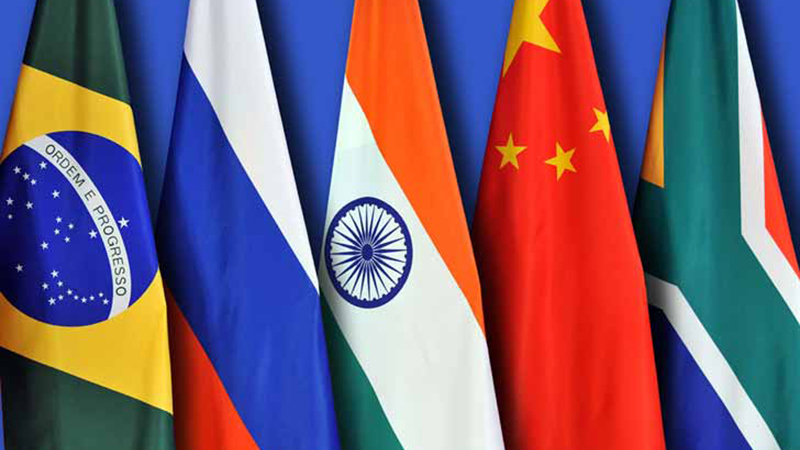
India is set to host a major BRICS National Security Advisers’ Meeting in New Delhi on June 22 and 23, bringing together senior security officials from one of the world’s most influential emerging-power groupings at a time of sharp geopolitical uncertainty. The meeting will be chaired by National Security Adviser Ajit Doval and will focus on the theme “Non-traditional security challenges confronting the world today.”
The gathering comes under India’s BRICS Chairship in 2026 and forms an important part of the diplomatic and security calendar ahead of the BRICS Leaders’ Summit expected later this year. The NSA-level meeting will bring together National Security Advisers and Heads of Delegation from BRICS member countries to discuss evolving threats that go beyond conventional military conflict. These include terrorism, cyber threats, information warfare, misuse of emerging technologies, disruption of critical infrastructure, transnational crime, maritime instability and the wider security effects of regional conflicts.
BRICS is no longer a small grouping of five large emerging economies. It has expanded into a broader platform that includes Brazil, Russia, India, China, South Africa, Egypt, Ethiopia, Iran, Saudi Arabia, the United Arab Emirates and Indonesia. This expansion has given BRICS a wider geopolitical footprint across Asia, Africa, West Asia, Eurasia and Latin America. It has also made internal coordination more complex, as the grouping now includes countries with different strategic priorities, regional pressures and security partnerships.
The New Delhi meeting is an opportunity to shape the BRICS security conversation around practical threats that affect the Global South. India has consistently raised the issue of terrorism, cross-border radicalisation, terror financing and the use of digital platforms by extremist networks. At the NSA meeting, New Delhi is expected to push for stronger cooperation on counter-terrorism, intelligence sharing, digital security and the protection of critical infrastructure from cyber-enabled attacks.
A key part of the agenda will be the review of outcomes from the BRICS Joint Working Groups on Counter-Terrorism and on Security in the use of Information and Communication Technologies. This gives the meeting a practical character. The discussions are not limited to broad statements on global security; they are linked to working mechanisms that deal with terrorism, digital vulnerabilities and the security implications of new technologies.
The presence of high-level representatives from major BRICS powers gives the meeting added diplomatic weight. Chinese Foreign Minister Wang Yi is expected to attend in his capacity as a senior Chinese security and foreign policy official. Russian Security Council Secretary Sergei Shoigu is also among the prominent security figures expected at the conclave. Iran’s participation is being closely watched because Tehran is now a full member of BRICS and remains central to several West Asian security equations.
The India-China angle will attract particular attention. Wang Yi’s presence in New Delhi comes at a time when India and China continue to manage a difficult relationship shaped by border tensions, strategic competition and economic interdependence. Any bilateral engagement between Wang Yi and Ajit Doval on the sidelines will be important, especially because both have been involved in the Special Representatives mechanism on the India-China boundary question. Even when major breakthroughs are not expected, such meetings help maintain channels of communication between two Asian powers whose relationship has a direct bearing on regional stability.
The Russia factor is equally important. Russia remains a founding BRICS member and a long-standing strategic partner of India. Moscow’s participation through senior security leadership underlines the continuing importance of BRICS as a platform where Russia can engage major non-Western partners. For India, managing its relations with Russia within BRICS while maintaining strong ties with the United States, Europe, Japan and other Indo-Pacific partners reflects its broader policy of strategic autonomy.
BRICS now includes Iran, Saudi Arabia and the UAE, three countries whose interests intersect across energy, maritime security, regional conflicts and Gulf stability. This makes the BRICS security track more relevant. Any discussion on West Asia must account for energy security, shipping routes, regional rivalries, extremist networks and the security of millions of expatriate workers from developing countries.
India is heavily dependent on energy flows from the Gulf, has a large diaspora in West Asia and relies on secure maritime routes through the Arabian Sea, the Persian Gulf and the wider Indian Ocean. Disruption in the Gulf region affects India’s energy costs, trade flows, remittances and national security planning. Therefore, a BRICS security conversation that includes West Asian actors is strategically useful for New Delhi.
Cybersecurity is expected to be one of the strongest themes at the meeting. The world’s security environment is now shaped by cyberattacks on power grids, banking networks, hospitals, ports, satellites, military systems and government databases. Artificial intelligence has added new risks, including deepfake propaganda, automated hacking, drone swarms, algorithmic surveillance and faster disinformation campaigns. India’s emphasis on security in the use of Information and Communication Technologies reflects the need to treat digital systems as national security assets.
The meeting also fits into India’s broader diplomatic positioning. During its BRICS Chairship, India has projected the theme “Building for Resilience, Innovation, Cooperation and Sustainability.” This theme connects economic development with security resilience. For India, resilience means stable supply chains, secure technology systems, reliable energy flows, counter-terror capacity, cyber preparedness and stronger institutions. The NSA meeting brings this theme into the hard-security domain.
The conclave also shows how BRICS is trying to evolve beyond economics. In its early years, BRICS was largely discussed in terms of development finance, trade, emerging-market coordination and reform of global financial institutions. Today, its agenda includes terrorism, cyber governance, energy security, maritime routes, technology risks, global governance reform and geopolitical crisis management. The NSA meeting in New Delhi reflects this widening strategic role.
New Delhi is well placed to frame the meeting around practical cooperation rather than ideological alignment. Counter-terrorism, cyber safety, protection of digital infrastructure, anti-money laundering cooperation, organised crime control and secure technology use are areas where BRICS members can find working-level convergence despite political differences.
The meeting also strengthens India’s image as a convening power. New Delhi is bringing together China, Russia, Iran, Gulf powers, African members and other emerging economies on one security platform while continuing active engagements with the Quad, G20, SCO, I2U2 and major Western partners. This multi-aligned diplomacy gives India room to engage different power centres without being locked into one bloc.
For the Indian security establishment, the NSA meet provides an opportunity to place its priorities before an expanded BRICS audience. India is likely to underline that terrorism cannot be treated selectively, that digital platforms must not become safe spaces for extremist networks, and that new technologies must be governed with responsibility. These points are consistent with India’s long-standing position that security cooperation must be practical, accountable and free from double standards.
The New Delhi meeting is also expected to help prepare the ground for the BRICS Leaders’ Summit. NSA-level discussions often shape the security language that later appears in summit declarations, chair statements and working-group mandates. If the meeting produces broad convergence on non-traditional security threats, it could strengthen India’s ability to guide the larger summit agenda later in the year.
The outcome of the meeting will be watched closely for three reasons. First, it will show how far an expanded BRICS can cooperate on terrorism and cyber threats. Second, it will indicate whether the grouping can manage internal differences over West Asia and other geopolitical flashpoints. Third, it will test India’s ability to steer a complex platform at a time when the global order is becoming more fragmented.
India’s hosting of the BRICS NSA Meeting is a strategic moment that brings together security, technology, counter-terrorism, regional diplomacy and global governance. By placing non-traditional security challenges at the centre of the agenda, New Delhi is signalling that the security threats of the future will not come only from armies and borders. They will also come through networks, data systems, extremist financing, digital manipulation, energy chokepoints and fragile regional conflicts.
For India, its the moment to make BRICS platform relevant to build practical security cooperation, protect national interests of each other, strengthen the voice of the Global South and position itself as a serious convenor in a multipolar world. The New Delhi NSA meet gives BRICS exactly that opportunity.
You may also like
-
India and Mauritius Sign Oil and Gas Cooperation Pact, Deepen Long-Term Energy Partnership
-
India, US Armies Set for Major Yudh Abhyas Drill Near China Border in Uttarakhand
-
Jaishankar to Visit Russia for 27th IRIGC-TEC as India and Russia Push Trade, Technology and Economic Cooperation
-
UN Welcomes Sri Lanka’s New Measures to Facilitate Voluntary Return of Refugees from India
-
Indian Air Force Concludes High-Tempo Multinational Exercises Pitch Black and Udara Shakti 2026
