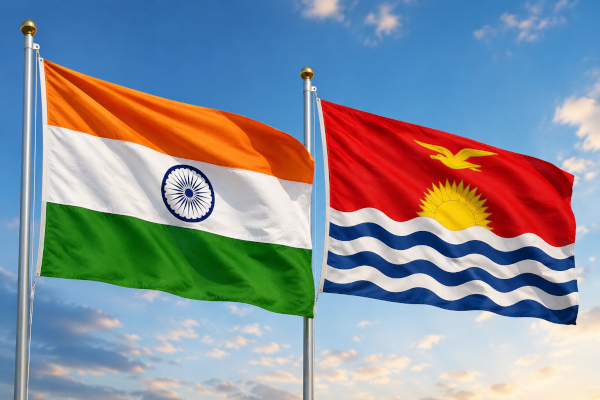
India and Kiribati have taken another step towards strengthening bilateral healthcare cooperation, with discussions focusing on affordable medicines, dialysis support, sea ambulance capability, capacity building and shared development priorities. The meeting between India’s High Commissioner to Fiji, Suneet Mehta, and Kiribati’s Minister for Health and Medical Services, Bootii Nauan, reflects India’s growing engagement with Pacific island nations through practical, people-centred development cooperation.
Kiribati is a small island nation spread across the central Pacific, where geography itself creates a major healthcare challenge. Scattered islands, long travel distances, limited specialist care, climate vulnerability and dependence on external medical support make health-system resilience a national priority. For such countries, cooperation in medicines, medical equipment, training and emergency transport has direct value for ordinary citizens.
India’s role in this partnership is built around affordable and accessible healthcare. As one of the world’s largest producers of generic medicines, India can support partner countries with high-quality drugs at reasonable cost. This is especially important for small island states where medicine procurement is often expensive because of distance, freight costs and limited market size. Reliable access to Indian medicines can help Kiribati strengthen public hospitals, clinics and community health services.
Dialysis support is another important area. Kidney disease treatment requires specialised equipment, trained technicians, continuous consumables and regular patient care. For remote island nations, dialysis capacity reduces the need for expensive overseas treatment and gives patients a better chance of receiving care closer to home. India has already supported Kiribati with a haemodialysis unit and technical training, making the latest discussions part of a continuing health partnership.
The proposal around sea ambulance support is highly relevant to Kiribati’s geography. Island nations require emergency medical transport systems that can move patients across water quickly and safely. A sea ambulance can support evacuation from outer islands, connect remote communities with larger medical centres and improve response during emergencies, disasters and maternal health complications. In the Pacific, transport is often part of healthcare itself.
Capacity building remains the backbone of India’s development diplomacy. Training doctors, nurses, technicians, pharmacists, administrators and public-health workers can create long-term value beyond the supply of equipment. India’s training platforms and technical cooperation programmes allow partner countries to build local skill pools. This approach helps health systems become more self-reliant over time.
The meeting also fits into the wider framework of India’s engagement with the Pacific through the Forum for India-Pacific Islands Cooperation. FIPIC has become a key platform through which India engages Pacific island countries on health, climate resilience, renewable energy, water security, digital tools, capacity building and sustainable development. For island nations facing climate-linked risks, such cooperation has strategic and humanitarian importance.
India’s development partnership with Kiribati has already included community projects, solar lighting, yoga training, dialysis support and sustainable development initiatives. These projects show that the relationship is built through practical assistance rather than symbolic diplomacy. The latest healthcare discussion strengthens this same pattern.
The broader India-Kiribati engagement also includes trade, entrepreneurship, coconut and copra industries, water and sanitation infrastructure, climate-resilient initiatives and Indian business participation in sustainable development. The discussion on a desalination plant under the FIPIC-III commitment is especially important because clean water and public health are closely connected. Better water availability reduces disease burden, supports sanitation and improves community resilience.
For India, this cooperation strengthens its image as a dependable development partner in the Pacific. The region has become increasingly important in global diplomacy because of maritime routes, climate change, fisheries, disaster resilience and strategic competition. India’s approach is based on respect, capacity building and solutions suited to local needs.
For Kiribati, India offers experience in low-cost healthcare delivery, generic medicines, telemedicine potential, medical training, renewable energy and disaster-resilient development. These areas match the needs of a small island state where healthcare, climate and infrastructure challenges are interconnected.
The healthcare meeting therefore represents more than a courtesy call. It shows how India is deepening its Pacific outreach through tangible support. Medicines, dialysis machines, sea ambulance discussions and capacity building directly touch public life. They create goodwill, strengthen institutions and build trust between distant but friendly democracies.
India’s engagement with Kiribati also reflects a larger diplomatic message. The Global South requires partnerships that solve real problems. Health cooperation, water security, renewable energy and skill development are areas where India can offer practical support without imposing heavy burdens on partner countries. This makes India’s Pacific outreach both strategic and humane.
As India expands its role in the Indo-Pacific, healthcare diplomacy will remain a powerful tool. It brings together compassion, capability and credibility. The latest India-Kiribati discussion shows that development partnership is becoming one of the strongest pillars of India’s engagement with Pacific island nations.
You may also like
-
Tarang Shakti Delegates from 28 Countries Visit HAL and BEL to Explore India’s Defence Manufacturing Ecosystem
-
Swiss President Guy Parmelin to Visit India as EFTA Economic Partnership Deepens
-
India and Brazil Move to Expand Mercosur Trade Pact Beyond 450 Tariff Lines
-
India and Qatar Accelerate FTA and Investment Treaty Talks
-
Ayurveda on Eating at the Right Time: How Food Timing Supports Balance and Health
