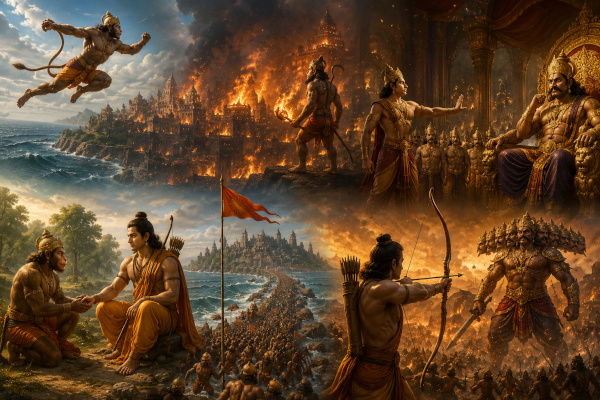
War is fought with weapons, soldiers, formations and logistics. It is also fought with symbols. A symbol can shake the enemy’s confidence, lift the morale of one’s own army and create legitimacy in the eyes of allies, civilians and future generations. The Ramayana shows this very clearly. The war against Ravana is filled with physical combat, but its deeper power comes from symbolic acts that change the moral atmosphere of the battlefield.
Rama’s campaign against Lanka is built on justice, restraint and legitimacy. Ravana holds power through fear, abduction and arrogance. Rama builds strength through alliance, discipline, sacrifice and dharma. This creates the main moral divide of the war. Every major act in the campaign reinforces this divide. Hanuman’s leap, the burning of Lanka, Angada’s entry into Ravana’s court, Vibhishana’s defection and Rama’s final confrontation with Ravana all become symbolic weapons. They tell the world that Ravana’s power can be challenged, his capital can be entered, his ministers can abandon him and his final defeat is approaching.
Hanuman’s leap across the ocean is the first great symbol of the campaign. Militarily, it is a reconnaissance mission. Symbolically, it is much more powerful. The ocean represents distance, fear and the belief that Lanka is unreachable. Hanuman crosses it alone. This single act destroys the psychological protection around Ravana’s island kingdom. Lanka is no longer a distant fortress beyond reach. It becomes a reachable target. For Rama’s army, Hanuman’s leap proves that courage and devotion can break impossible barriers. For Ravana’s side, it sends a warning that Rama’s forces can penetrate their most secure spaces.
Hanuman’s entry into Lanka also carries symbolic value. He enters the enemy capital, studies its layout, observes its strength and finds Sita. A kingdom that cannot prevent one envoy from entering its capital begins to lose its aura of invincibility. In modern defence language, this is the collapse of the enemy’s protected image. Fortresses often depend on reputation. Once that reputation is broken, physical walls lose part of their power.
A powerful modern parallel can be drawn with India’s Operation Sindoor, where Indian precision strikes targeted terror infrastructure across the border, including Markaz Taiba in Muridke, identified by India as the headquarters of Lashkar-e-Taiba. This was symbolic warfare as much as kinetic warfare. LeT’s Muridke complex carried a dark symbolic value in India’s security memory because of its association with cross-border terrorism and the 26/11 Mumbai attacks. By striking such a centre, India sent a message that terror organisations could no longer hide behind distance, geography, political shielding or institutional disguise. The act resembled Hanuman’s entry into Lanka and the burning of Ravana’s city. In both cases, the enemy’s protected space was breached. The strike weakened the adversary’s aura of safety, restored national morale and showed that the source of aggression could be reached directly. Just as Lanka’s burning told Ravana that Rama’s forces had entered the heart of his power, India’s strike on LeT-linked infrastructure showed that terror headquarters and training centres across the border could be made accountable through precise and calculated force.
The meeting between Hanuman and Sita is another major symbol. Sita’s presence in Ashoka Vatika becomes the moral centre of the war. Hanuman does not simply confirm her location. He confirms the justice of Rama’s campaign. The war is no longer an abstract conflict between two rulers. It becomes a mission to restore honour, rescue the innocent and punish unlawful power. This clarity gives Rama’s side moral unity. Armies fight better when their purpose is clear.
The destruction of Ashoka Vatika turns reconnaissance into psychological warfare. Hanuman damages Ravana’s prized garden, defeats elite warriors and forces the enemy court to respond. This action is military, psychological and symbolic at the same time. The garden represents royal luxury and imperial pride. Its destruction tells Lanka that Ravana’s private world is vulnerable. The enemy is forced to witness the strength of a single warrior from Rama’s side. The message is direct: if one envoy can do this, the full army can do far more.
The burning of Lanka is one of the strongest examples of symbolic warfare in the Ramayana. Fire becomes the message. Hanuman’s burning tail, intended as humiliation by Ravana’s side, becomes the instrument of Lanka’s humiliation. The punishment turns against the punisher. The city that tries to mock Rama’s envoy is forced to watch its own streets burn. This reverses the psychological balance. Ravana’s court tries to display control. Hanuman converts that moment into a spectacle of resistance.
The burning of Lanka does not only damage structures. It damages confidence. Citizens see panic. Soldiers see disorder. Ministers see vulnerability. Ravana sees that the war has entered his capital before Rama’s army has crossed the ocean. This is symbolic depth warfare. The battlefront shifts from the outer perimeter to the mind of the enemy. Ravana still has armies, weapons and commanders, but his image of absolute control is cracked.
Angada’s mission to Ravana’s court is another brilliant example of symbolic warfare. Rama sends Angada as an envoy before the full assault. This act shows confidence, discipline and moral authority. Rama gives Ravana a final chance to return Sita and avoid destruction. The message places the burden of war on Ravana. It tells every witness in the court that Rama seeks justice, while Ravana chooses pride.
A modern parallel can be seen in India’s repeated warnings to Pakistan over cross-border terrorism. India used diplomatic channels, public statements and international forums to place responsibility clearly on Pakistan for terror infrastructure operating from territory under its control. The message carried the same logic as Angada’s mission to Ravana’s court. India gave Pakistan repeated opportunities to act against terror networks, stop infiltration and prevent its soil from being used against India. This placed the moral and political burden on Pakistan. When terror attacks continued, India’s response gained stronger legitimacy because the warning had already been given. Just as Angada’s fearless message showed that Rama sought justice before battle, India’s warnings showed that its later military responses came after patience, restraint and clear communication.
Angada’s conduct inside the court carries even greater symbolic force. He stands fearless among enemies. He speaks openly before Ravana and his warriors. He places his foot firmly and challenges them to move it. This is a direct symbolic strike against Ravana’s martial pride. The court becomes a battlefield of morale. Ravana’s warriors fail to shake Angada’s position. That failure becomes a public sign of weakening power. Angada does not need an army inside the court. His posture itself becomes a weapon.
Vibhishana’s defection is one of the most powerful symbols in the war. A ruler’s own brother leaves him and joins Rama. This is more than an intelligence gain. It is a moral verdict from inside Lanka. Vibhishana’s choice tells the world that Ravana’s rule has lost legitimacy even within his own family. Defection in war carries heavy symbolic weight because it shows internal fracture. An enemy can fight outside pressure, but internal loss of faith damages the core of command.
Vibhishana strengthens Rama’s side in two ways. He provides knowledge about Lanka, Ravana and the enemy’s strengths. He also gives Rama’s campaign moral validation from within the enemy camp. Rama accepts him with dignity. This act shows that Rama’s camp is not built on hatred of Lanka. It is built on opposition to adharma. Anyone who chooses justice can find protection under Rama. This is strategic messaging of the highest order.
Rama’s acceptance of Vibhishana also creates a political symbol for the future. Rama is not only fighting to defeat Ravana. He is preparing the ground for lawful rule after the war. Every successful campaign needs an end state. Vibhishana represents that end state. He becomes the symbol of a Lanka that can exist after Ravana. This gives the war a constructive purpose. Victory is linked to restoration, not destruction alone.
A strong modern Indian parallel can be seen in the 1971 Bangladesh Liberation War. India’s campaign in the eastern theatre was linked to a clear political end state: the emergence of Bangladesh under its own liberation leadership. India supported the Mukti Bahini and recognised the future political authority of Bangladesh before the final collapse of Pakistan’s eastern command. This resembles Rama’s acceptance of Vibhishana because both examples show that victory needs a lawful order after the battle. The aim was larger than defeating the enemy’s military formation. It was to create conditions for stable rule after the war. Just as Vibhishana represented a Lanka beyond Ravana, the Bangladesh liberation leadership represented an East Bengal beyond Pakistani military rule. This gave the campaign a constructive purpose and turned military success into political restoration.
The construction of Rama Setu also carries symbolic force. Militarily, it is an engineering achievement that enables the army to cross the ocean. Symbolically, it turns separation into connection. The ocean that seemed to protect Lanka becomes a pathway for Rama’s army. This is a major psychological transformation. Ravana’s confidence rests partly on geography. The bridge defeats that confidence. The army crossing the sea becomes a moving symbol of determination, unity and divine-backed effort.
The Vanara army itself is a symbol. It is not a conventional imperial army. It is an alliance built through loyalty, trust and shared purpose. Rama’s force includes Sugriva, Hanuman, Jambavan, Angada, Nala, Neela and countless warriors who come together for a righteous mission. This gives Rama’s campaign a broad moral base. Ravana commands through fear and hierarchy. Rama leads through trust and earned loyalty. The contrast is visible to every observer.
Battlefield symbols also appear during the siege of Lanka. The deployment of Rama’s commanders at different gates shows order and confidence. The siege is not a chaotic rush. It is organised pressure. Each gate becomes a theatre of meaning. Lanka’s walls represent Ravana’s pride. Rama’s forces surrounding those walls represent the closing circle of justice. The siege itself becomes a symbol of inevitable accountability.
Ravana also uses symbols, but his symbols serve arrogance and intimidation. His court, wealth, weapons and mighty warriors project imperial power. Indrajit’s illusions project fear and confusion. Kumbhakarna’s massive presence projects brute strength. These symbols create temporary shock, but they do not create lasting legitimacy. Fear can delay defeat, but it cannot create moral unity. Ravana’s side suffers because its symbols are tied to domination, while Rama’s symbols are tied to justice.
Rama’s final confrontation with Ravana carries the greatest symbolic weight. It is the meeting of dharma and arrogance on the battlefield. Rama does not win only because he is a superior warrior. He wins because the entire moral structure of the war has already moved in his favour. Ravana stands as a king who ignored counsel, rejected peace, insulted envoys, held Sita captive and brought destruction upon his own people. Rama stands as the warrior who gave warnings, honoured allies, protected defectors and fought for a rightful cause.
The fall of Ravana is therefore more than the death of an enemy commander. It is the collapse of an entire symbolic order built on pride. His defeat proves that military power without moral restraint becomes self-destructive. His fall also confirms Rama’s legitimacy. The victory belongs to arms, strategy, alliance and dharma together. This is why the Ramayana war remains a study in both battlefield science and moral warfare.
Symbolic warfare has clear lessons for modern defence thinking. Modern armies use symbols through flags, regimental identity, public messaging, precision operations, naming of missions, national ceremonies, battlefield memorials and visible acts of resolve. These symbols shape morale at home and perception abroad. A strong symbol can tell soldiers why they fight, tell citizens what is at stake and tell adversaries that national will is firm.
In modern war, perception moves as fast as missiles and drones. Images, narratives and battlefield actions travel instantly. A single successful operation, a visible act of courage or a disciplined public message can influence morale far beyond the physical battlefield. Military power gains greater effect when it carries moral clarity. The Ramayana understood this ancient truth deeply.
The symbolic warfare of Rama’s campaign teaches that legitimacy is a force multiplier. Hanuman’s leap breaks the myth of distance. Lanka’s burning breaks the myth of invincibility. Angada’s challenge breaks the pride of Ravana’s court. Vibhishana’s defection breaks the unity of the enemy camp. Rama’s final battle breaks the rule of adharma. Each act prepares the ground for victory before the final weapon is released.
The Ramayana presents war as a contest of strength, intelligence, courage and meaning. Weapons can destroy armies, but symbols can destroy confidence. A commander who controls symbols controls morale. A force that carries legitimacy enters battle with deeper strength. Rama’s victory over Ravana shows that the most powerful army is the one whose sword, message and moral purpose move in the same direction.
You may also like
-
Indian Navy Vice Chief Inspects Japan’s Mogami-Class Stealth Frigate as India-Japan Shipbuilding Cooperation Expands
-
Philippine Marine Wargames Reportedly Show BrahMos Can Penetrate Chinese Destroyer Air Defences
-
Safran Signs 18 Agreements with Indian Aerospace Suppliers, Expanding Make in India Manufacturing Partnerships
-
Indian Army’s Vajra Corps Certifies First Batch of Drone Operators, Strengthens Battlefield Surveillance
-
India to Seek 35% Increase in Defence Modernisation Budget for FY 2027–28
