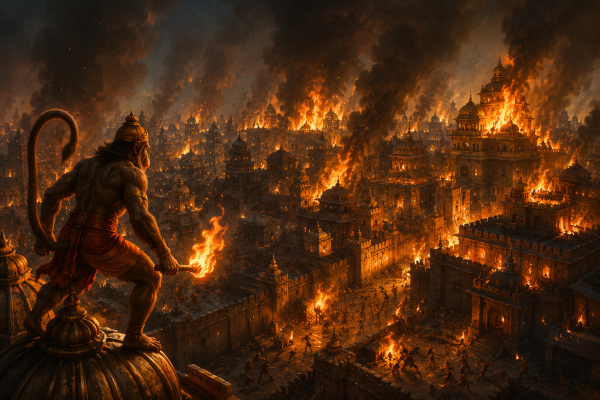
In the war for Lanka, fire becomes more than flame. It becomes a weapon of shock, disruption and psychological collapse. The Ramayana presents fire as a force that enters the enemy’s capital, strikes its confidence, damages its infrastructure and exposes the weakness of a city that appeared invincible from the outside. Hanuman’s burning of Lanka and Sugriva’s later instruction to the Vanaras to enter the city with torches show a clear understanding of urban sabotage in ancient warfare.
Hanuman’s mission begins as reconnaissance. He crosses the ocean, enters Lanka, observes its defences, studies its streets, identifies Sita’s location and measures the strength of Ravana’s command structure. His capture creates a new opportunity. Ravana’s court orders Hanuman’s tail to be wrapped in cloth and set on fire as an insult. Hanuman turns that humiliation into a battlefield instrument. He uses the enemy’s own act against them and converts a punishment into an urban strike.
The burning of Lanka carries a precise military meaning. Hanuman moves through the city with speed, agility and awareness of terrain. Palaces, mansions, towers, storehouses and key urban spaces fall into flames. A city built on wealth, pride and concentrated power suddenly feels vulnerable from within. The defenders see that their capital can be reached, disturbed and damaged by a single warrior. This creates psychological pressure before Rama’s army even arrives at the gates.
The Battle of Dograi in the 1965 Indo-Pak War gives a powerful ground-combat parallel to the assault pressure seen in Lanka. Dograi stood near Lahore, close to the Ichhogil Canal, and formed part of a fortified defensive belt. Pakistani troops had prepared the area with pillboxes, machine guns, mines, wire obstacles and houses converted into firing positions. This turned the village into a compact defensive zone where every lane, building and approach carried danger. Indian troops of 3 Jat moved through the night, advanced toward the objective in silence and entered the defended settlement with determination. The battle quickly became a close-quarter fight, where rifles, grenades, bayonets and hand-to-hand courage decided the ground street by street.
The value of Dograi lies in the principle of penetration. A defended settlement gives the defender confidence because the ground is familiar, the firing points are prepared and the approaches are covered. Once an attacking force breaks into that space, the defender’s advantage begins to shrink. Every captured house becomes a new foothold. Every cleared lane becomes a passage for pressure. Every silenced pillbox opens the next movement. The battle shifts from outer defence to internal survival. Commanders lose the comfort of distance, reserves are pulled into confusion and the defender begins to fight inside the very space that was meant to protect him.
This gives Dograi a clear connection with the Ramayana’s Lanka campaign. Hanuman’s entry into Lanka first proved that the city could be penetrated. His movement through its streets, towers and guarded spaces changed Lanka from a secure capital into a vulnerable battlefield. Later, the Vanara assault carried the same logic at a larger scale. Once attackers enter a fortified urban space, the walls lose their full meaning. The protected zone becomes contested ground. The enemy begins to feel pressure inside his own stronghold.
Dograi shows this principle in modern Indian war history. 3 Jat’s night assault forced the defender into close combat inside a prepared position near Lahore. The Indian attack carried shock, speed and physical courage into a space designed for resistance. In the Ramayana, Hanuman’s action and the Vanara entry into Lanka create the same battlefield effect through epic imagery. The defender’s capital becomes a place of alarm, movement and uncertainty. The attacker gains momentum by turning the enemy’s secure ground into a zone of direct confrontation.
Fire in an urban battlefield attacks more than buildings. It attacks rhythm. A fortified city depends on order, command posts, supply stores, armouries, routes, watch points, shelters and morale. Flames disturb movement, scatter defenders, create confusion in streets and force commanders to divide attention. Soldiers rush toward smoke, civilians flee through lanes, guards abandon fixed positions and officers struggle to understand the scale of the strike. The city’s defensive machine begins to lose its clean structure.
Hanuman’s action also functions as psychological warfare. Lanka is Ravana’s centre of power, pride and identity. Its golden towers represent his authority. When those spaces burn, the message travels deeper than physical damage. Ravana’s subjects witness a sign that their king’s protection has limits. His warriors realise that the enemy can penetrate their capital. His court receives proof that Rama’s side has courage, reach and initiative. A single raid becomes a warning to the entire regime.
The event also reveals the link between reconnaissance and sabotage. Hanuman’s movement through Lanka gives him knowledge of the city before the flames spread. He has already seen the layout, the royal spaces, the guarded zones and the movement patterns. This makes his strike more meaningful. In modern military language, intelligence shapes disruption. A force that understands the enemy’s urban design can create pressure at points that affect command, logistics and morale together.
Later, when the main war begins, Sugriva instructs the Vanaras to enter Lanka with torches and set parts of the city ablaze. This expands the earlier single-warrior shock action into a broader urban assault method. The Vanaras are already fighting at the gates and walls. Fire adds another layer to the attack. It stretches the defenders between outer combat and internal disorder. Ravana’s warriors face pressure from the army outside and flames inside their own urban space.
This is a classic principle of urban sabotage. A defended city holds strength through concentration. Walls, gates and towers give the defender a fixed advantage. Fire breaks that concentration by creating multiple emergencies at once. A commander must protect the gate, control the streets, secure the palace, move reserves, calm the population and preserve supplies. Each new fire becomes a demand on manpower. Each burning structure becomes a signal that the attacker is shaping the battle inside the defender’s mind.
The Vanaras are suited for this kind of warfare because their strength lies in mobility, speed and physical adaptation. They climb, leap, scatter, regroup and strike from unexpected directions. In a city of towers and raised structures, such movement becomes a natural advantage. Torches in their hands turn mobility into disruption. Their assault does through motion what siege engines do through force: it breaks the enemy’s sense of control.
Modern warfare studies the same principle through the lens of infrastructure disruption. Cities depend on power, communications, transport, fuel storage, supply hubs and command centres. A strike on these systems can slow a defender, confuse command and reduce response capacity. The Ramayana expresses this idea through the language of fire, streets and fortifications. Lanka’s burning shows that a city’s strength rests on internal order as much as external walls.
The use of fire also carries symbolic power in the epic. Agni is a sacred force, a witness and a purifier. In Lanka, fire becomes the visible consequence of adharma. Ravana’s kingdom has wealth, architecture and military strength, yet its moral centre has collapsed through the abduction of Sita. The flames become a sign that the city’s outer splendour cannot protect a ruler whose conduct has brought war to his own gates. The battlefield lesson and the dharmic lesson move together.
A modern commander would read this episode as a study in shock action, target sensitivity and morale disruption. Hanuman’s raid demonstrates how a small force can create strategic effect when courage, intelligence and mobility come together. Sugriva’s later instruction shows how the same method can be scaled during a larger assault. Fire becomes a force multiplier because it expands the battle across physical, psychological and logistical layers.
The defenders of Lanka face a hard reality during these moments. Their walls protect the boundary, while the attacker creates pressure within the city’s living body. The flames disturb command confidence, consume stores, frighten the population and force emergency movement. This is the essence of urban sabotage in warfare: create internal strain that weakens the defender’s ability to resist external assault.
The Ramayana presents this with vivid clarity. Hanuman’s burning of Lanka is a commando-style urban disruption after deep penetration. Sugriva’s torch-bearing assault is a coordinated method to intensify pressure during siege warfare. Together, both episodes show that victory in a city battle comes through more than strength at the gate. It comes through intelligence, timing, mobility, morale pressure and the ability to make the enemy’s own capital feel unsafe.
In the larger arc of the war, fire announces the coming fall of Ravana’s power. Lanka burns first as a warning and later as a battlefield condition. The flames reveal that the city’s grandeur can be shaken, its defenders can be stretched and its ruler can be forced into reactive decisions. Rama’s campaign therefore gains momentum before the final duel. The enemy’s centre begins to crack through fear, disorder and visible loss.
Arson and urban sabotage in the Ramayana are presented as instruments of war shaped by purpose. They damage infrastructure, weaken supplies, disturb command flow and strike the morale of a fortified capital. In this episode, fire becomes a strategic language. It tells Ravana that Lanka has been entered, measured and marked. It tells the defenders that the war has moved inside their walls. It tells the reader that the fall of a powerful city begins when its confidence burns before its towers fall.
You may also like
-
India and US Bring Advanced Counter-Drone Warfare Into Yudh Abhyas 2026
-
Digantara Expands Bengaluru Space Hardware Capability With New Cleanroom
-
Armenian Military Delegation Visits Indian Air Force Station as India–Armenia Defence Ties Deepen
-
Abhira in the Mahabharata: The Pastoral People of Western India and the Northern Deccan
-
FAS Estimates India’s Nuclear Stockpile at Up to 190 Warheads as Strategic Forces Modernise
