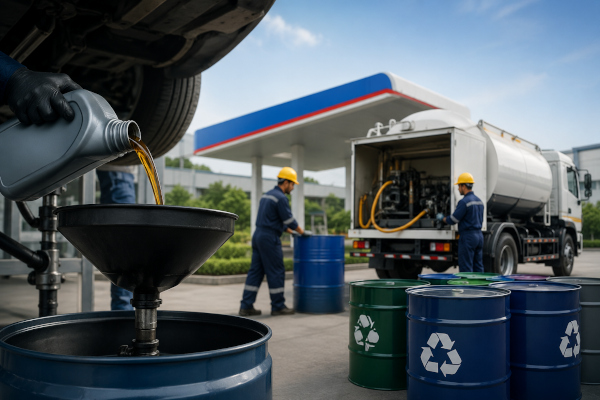
India’s automotive and energy sectors have taken an important step towards responsible waste management with HPCL and Tata Motors launching a pilot project for the organised collection and recycling of used automotive lubricants. The collaboration is designed to create a structured system where used oil from vehicles can be collected, stored, transported and processed through authorised channels instead of slipping into informal or unsafe disposal routes.
Used lubricant is one of the less visible waste streams of India’s transport economy. Every truck, bus, pickup, commercial vehicle and workshop generates spent oil after servicing, and this material carries environmental risk when it is dumped, burned casually or handled outside regulated systems. The new pilot treats used lubricant as a recoverable industrial resource, bringing it back into the value chain through re-refining rather than allowing it to become a pollutant.
The project brings together two different strengths. HPCL will anchor the aggregation and transportation of used lubricants through authorised collection mechanisms and ensure that the material is channelled to registered recyclers. Tata Motors will use its authorised service network to support structured collection and promote responsible disposal practices across its commercial vehicle ecosystem.
The larger goal is circularity. Used automotive lubricants can be reprocessed into high-quality re-refined base oil, which can then return to the lubricant supply chain. This reduces resource wastage, lowers environmental risk and supports India’s wider shift towards a circular, resource-efficient industrial model. The pilot will initially operate across select states and will be monitored by a joint committee from both companies to study performance, scalability and operating discipline.
The timing is significant because India has already placed used oil under a formal Extended Producer Responsibility framework. The Government notified the Hazardous and Other Wastes Second Amendment Rules, 2023, adding EPR provisions for used oil, and the framework came into force from April 1, 2024. Producers of base oil or lubrication oil and importers of used oil are required to meet recycling obligations through EPR certificates generated by registered recyclers.
The CPCB’s used oil framework also makes traceability central to the system. Collection agents are expected to register on the portal, maintain records, follow safety measures, prevent spills and leaks, transport used oil through registered vehicles and supply it only to registered recyclers or producers. This is exactly the kind of organised chain that the HPCL–Tata Motors pilot is trying to demonstrate at industrial scale.
For Tata Motors, the project fits naturally into its commercial vehicle service ecosystem. Its large network of service touchpoints gives the company access to vehicle owners, fleet operators and workshop-level oil change activity. If used oil can be collected at the point of servicing itself, the system becomes cleaner, more convenient and easier to monitor. Tata Motors has stated that its commercial vehicle network includes over 4,500 sales and service touchpoints across India.
For HPCL, the partnership strengthens its role beyond fuel and lubricant supply. The company already operates across refining, marketing, lubricants, retail and distribution, and the used oil pilot allows it to participate in the post-consumption stage of the lubricant lifecycle. This makes the lubricant business more complete: production, sale, use, collection, re-refining and reintegration into the market.
The real importance of this pilot lies in its replicability. India has a huge automotive servicing ecosystem, but much of the used oil chain has historically depended on fragmented collection. A traceable model led by major companies can help raise standards for garages, service centres, fleet operators and recyclers. It can also encourage more formal recycling capacity and create confidence in re-refined base oil as a legitimate industrial input.
If the pilot succeeds, it could become a template for wider industry adoption. The model can reduce unsafe disposal, support compliance with India’s EPR rules, create a cleaner supply chain for used lubricants and help the automotive sector move from simple waste handling to genuine circular economy practice. In a country where transport activity is expanding rapidly, such systems will matter as much as cleaner vehicles, better fuels and improved engine efficiency.
Sources:
Tata Motors Commercial Vehicles — HPCL and Tata Motors Partner to Develop Scalable Circular Economy Model for Used Automotive Lubricants
https://cv.tatamotors.com/news/hpcl-and-tata-motors-partner-to-develop-scalable-circular-economy-model-for-used-automotive-lubricants
IBEF — HPCL and Tata Motors launch pilot project for used lubricant recycling
https://www.ibef.org/news/hpcl-and-tata-motors-launch-pilot-project-for-used-lubricant-recycling
CPCB — Extended Producer Responsibility for Used Oil Management Portal
https://eprusedoil.cpcb.gov.in/
CPCB — About Used Oil EPR Framework
https://eprusedoil.cpcb.gov.in/aboutus
CPCB — FAQs on EPR for Used Oil Management
https://eprusedoil.cpcb.gov.in/public/assets/images/Used_Oil_FAQ.pdf
CPCB — Guidelines for Collection, Handling, Transportation and Storage of Used Oil by Collection Agent
https://eprusedoil.cpcb.gov.in/public/assets/images/Collection_agent_Guidelines.pdf
HPCL — Business Responsibility and Sustainability Report 2024-25
https://www.hindustanpetroleum.com/documents/pdf/HPCL_BRSR_2024-25.pdf
You may also like
-
US Hosts 91% of Overseas Unicorns Built by Founders Who Grew Up in India, Prosus-Dealroom Report Finds
-
India Approves Pioxaniliprole, Indigenous Insecticide Molecule Developed by PI Industries
-
India Overtakes Hong Kong to Become Asia’s Fourth-Largest REIT Market
-
Banaras Langda Aam — Kashi’s Green-Skinned Summer Treasure and the Mango Heritage of the Gangetic Plain
-
ONGC Strikes Gas in Mahanadi Deepwater Basin Off Odisha Under Samudra Manthan Campaign
