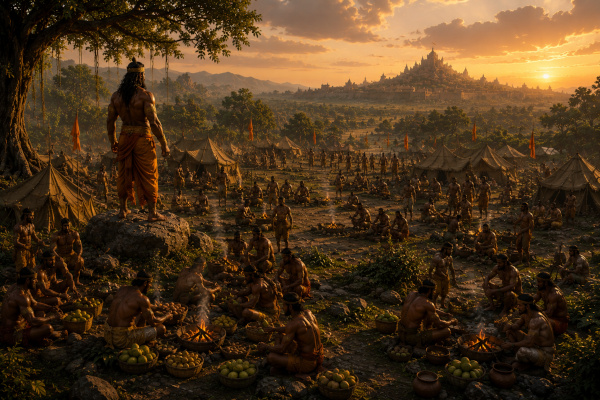
The crossing of the sea was a moment of awe, but the war did not begin the instant Rama’s army reached Lanka. The Vanara host did not rush blindly from the bridge into battle. After the great passage across Rama Setu, the army halted, examined the land, and encamped at a place where there were roots, fruits and water. It is a small detail in the epic, yet it carries a complete military lesson: an army that has crossed an obstacle must first secure the means to survive, organise and strike.
The scene is vivid. Behind them lay the roaring sea and the bridge built through impossible labour. Ahead stood Lanka, Ravana’s fortified island kingdom, glittering with towers, gates and guarded approaches. Between the bridgehead and the enemy city, Rama’s army needed a place to breathe. The Vanaras had crossed as a force of purpose; now they had to become a force ready for battle. That transformation required food, water, rest, formation space and command order.
This is the essence of military logistics. Courage carries warriors into danger, but supply keeps them there. A thirsty army becomes weak before the enemy even appears. A hungry army loses speed, discipline and concentration. A force that camps in the wrong ground exposes itself to confusion, disease, panic and surprise. The Ramayana recognises this with striking simplicity. Before the arrows fly and the maces fall, the army must be placed where life can be sustained.
The choice of a camp with roots and fruits shows the intelligence of using local resources. The Vanara army was vast, mobile and physically powerful, but its size also created a burden. Thousands of fighters needed nourishment. Carrying everything across the sea would have slowed the operation. By selecting a place where food was naturally available, the army reduced pressure on long-distance supply and converted the terrain itself into a supporting partner.
Water was even more important. In every age of warfare, water decides the endurance of armies. Soldiers can march with limited food for some time, but without water, strength collapses quickly. Animals, messengers, cooks, wounded fighters and labour teams all need water. A camp near a reliable water source becomes a living base. A camp away from water becomes a slow trap. The Ramayana places this detail quietly, but it shows a clear understanding of battlefield sustainment.
The encampment also gave Rama’s army a staging ground. A staging ground is where a force reorganises after movement and prepares for the next phase. The Vanaras had just completed a massive sea crossing. Their formations needed to be restored. Commanders had to know where their groups stood. Scouts had to move forward. Messengers had to carry instructions. The wounded and exhausted had to recover. The army had to shift from crossing mode to combat mode.
Modern warfare follows the same rhythm. After a major river crossing, amphibious landing or mountain insertion, troops do not simply scatter toward the objective. They secure a beachhead, establish supply points, mark routes, place command posts, organise medical support, position reserves and prepare fire plans. The first hours after crossing are fragile. A force has arrived, but its strength becomes real only when logistics, communication and positioning are brought under control.
Rama’s halt before Lanka can be read as the creation of a forward operating base. In modern military language, such a base allows soldiers to rest, refit, receive supplies, gather intelligence and launch operations. It becomes the hinge between movement and combat. The Vanara camp near food and water performed this exact function. It gave Rama a firm footprint on enemy-facing ground after the sea had been crossed.
This detail also shows the difference between a raid and a campaign. Hanuman had earlier entered Lanka alone, observed the city, located Sita and returned with intelligence. That was a deep reconnaissance mission. Rama’s army, however, had come for a decisive campaign. A campaign requires staying power. It needs repeated attacks, reserves, supplies, treatment of the wounded, protection of routes and control of space. The camp near roots, fruits and water marks the moment when Rama’s mission becomes a sustained military operation.
The camp also protected morale. The Vanaras had performed an extraordinary act by crossing the sea, but even the most enthusiastic army needs order after exertion. Food steadies the body. Water restores strength. A known camp gives soldiers psychological anchorage. Around such a base, warriors can gather, hear commands, sharpen resolve and prepare for the enemy. Morale is not only born from speeches; it also comes from the confidence that the army is fed, placed and led.
Positioning mattered as much as supply. Rama’s army had to camp close enough to threaten Lanka and far enough to avoid reckless exposure. A good camp must see the enemy without becoming easy prey. It must allow movement in multiple directions. It must have space for troops to assemble. It must provide routes for messengers and reserves. The Ramayana’s simple reference to the chosen ground carries this larger logic of military geography.
In modern battle planning, this is called operational positioning. Armies choose assembly areas, logistics nodes and tactical headquarters based on terrain, access, concealment, supply and distance from the enemy. A badly chosen base can slow an offensive before it begins. A well-chosen base becomes a springboard. Rama’s camp served as the springboard from which the final campaign against Ravana would unfold.
The episode also underlines that logistics is a form of foresight. The commander who thinks only of the final battle sees the enemy’s walls. The commander who thinks deeply sees water, food, approach routes, fatigue levels, reserve movement and night security. Rama’s leadership carries this wider vision. He has the moral cause, but he also respects the practical foundations of war. Dharma does not remove the need for preparation; it gives preparation a sacred purpose.
This is where the Ramayana feels remarkably modern. Today, tanks need fuel, aircraft need runways, drones need control stations, artillery needs ammunition, ships need ports, and soldiers need food, water, shelter and medical evacuation. A missile may travel hundreds of kilometres, but the soldier holding ground still depends on supply lines. The shining edge of combat is always supported by an unseen chain of trucks, depots, engineers, mechanics, medics, signals units and planners.
In mountainous frontiers, logistics becomes even more decisive. Roads, bridges, tunnels and forward supply dumps decide how quickly troops can be moved and sustained. High-altitude posts require rations, fuel, oxygen support, winter clothing, ammunition and evacuation routes. The army that reaches a frontier first gains advantage; the army that sustains itself there gains endurance. This is the modern echo of Rama’s decision to secure food, water and ground after crossing the sea.
India has seen this truth in its own military experience. In Operation Meghdoot, Siachen was not secured by numbers alone, but by a supply chain that could breathe in thin air. Transport aircraft pushed men and stores into the high-altitude theatre, helicopters climbed into brutal cold and rarefied skies, and Indian troops were placed on the commanding peaks before Pakistan could turn the glacier into its own fortress. The battlefield was a frozen wilderness, yet logistics turned it into a held position. The same principle now shapes India’s border infrastructure: Atal Tunnel gives a faster strategic link toward Ladakh, Sela Tunnel opens all-weather access to Tawang, and the expanding BRO network turns remote frontier terrain into usable military space. Like Rama’s army choosing a camp with roots, fruits and water after crossing the sea, modern India understands that the first victory is often the creation of a base from which soldiers can move, endure and strike.
The Vanara army’s camp also shows the importance of adapting logistics to the nature of the force. This was not a conventional chariot army moving through plains with standard baggage trains. It was a forest-born force, agile, physical and accustomed to natural terrain. Roots and fruits suited its character. The commander who understands his army’s nature supplies it wisely. Modern forces do the same when mountain troops, mechanised columns, naval landing groups and special operations units receive different logistical packages according to mission and environment.
There is also a lesson in restraint. The sight of Lanka could have provoked immediate assault. The warriors were eager. The cause was righteous. The enemy was near. Yet the army paused to organise itself. This pause was not weakness; it was discipline. In warfare, impatience can waste courage. The well-timed halt often saves strength for the decisive moment. Rama’s army waited because battle must be entered with readiness, not merely emotion.
The encampment near natural resources also reduced vulnerability at the bridgehead. After any crossing, the rear route is precious. Rama Setu was the line that connected the army to the mainland. If the troops crowded without order near the crossing point, confusion could spread. By moving into a suitable camp with resources, the army created depth beyond the bridge and avoided turning the crossing area into a bottleneck. Modern commanders treat bridgeheads with the same care, expanding them quickly so that the force has room to manoeuvre.
The Ramayana’s military wisdom lies in such details. It does not always explain logistics in technical language, but it shows the behaviour of an army that understands survival before combat. The roots and fruits are not decorative scenery. The water source is not a casual mention. Together, they reveal that the epic sees war as a complete system: intelligence finds the enemy, engineering opens the route, logistics sustains the force, and leadership turns all of it toward victory.
Rama’s army before Lanka is therefore a powerful image of organised readiness. The bridge has been crossed. The sea has been mastered. The enemy citadel stands ahead. The warriors gather where the land can feed them and the water can sustain them. Fires are lit. Scouts move. Commanders speak. The roar of the ocean fades behind the murmuring strength of an army preparing itself with patience.
This is the defence lesson of the episode: the battle is often won before the battle is seen. It is won in the choice of camp, the availability of water, the flow of food, the rest given to fighters, the routes kept open, and the discipline to prepare before striking. Rama’s campaign shows that logistics is not a background activity. It is the quiet power that allows courage to last long enough to become victory.
You may also like
-
Astra Microwave Expands Counter-Drone Capabilities with Layered Detection and Neutralisation Systems
-
MDL Begins Development of Indigenous Lithium-Ion Battery System for Project-75(I) Submarines
-
Tarang Shakti Delegates from 28 Countries Visit HAL and BEL to Explore India’s Defence Manufacturing Ecosystem
-
India’s 114 Rafale Fighter Jet Programme Moves Towards Final Decision with Focus on Indigenous Integration
-
Embraer and Mahindra Identify Nagpur as Potential C-390 Millennium Assembly Hub in India
