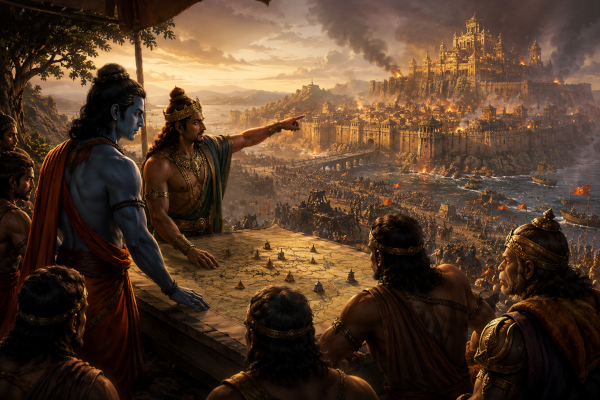
In the Yuddha Kanda of the Ramayana, Vibhishana’s arrival in Rama’s camp is one of the finest ancient examples of human intelligence changing the character of a campaign. Until that moment, Rama’s coalition has courage, numbers, mobility and moral purpose. What it gains through Vibhishana is something more decisive: an internal map of the adversary. Lanka is transformed from a distant fortified island into a readable military system, with commanders, gate deployments, political tensions, rituals, vulnerabilities and habits of decision-making.
This is the real defence lesson in Vibhishana’s defection. A defector is far more than a man changing sides. He is a living archive of the enemy’s order of battle, command psychology, internal rivalries and operational rhythm. In modern warfare, satellites can photograph bases, drones can watch movement, radars can track aircraft and signals intelligence can intercept communications. Yet an insider can explain why a commander behaves in a certain way, which gate is held by which general, which ritual gives a warrior strength, which minister fears which prince, which unit has discipline, which unit survives on reputation, and which apparent strength hides fragility.
Vibhishana gives Rama exactly this kind of knowledge. He understands Lanka as a resident of its power structure. He knows Ravana’s court from the inside. He knows the temper of its commanders. He understands the pride of Ravana, the ferocity of Indrajit, the scale of Kumbhakarna, the defensive geometry of the city, and the political atmosphere inside the fortress. This makes him a human intelligence asset of rare value. He brings facts, interpretation and prediction together.
Modern military intelligence divides information into many streams: imagery intelligence, signals intelligence, measurement intelligence, open-source intelligence, cyber intelligence and human intelligence. Among them, HUMINT has a special place because people explain people. A satellite may show the layout of a missile site, while an insider can reveal the launch crew’s routine, the political pressure on the commander, the alternate command bunker, the level of morale, the fuel shortage, the real chain of approval, and the emergency plan activated during attack. Vibhishana plays this role for Rama’s side. He converts Lanka from mystery into structure.
This matters because every fortified system has an outer wall and an inner logic. The outer wall can be seen. The inner logic must be understood. Lanka’s walls, towers and gates are visible to scouts. Its psychology, command culture and ritual dependencies need an insider. Vibhishana helps Rama understand both. When Ravana deploys forces at different gates, Vibhishana’s knowledge helps identify the commanders and assess the threat. When Indrajit uses ritual and concealment to gain battlefield advantage, Vibhishana helps Rama’s side understand the pattern. In modern terms, he contributes to the targeting cycle: find, fix, track, assess and strike.
Indrajit’s case is especially important. He is dangerous because he combines combat skill, deception and ritual preparation. He appears, disappears, strikes from concealment and uses psychological shock. For a conventional army, such an enemy is deeply disruptive. Vibhishana’s knowledge of Indrajit’s methods gives Rama’s camp a way to convert the unseen into the objective actionable. Modern warfare has many such parallels. Special forces, missile units, drone operators, cyber teams and mobile air-defence batteries often rely on concealment, rhythm and protected preparation sites. The side that discovers those rhythms gains a decisive edge.
A defector can reveal the difference between a visible target and a valuable target. A palace may look important, while a small command shelter may hold the real communication node. A ceremonial gate may appear central, while a secondary road may move reserves. A famous commander may attract attention, while a quieter planner may hold the campaign together. Vibhishana’s importance lies in this shift from surface to depth. He helps Rama’s side see Lanka as a system of decisions, dependencies and personalities.
A striking modern parallel can be seen during the 1971 Bangladesh Liberation War, when Bengali soldiers, officers and sailors who broke away from Pakistan’s military structure became invaluable assets for India and the Mukti Bahini. They carried inside knowledge of Pakistani deployments, command behaviour, riverine routes, local terrain, supply lines, port vulnerabilities and the psychology of the occupying force. The most dramatic example came through Bengali naval defectors who helped shape the commando operations that later struck Pakistan’s logistics and waterways in East Pakistan. Like Vibhishana, these men brought more than sympathy to the side they joined; they brought the enemy’s operating system in human form. Their intelligence helped convert courage into planning, planning into precision, and precision into battlefield advantage. In both Lanka and 1971, the lesson remains the same: a defector with credible insider knowledge can become a force multiplier, because he reveals what maps, scouts and distant observation alone may fail to uncover.
Modern armies call this “order of battle” intelligence, but the phrase is wider than a list of units. A true order of battle includes leadership quality, logistics, readiness, doctrine, morale, reserve strength, communications, terrain use and likely courses of action. Vibhishana provides an ancient version of this. He knows who commands where, how Ravana thinks, how Lanka reacts under pressure, and how its elite warriors operate. His intelligence has tactical value at the gate, operational value during the campaign, and strategic value in reading Ravana’s choices.
There is also a psychological dimension. Defection tells an army that the enemy’s unity has cracked. A fortress may stand, yet confidence inside it may have begun to fracture. When a senior insider crosses over, he brings a message sharper than any weapon: the adversary’s own house contains dissent. Modern information warfare uses such moments carefully. The defection of a pilot, scientist, intelligence officer, minister, field commander or cyber specialist can affect morale on both sides. The receiving side gains confidence. The losing side begins internal suspicion. Commanders start checking loyalties. Security services start chasing shadows. Decision-making slows under fear of leaks.
This is why defector intelligence must be handled with discipline. Rama’s acceptance of Vibhishana carries both moral and strategic meaning. He grants refuge, but he also receives value. In modern terms, a defector is first protected, then debriefed, then validated. Every claim is matched against other intelligence streams. Satellite images, intercepted communications, captured documents, battlefield reports and prisoner interrogations help confirm details. One insider can open the door; a professional intelligence system verifies the rooms inside.
The Ramayana captures this balance in a deeply human way. Vibhishana arrives with a claim of loyalty to dharma and a rejection of Ravana’s conduct. Rama accepts him, but the camp debates the risk. This debate resembles modern intelligence vetting. A defector may carry truth, deception, trauma, ambition, revenge or a mixture of all. Good commanders use such sources with respect and caution. They value the insight, protect the source, and test the intelligence. Trust becomes a strategic act guided by verification.
Vibhishana’s value also shows how political intelligence and military intelligence merge during war. He reveals more than troop placements. He reveals the nature of Ravana’s rule. He shows that Lanka’s strength rests on fear, pride and loyalty to a powerful ruler whose judgment has narrowed. Modern campaigns often turn on this kind of insight. Understanding an adversary’s politics can shape military planning. If a regime is held together by personal loyalty, targeting elite units or exposing leadership failures may create strategic pressure. If a state depends on a rigid command chain, disruption of senior command may paralyse field units. If a force relies on ideological zeal, psychological operations must take a different form.
The insider also helps distinguish between the adversary as a nation, the adversary as a regime and the adversary as a set of commanders. Vibhishana is from Lanka, yet he stands against Ravana’s choices. This distinction is a sophisticated lesson for modern war. Effective strategy separates people, leadership, military capability and political legitimacy. Such clarity improves messaging, reduces unnecessary hatred and creates space for surrender, coalition-building and post-war settlement. Rama’s acceptance of Vibhishana turns a defector into a future stabilising authority. In modern terms, the campaign begins thinking beyond victory into governance after victory.
This is one of the most underappreciated aspects of Vibhishana’s role. He is intelligence asset, political signal and post-conflict bridge at the same time. Modern warfare often struggles when battlefield success arrives faster than political planning. A force may capture territory and then face administrative vacuum, insurgency, revenge cycles and legitimacy crisis. Rama’s side has, through Vibhishana, a legitimate internal figure who understands Lanka and can help transition power after Ravana’s fall. That is advanced strategic thinking: intelligence collection linked to political end-state.
Defectors also influence precision. A commander with poor intelligence attacks broadly. A commander with insider intelligence attacks selectively. Selective action preserves force, protects civilians, reduces waste and increases strategic legitimacy. When an insider identifies the true nerve-centres of an enemy system, the attacker can focus on command nodes, elite formations, ritual centres, logistics routes and vulnerable timings. In today’s terms, this is the difference between raw firepower and intelligent targeting. Modern war increasingly rewards the side that can combine sensors, sources and decision speed.
Vibhishana’s knowledge of Indrajit’s ritual can be read as a lesson in time-sensitive targeting. Some threats become vulnerable only during preparation. A missile battery is dangerous when deployed, but vulnerable while moving or reloading. A drone swarm is dangerous in flight, but vulnerable at its launch site. A cyber operation is dangerous during execution, but vulnerable during staging. A special unit is dangerous during infiltration, but vulnerable at its assembly point. Vibhishana helps identify such moments in the Ramayana’s battlefield environment. He shows that timing is intelligence.
There is also a lesson in cultural intelligence. Modern analysts sometimes treat war as machines against machines, platforms against platforms and numbers against numbers. The Ramayana reminds us that culture, belief, ritual and honour shape combat behaviour. Indrajit’s power is linked to ritual. Ravana’s decisions are linked to pride. Kumbhakarna’s entry is linked to loyalty and fate. Vibhishana understands these cultural codes. Modern militaries need similar cultural literacy. Tribal loyalties, religious symbolism, clan structures, elite prestige, martyrdom narratives, command rituals and historical memory can shape how an adversary fights.
The finest commanders therefore treat intelligence as more than data. Data says where. Intelligence says why. Wisdom says what next. Vibhishana moves Rama’s campaign along this ladder. He gives the coalition eyes inside Lanka, but more importantly, he gives it a mind inside Lanka. He turns enemy behaviour into readable patterns.
This makes Vibhishana far more than a simple spy figure. He represents the highest form of wartime insider value: the ethical defector whose political break creates military clarity. He leaves Ravana because he sees a kingdom moving toward ruin. His choice carries risk, reputation damage and exile. That moral dimension strengthens his intelligence value because he understands the price of Ravana’s strategy from within. In modern conflicts, defectors often emerge when leadership becomes isolated, corrupt, reckless or self-destructive. Their movement across the line signals that the adversary’s narrative has begun to fail among its own informed circles.
For Rama, the lesson is equally powerful. Great commanders build alliances, conduct reconnaissance and welcome useful truth from unexpected sources. They combine honour with hard assessment. They hear the insider, test the insight, and convert knowledge into action. Rama’s strength lies in this fusion of ethics and strategy. He grants shelter to Vibhishana, yet the shelter also becomes a strategic advantage. Compassion and calculation move together.
In the larger arc of warfare, Vibhishana’s defection shows that battles are won before weapons clash. They are won in the map room, in the interrogation tent, in the political reading of the enemy, in the ability to separate signal from noise, and in the courage to trust a valuable source after careful judgment. The strongest army is the one that understands the enemy’s body, mind and soul. Vibhishana gives Rama that understanding.
The modern battlefield may have satellites, cyber tools, drones, artificial intelligence, electronic warfare and precision missiles, but the value of a credible insider remains extraordinary. Machines can observe movement; human sources can reveal intention. Sensors can count vehicles; defectors can explain fear, rivalry, exhaustion, arrogance and doubt. The Ramayana understood this centuries before modern intelligence schools gave it formal vocabulary.
Vibhishana’s role in Rama’s campaign is therefore a timeless defence case study. It teaches that defector intelligence, handled with discipline, can expose fortifications, reveal leadership psychology, identify critical vulnerabilities, sharpen targeting, weaken enemy morale, improve political messaging and shape the post-war order. In Lanka, the insider became the key to reading the fortress. In modern war, the same principle endures: victory belongs to the side that turns information into understanding, and understanding into precise action.
Chapter 1: Strategic Alliance-Building in the Ramayana: How Rama Turned Exile into Coalition Warfare
Chapter 2: Intelligence from Defectors: Vibhishana, Rama and the Battlefield Value of Inside Knowledge
You may also like
-
Kokasa Launches to Build Indigenous Mission-Critical Systems for Su-30MKI, MiG-29 and T-72
-
Flying Wedge Defence Partners With Portugal’s Keydef to Manufacture Kaal Bhairava and YAMA Drones in Europe
-
ASEAN Diplomats Visit BrahMos Facility as India Showcases Defence Engineering Capabilities
-
India and UAE Agree to Expand Army Cooperation and Desert Cyclone Participation
-
ARKin Labs Showcases Indigenous UAV Avionics for Defence, Agriculture and Enterprise Drones
