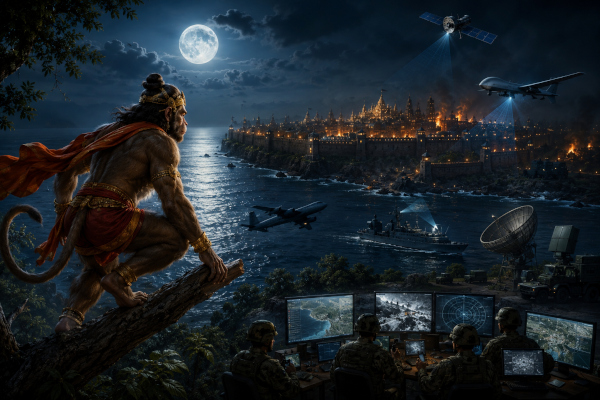
One of the major war tactic in the Ramayana is long-range reconnaissance. Before Rama’s army marches to Lanka, before the bridge is built, before the siege begins and before Ravana is confronted in open battle, one warrior crosses the sea and enters enemy territory alone. Hanuman’s mission to Lanka is not merely an act of devotion or courage. It is a complete deep-intelligence operation: insertion across a major natural barrier, covert entry into a hostile capital, target confirmation, surveillance of enemy leadership, assessment of fortifications, psychological probing, controlled destruction and safe return with actionable intelligence.
In modern defence language, Hanuman performs the work of a deep reconnaissance asset, special operations scout, human intelligence collector and psychological warfare operator. Rama does not invade Lanka blindly. He first needs certainty. Where is Sita? Is she alive? Where is she being held? What does Lanka look like? How strong are its defences? How does Ravana’s court behave under pressure? Can the island fortress be penetrated? Hanuman’s mission answers these questions before the main campaign begins.
That is the timeless military principle: no serious war can be fought blind. Armies may possess courage, weapons and manpower, but without reconnaissance they are moving in darkness. The Ramayana understands this deeply. Rama’s grief becomes strategy only after Hanuman converts uncertainty into verified knowledge.
Hanuman’s mission begins with distance. Lanka is not a neighbouring camp or a nearby forest outpost. It lies across the ocean. The sea gives Ravana natural protection, strategic depth and psychological confidence. In modern terms, Lanka has an anti-access barrier. A land army cannot simply walk to the enemy capital. Before the Vanara army can even think of invasion, one operative must cross the sea, enter the enemy’s heartland and return alive.
This is what makes Hanuman’s leap militarily significant. He is not just crossing water; he is crossing the unknown. Once he reaches Lanka, he has no nearby base, no extraction force, no immediate reinforcement and no second line of support. His survival depends on stealth, judgement, memory, strength and discipline. This is the essential character of long-range reconnaissance: the operative must go far ahead of the main force, gather truth and come back with clarity.
The same principle sits at the heart of modern warfare. Today, countries invest heavily in satellites, drones, maritime patrol aircraft, electronic intelligence, battlefield radars, surveillance networks and special forces because the first advantage in war is often the advantage of seeing. The side that sees first can prepare first, decide first and, if necessary, strike first. India’s own defence modernisation reflects this lesson. The country is steadily building a layered reconnaissance and surveillance ecosystem across land, sea, air and space — not as a luxury, but as a national security necessity.
India’s modern idea of offensive defence became clearly visible after the 2019 Pulwama terror attack, when New Delhi chose not to remain trapped in a purely reactive security posture. After gathering intelligence on Jaish-e-Mohammed infrastructure, India carried out what the Ministry of External Affairs described as a “non-military pre-emptive action” against the JeM training camp at Balakot on February 26, 2019. The significance of Balakot was not only the physical targeting of terror infrastructure, but the strategic message behind it: India would no longer allow terrorist groups and their handlers to assume that geography, borders or deniability could provide permanent sanctuary. This is offensive defence in practice — first build intelligence, identify the threat, choose a calibrated target, strike with precision and keep the action limited to terrorist infrastructure rather than widening the conflict unnecessarily. Like Hanuman’s Lanka mission, it began with reconnaissance and intelligence, moved into enemy-held space, targeted the source of danger, created psychological pressure and returned the initiative to the defender. The lesson is clear: a nation that can see deep can also deter deep.
Hanuman’s first act after entering Lanka is restraint. He does not storm the city gates in a display of strength. He reduces his form, moves quietly and studies the city. This is the mark of a disciplined reconnaissance mind. A lesser warrior might have wanted immediate combat. Hanuman knows the mission is not to prove bravery; the mission is to gather information. Until Sita is located and the enemy environment is understood, combat would be a distraction.
This is a lesson modern militaries also recognise. Reconnaissance is not the same as attack. The scout must resist the temptation to become a raider too early. His first weapon is not force, but observation. Hanuman moves through Lanka as a silent sensor. He studies the city, the palaces, the guarded spaces, the roads, the atmosphere of wealth and power, and the layout of Ravana’s capital. A city is not only a place; in war, it is a map of vulnerabilities and strengths.
When Hanuman reaches the Ashoka grove, his intelligence mission becomes even more precise. The Valmiki Ramayana describes him entering the garden and searching carefully for Sita, reasoning that if she were alive, she might come to such a place. He eventually observes her from concealment, confirming her presence and condition. This is surveillance from a hidden position, not a rushed emotional encounter.
This moment is extremely important. Hanuman does not immediately reveal himself. He observes Sita’s state, the Rakshasis guarding her, the pressure placed upon her, and Ravana’s behaviour toward her. He verifies not only location, but also morale, urgency and threat. In modern intelligence terms, he is not just confirming a target; he is assessing the human condition around the target.
India’s modern reconnaissance capabilities also aim at this layered understanding of the battlefield. Space-based Earth observation allows wide-area monitoring; aircraft provide theatre-level surveillance; drones provide persistent local observation; maritime reconnaissance aircraft track activity across the ocean; and electronic systems help build a real-time operational picture. ISRO states that India has one of the largest constellations of remote sensing satellites in operation, with instruments serving varied spatial, spectral and temporal needs.
This matters because India’s geography is demanding. It has high mountains, long land borders, deserts, dense forests, a vast coastline, island territories and a huge Indian Ocean responsibility. A country with such geography cannot depend on one type of reconnaissance. It needs a layered system — eyes in space, eyes in the sky, eyes at sea, eyes on the border and eyes in the electromagnetic spectrum.
Hanuman’s mission gives Rama exactly this kind of layered insight in epic form. He confirms Sita’s location, studies Lanka’s structure, observes Ravana’s court and later reports what he has seen. In Yuddha Kanda, Rama specifically asks Hanuman to describe Lanka in detail, including its fortifications and armed forces. Hanuman’s reconnaissance is therefore not treated as a heroic anecdote; it becomes the basis for military planning.
Modern India is trying to build the same discipline at national scale: collect information, process it, share it with commanders and convert it into decision advantage. The Indian Navy’s P-8I aircraft is a strong example. The Ministry of Defence describes the P-8I as designed for long-range maritime reconnaissance, anti-submarine warfare, anti-surface warfare and ISR missions, calling it the “eyes of the Indian Navy” across the vast Indian Ocean Region.
That phrase is important. In the ocean, the enemy is often invisible. Submarines hide below the surface. Ships disperse over enormous distances. Suspicious vessels can blend into commercial traffic. Maritime threats do not always announce themselves. A navy that cannot see cannot control the sea. The P-8I gives India a long-range surveillance and response capability in the Indian Ocean, just as Hanuman gave Rama the first true picture of Lanka beyond the sea.
The parallel is not literal, but strategic. Hanuman crossed the sea because Lanka was beyond ordinary sight. India uses maritime patrol aircraft, coastal surveillance, satellites and naval networks because the Indian Ocean is too vast to monitor by ships alone. The principle is the same: distance must be defeated by reconnaissance before it can be defeated by force.
India’s space-based reconnaissance and remote sensing capabilities also reflect this requirement. Optical satellites such as the Cartosat series provide high-resolution imagery, while radar imaging satellites provide the ability to observe under conditions where ordinary optical imaging may be limited. ISRO describes Cartosat-3 as a third-generation agile advanced satellite with high-resolution imaging capability. It also describes EOS-04 as a radar imaging satellite designed to provide high-quality images under all weather conditions. RISAT-1, carrying a C-band Synthetic Aperture Radar payload, was designed to image surface features during both day and night under all-weather conditions.
This is the modern version of seeing through darkness, cloud, distance and deception. A battlefield is rarely presented in clear daylight. Weather, terrain, camouflage, movement and enemy deception all try to hide reality. Radar imaging, high-resolution satellites and persistent surveillance platforms help reduce that uncertainty. The purpose is not merely to collect pictures; it is to give commanders confidence.
Hanuman’s interaction with Sita also shows another part of intelligence work: authentication. He does not merely say he has come from Rama. He gives Sita Rama’s ring as proof. In hostile territory, where deception is possible, trust must be established through a recognised signal. Sita then gives him a token and message for Rama. The intelligence cycle is complete: Hanuman goes with proof, confirms the target, receives confirmation in return and comes back with verified information.
Modern intelligence systems also depend on authentication, verification and cross-checking. A single unverified input can mislead a commander. Good reconnaissance must confirm, validate and report clearly. In an age of drones, satellites, cyber deception, misinformation and deepfakes, verification is more important than ever. The Ramayana captures this in symbolic form through the exchange of tokens.
After locating Sita, Hanuman does not simply return. This is where his mission becomes even more sophisticated. He chooses to test the enemy. He destroys the Ashoka grove and forces the Rakshasa command structure to respond. This is not random destruction. It is controlled provocation. Hanuman wants to understand how Lanka reacts under pressure — who is sent, how strong the defenders are, how quickly command escalates, and how Ravana behaves when challenged.
In modern military language, this resembles reconnaissance by combat. Sometimes an enemy reveals more through reaction than through passive observation. A probing attack can expose response times, command hierarchy, weapons, morale and tactical habits. Hanuman’s destruction of the grove, his battles with Rakshasa warriors and his appearance in Ravana’s court reveal the psychology and structure of the enemy.
India’s contemporary defence posture also recognises that reconnaissance is not passive watching alone. Surveillance must be tied to command systems, decision-making and response. This is why India is building automated and networked systems that shorten the gap between detection and action. Akashteer, India’s indigenous automated Air Defence Control and Reporting System, was highlighted by the Government as a real-time system that contributed to neutralising inbound threats during the May 2025 crisis.
The lesson here is not only about seeing, but about seeing fast enough to act. In modern warfare, drones, missiles, rockets and aircraft compress reaction time. A commander may have minutes or seconds to respond. Reconnaissance, surveillance, command and control must therefore become one chain. Hanuman’s mission is ancient, but its logic is modern: information is useful only when it reaches the decision-maker in time.
India’s acquisition of 31 MQ-9B SkyGuardian and SeaGuardian high-altitude, long-endurance remotely piloted aircraft also fits this larger picture. The Ministry of Defence recorded the contract in 2024 as a tri-service procurement, with an additional logistics arrangement for depot-level maintenance, repair and overhaul in India. A Government of India release noted that the MQ-9B aircraft would enhance the intelligence, surveillance and reconnaissance capabilities of India’s armed forces across all domains.
This is capability-building with strategic patience. India is not only buying platforms; it is also trying to build maintenance, industrial support and operational familiarity at home. That matters because reconnaissance cannot remain dependent on imported hardware alone. A country must learn to operate, maintain, upgrade and eventually design more of its own systems. The goal is not dependence, but absorption of capability.
At the same time, India has been developing indigenous systems. DRDO has described TAPAS BH as its solution for tri-service Intelligence, Surveillance, Target Acquisition, Tracking and Reconnaissance requirements. Earlier official descriptions of TAPAS noted ISR roles for the three armed forces, with payload possibilities including electro-optic sensors, synthetic aperture radar, electronic intelligence, communication intelligence and situational awareness payloads.
This is important because indigenous reconnaissance platforms are not built in one leap. They require sensors, airframes, engines, data links, endurance, payload integration, ground control systems, training and doctrine. India’s journey is therefore incremental. It is building capability brick by brick — satellites, UAVs, maritime patrol aircraft, battlefield surveillance systems, electronic sensors, command networks and a domestic drone ecosystem.
The broader drone ecosystem is especially relevant. A 2026 PIB note recorded that India had built a regulated drone ecosystem with more than 38,500 registered drones, nearly 39,900 DGCA-certified remote pilots and 244 approved training organisations as of February 2026. The same note listed uses ranging from surveys and infrastructure inspection to disaster management, railway and highway monitoring and defence applications.
This civilian-defence overlap matters. Modern military capability often grows from a national technology base. A country that trains drone pilots, builds drone software, develops sensors, certifies platforms and creates manufacturing supply chains is also preparing the foundation for future defence applications. The battlefield of the future will not be served only by large imported systems. It will need swarms, tactical drones, loitering sensors, rugged communications, AI-assisted analysis and local manufacturing capacity.
Hanuman’s mission also shows the value of human judgement over mere observation. Seeing Lanka is one thing; interpreting Lanka is another. Hanuman understands what he sees. He knows when to remain hidden, when to speak, when to reassure Sita, when to provoke Ravana, when to fight and when to return. Intelligence is not just collection; it is interpretation.
This is equally true for modern India. Satellites may collect images, drones may stream video, aircraft may detect movement and radars may track objects, but human command must still interpret intent. Is a movement routine or hostile? Is a ship innocent or suspicious? Is a drone probing defences or conducting an attack? Is a radar emission accidental or part of a larger pattern? Reconnaissance becomes powerful only when fused with analysis.
Hanuman’s burning of Lanka is often remembered as an act of fury, but it is also psychological warfare. Ravana’s capital believed itself secure. Hanuman shatters that confidence. One operative enters, finds Sita, survives capture, stands in court and turns punishment into counterattack. Lanka learns before the war begins that its security can be penetrated. Rama’s side learns that the enemy is powerful, but not invincible.
Modern reconnaissance too has psychological effect. When a country can monitor its borders, track maritime movement, detect aerial threats and observe remote areas, it strengthens deterrence. The enemy knows it may be seen. The side with better surveillance can impose caution on the adversary. Visibility itself becomes a weapon.
This is why India’s modern capability-building is so important. The country faces a two-front continental challenge, a vast maritime zone, cross-border terrorism, drone threats, grey-zone operations, cyber-enabled targeting and the growing use of unmanned systems. Against such threats, old-style reaction is not enough. India must see early, fuse intelligence quickly and respond proportionately.
Operation Sindoor was presented officially as a calibrated military response to asymmetric warfare, with India striking terrorist infrastructure without crossing the Line of Control or international boundary. Later official remarks described it as reflecting modern technology, accurate intelligence and smart strategies. Whatever the operational specifics, the larger message is clear: modern military response depends on intelligence precision. Blind retaliation is not strategy. Calibrated action requires verified targets, surveillance, timing, political clarity and technological confidence.
This brings us back to Hanuman. His mission does not end with destruction. It ends with return and reporting. Reconnaissance that does not reach command cannot shape war. Hanuman returns to Rama and gives him truth: Sita is alive, Lanka is fortified, Ravana is arrogant, the city can be penetrated, the enemy can be provoked, and the campaign is possible. That report transforms Rama’s emotional suffering into operational certainty.
India’s modern reconnaissance architecture seeks the same transformation at national scale: to convert uncertainty into knowledge, knowledge into preparedness, and preparedness into deterrence. Whether through satellites, P-8I maritime aircraft, MQ-9B long-endurance drones, indigenous UAV programmes, coastal sensors, air-defence networks or tactical drones, the direction is clear. India is building the ability to observe widely, decide quickly and act with precision.
The deeper lesson is humility. Hanuman, despite his immense strength, does not begin by showing strength. He begins by observing. Rama, despite being the greatest warrior of his side, asks for a detailed description of Lanka before moving into war. This is strategic humility. It accepts that courage is not enough. One must know before one acts.
Modern India’s defence growth follows the same mature logic. It is not enough to say India is brave, large or civilisationally confident. A rising power must build the systems that turn confidence into capability. It must learn from partners where necessary, develop indigenous systems where possible, absorb technology, build industry, train operators and connect sensors to commanders. This is not weakness. It is the practical wisdom of a serious state.
In the first article of this series, Rama’s alliance with Sugriva showed that wars are not won alone. In this second article, Hanuman’s mission shows that wars are not won blind. Before the bridge, before the siege and before the final duel, one reconnaissance mission changes the entire war.
That is why Hanuman’s leap to Lanka remains one of the greatest intelligence operations in epic literature. It is not only a story of devotion. It is a story of surveillance, stealth, verification, psychological pressure and actionable reporting. It teaches that the first victory in war is often not the destruction of the enemy, but the destruction of uncertainty.
And that lesson remains alive in modern India’s defence journey. A nation that can see farther, understand faster and respond smarter is a nation that does not merely react to threats — it shapes the battlefield before the battle begins.
You may also like
-
Kokasa Launches to Build Indigenous Mission-Critical Systems for Su-30MKI, MiG-29 and T-72
-
Flying Wedge Defence Partners With Portugal’s Keydef to Manufacture Kaal Bhairava and YAMA Drones in Europe
-
ASEAN Diplomats Visit BrahMos Facility as India Showcases Defence Engineering Capabilities
-
India and UAE Agree to Expand Army Cooperation and Desert Cyclone Participation
-
ARKin Labs Showcases Indigenous UAV Avionics for Defence, Agriculture and Enterprise Drones
