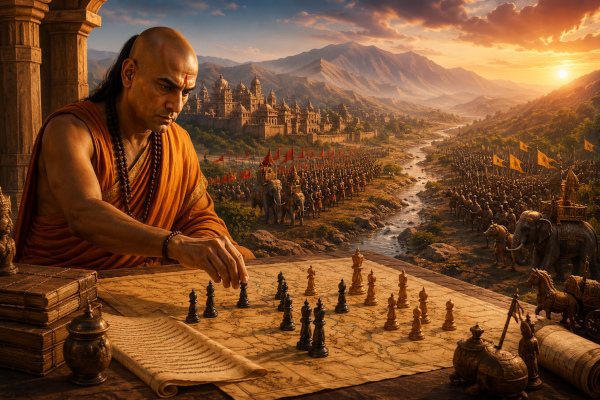
Long before modern universities gave the world the vocabulary of “game theory,” ancient India had already produced one of history’s most sophisticated manuals on strategic decision-making. In the Arthashastra, Kautilya did not describe politics as a world of emotions, slogans or moral posturing. He treated statecraft as a disciplined science of choices, incentives, power, timing, alliances, deception, deterrence and survival.
That is why the modern comparison between Kautilya and Nash is so fascinating. John Nash’s contribution to game theory was mathematical and formal. A Nash equilibrium describes a situation where no player can improve their outcome by changing strategy alone, assuming the other players keep their strategies unchanged. Stanford’s philosophy entry explains Nash equilibrium as a set of strategies where each player has no incentive to change given what the others are doing.
Kautilya was not writing modern mathematics. He did not produce a fixed-point theorem or a formal model like twentieth-century economists. But what he did produce was something extraordinarily advanced for the ancient world: a practical science of strategic interdependence. He understood that a ruler’s best move cannot be decided in isolation. It depends on the enemy’s strength, the ally’s reliability, the neighbour’s ambition, the treasury’s condition, the army’s morale, geography, timing, internal stability and the likely reactions of every player in the political field.
The Arthashastra is traditionally associated with Kautilya, also known as Chanakya, who is linked with Chandragupta Maurya and the rise of the Mauryan Empire. Britannica describes the Artha-shastra as a major Indian manual on politics attributed to Kautilya, while also noting that although the whole text may not date to the earliest period, several parts are traced back to the Mauryan age. This makes the text not merely a political manual, but a civilisational archive of Indian strategic thinking.
The brilliance of Kautilya lies in the fact that he saw power as dynamic. A king was not simply “strong” or “weak” forever. His condition could improve, stagnate or deteriorate. A rival who looked dangerous today could become vulnerable tomorrow. A friend could become unreliable. A neutral power could tilt the balance. A smaller state could survive by sheltering under a stronger one. A wise ruler, therefore, had to calculate constantly.
This is where Kautilya’s six-fold policy, or Shadgunya, becomes central. The Arthashastra lays out six strategic options: peace, war, neutrality, marching or preparation, seeking protection, and dual policy — making peace with one power while waging war against another. The translated text of Book VII explains these six forms directly: peace through agreement, war through offensive action, neutrality through indifference, marching through preparation, alliance through seeking protection, and dual policy through peace with one side and war with another.
This is remarkably close to the logic of strategic games. Kautilya is not saying that peace is always good or war is always bad. He is saying that the correct move depends on relative advantage. If peace gives better gains, choose peace. If war gives better results, prepare for war. If waiting improves one’s position, stay quiet. If alliance improves survival, seek shelter. If fighting one enemy while making peace with another increases advantage, use dual policy.
That is not moral confusion. It is strategic clarity.
Modern game theory asks: what will the other player do if I act? Kautilya asked the same question in the language of kings, armies and mandalas. The ruler had to think not only of his own intention, but of the enemy’s likely response. If he attacks, will another enemy strike from the rear? If he makes peace, will the enemy use the time to strengthen himself? If he allies with one king, will another coalition form against him? If he remains neutral, will he gain time or lose initiative?
This is the Indian strategic mind at work: not impulsive, not romantic, not naïve, but deeply aware of consequences.
The Rajamandala theory, or circle of states, further shows Kautilya’s understanding of geopolitics as a system. A state does not exist alone. It exists inside a circle of neighbours, rivals, allies, middle powers and neutral powers. Modern scholars have often described Kautilya’s mandala framework as a theory of interstate relations, and IDSA notes that Kautilya is widely known for the Raja Mandala theory, which deals with a state’s relations with other states.
In simple terms, Kautilya understood geography as destiny, but not as helpless destiny. Your neighbour may become a rival because proximity creates friction. Your neighbour’s neighbour may become a useful partner because he too has an interest in limiting your immediate rival. A distant power may become a balancing force. A middle power may become dangerous if ignored. This is the logic behind balance of power, coalition-building and strategic hedging — ideas that modern diplomacy still uses every day.
The real genius of the Arthashastra is that it combines realism with state capacity. Kautilya does not treat foreign policy as separate from internal strength. A ruler cannot play the great game outside if his own house is weak. Treasury, forts, army, ministers, people, territory, intelligence and discipline all matter. A poor state cannot sustain war. A corrupt administration cannot maintain loyalty. A weak intelligence system cannot see threats early. A ruler without internal order cannot command external respect.
That is why Kautilya’s statecraft is deeper than mere cunning. Popular culture often reduces Chanakya to clever tricks, revenge and political manipulation. The actual Arthashastra is much larger. It is about administration, taxation, law, trade, defence, diplomacy, espionage, agriculture, public order and national security. It recognises that strategy begins not at the battlefield, but in the treasury, the village, the granary, the fort, the council chamber and the intelligence network.
This is also where the comparison with Nash becomes meaningful, but only if we make it carefully. Nash formalised equilibrium in mathematical terms in the twentieth century. Britannica notes that game theory was further developed in the 1950s by John Nash, who established mathematical principles for analysing rivalries among competitors with mixed interests. Kautilya did something different: he created a practical strategic framework for rulers operating in a dangerous world.
So, Kautilya did not “invent Nash equilibrium” in the modern technical sense. But he did anticipate one of game theory’s most important insights: your best move depends on what others are likely to do. This is the core of strategic thinking. In that sense, ancient India had already developed a powerful political science of interactive decision-making long before the modern West gave it a mathematical name.
The Arthashastra also shows that Indian civilisation was not only spiritual and philosophical, but also analytical, administrative and strategic. India gave the world the Upanishads, Yoga, Ayurveda, grammar, mathematics and temple architecture. But it also gave the world Kautilya — a thinker who studied power without sentimentality and governance without illusion.
This is important for the modern Indian mind. For too long, ancient Indian knowledge has been presented in fragments: either as mythology, spirituality or ritual. The Arthashastra reminds us that India also had a hard-headed tradition of political realism. It understood deterrence. It understood intelligence. It understood economic strength. It understood alliances. It understood information warfare. It understood that peace must be backed by power, and power must be guided by intellect.
In the twenty-first century, Kautilya feels surprisingly modern. Nations today do not operate in a simple world of friends and enemies. They operate in overlapping networks: trade partners can be strategic competitors, military rivals can be economic partners, technology suppliers can become security risks, and small states can become decisive in larger geopolitical contests. This is exactly the kind of complexity Kautilya would have recognised.
Modern India’s diplomacy also often reflects this layered approach. India works with the United States, Russia, Europe, Japan, ASEAN, West Asia and the Global South without reducing its foreign policy to a single camp. It builds partnerships, protects autonomy, expands economic strength, invests in defence capacity and speaks the language of strategic balance. That is not accidental. It comes naturally to a civilisation that has long understood the art of managing multiple centres of power.
The positive lesson from Kautilya is not that India should become cynical. It is that India should be clear-eyed. A nation must value peace, but never confuse peace with weakness. It must build friendships, but never outsource its security. It must pursue prosperity, but never ignore the power structures that protect prosperity. It must speak of dharma, but also understand artha — because without material strength, even noble intentions become fragile.
Kautilya’s Arthashastra therefore deserves to be read not as a museum text, but as a living strategic classic. It teaches that national power is built patiently, protected intelligently and used carefully. It teaches that the ruler must think several moves ahead. It teaches that sentiment without calculation is dangerous, but calculation without purpose is empty.
The world may remember Nash for giving modern game theory its mathematical elegance. But India can rightly remember Kautilya for giving statecraft its ancient strategic depth. More than two thousand years ago, he saw politics as a field of interacting players, shifting incentives and calculated moves. That is why the Arthashastra still speaks to diplomats, soldiers, economists, administrators and strategists today.
Kautilya’s message remains sharp: the wise do not merely react to the game. They understand the board, study every player, calculate every move, and shape the outcome before others even realise the game has changed.
You may also like
-
The Serpent and the Meaning of Violence: When Grief Turned Ruru Against Every Snake
-
Kuntala in the Mahabharata: The Ancient Country of Northern Karnataka and Southern Maharashtra
-
The Hawk and the Smaller Birds: Bhishma’s Lesson on Surviving Greater Powers
-
Ashmaka or Assaka in the Mahabharata: The Ancient Kingdom of the Godavari Valley
-
Rare Stone Features Emerge as Kerala Archaeology Department Restores Megalithic Kudakkals at Karivellur
