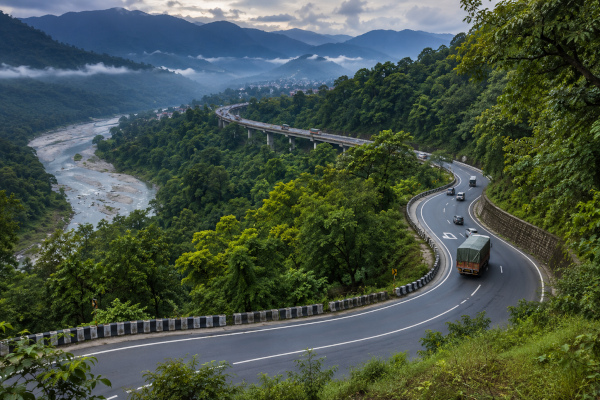
India’s sensitive Siliguri Corridor, popularly known as the Chicken’s Neck, is set to receive a major infrastructure push after the West Bengal government gave in-principle approval to hand over seven national highway stretches to central agencies. The decision clears the way for the National Highways Authority of India and the National Highways and Infrastructure Development Corporation Ltd to take charge of key road corridors that are important for North Bengal, Sikkim, Bhutan, Bangladesh and the wider Northeast connectivity grid.
The development is not just another road-administration decision. The Chicken’s Neck is one of India’s most strategically important land corridors because it links the Indian mainland with the northeastern states. Any improvement in this region has implications for civilian transport, border-area development, trade movement, tourism, disaster response and military logistics. Better roads through North Bengal can reduce bottlenecks, improve movement to border districts and strengthen the physical backbone connecting eastern India with the Himalayas and the Northeast.
The seven stretches were earlier under the national highway wing of the West Bengal Public Works Department. According to the press note cited by PTI, the handover proposals had remained pending for nearly a year despite repeated requests from the Union Ministry of Road Transport and Highways. The state’s latest approval now allows central agencies to begin development work without the earlier administrative blockage.
Among the corridors handed over to NHAI are 329.6 km of NH-312, connecting Jangipur, Omarpur, Krishnagar, Bongaon and Basirhat up to Ghojadanga on the India-Bangladesh border. The transfer also includes NH-31 from the Bihar-West Bengal border to Gazole and NH-33 up to Farakka. These stretches matter because they strengthen east-west and north-south movement through districts such as Malda, Murshidabad, Nadia and North 24 Parganas.
Four other strategically placed corridors have been handed over to NHIDCL. These include the Sevoke Army Cantonment-Coronation Bridge-Kalimpong-Sikkim border route under New NH-10, the Hasimara-Jaigaon stretch up to the India-Bhutan border, the Baradighi-Mainaguri-Changrabandha route up to the Bangladesh border, and the Siliguri-Kurseong-Darjeeling hill road. Together, these routes form a critical connectivity web across the Darjeeling hills, the Dooars, the Sikkim approach, Bhutan-facing areas and Bangladesh-linked border corridors.
The involvement of central agencies is significant. NHAI is responsible for development, maintenance and management of national highways entrusted to it by the Central Government, while NHIDCL, under the Ministry of Road Transport and Highways, is tasked with building, maintaining and upgrading national highways and strategic roads. NHIDCL’s role is especially relevant in difficult terrain and border-linked infrastructure, making it a natural fit for North Bengal’s hill and frontier routes.
For the Siliguri Corridor, the strategic logic is clear. The region’s geography is narrow, crowded and sensitive. It sits close to Nepal, Bhutan, Bangladesh and the China-facing Himalayan frontier. This means roads here cannot be judged only by passenger traffic or tourism demand. They are part of a national security architecture where road quality, bridge strength, all-weather access, rapid repair capacity and alternative route availability all matter.
The Sevoke-Kalimpong-Sikkim axis is especially important because it supports movement toward Sikkim and the eastern Himalayan frontier. The Hasimara-Jaigaon route links directly toward Bhutan, while the Changrabandha and Ghojadanga corridors connect with Bangladesh-facing trade and border movement. The Siliguri-Kurseong-Darjeeling hill road also supports the hill economy, tourism and administrative access to one of India’s most sensitive mountain regions.
The handover is also important for economic development. North Bengal has long needed stronger road infrastructure to connect its tea gardens, tourism circuits, border trade points, agricultural markets and hill towns. Faster project execution could help reduce transport delays, improve goods movement and open up better access for local businesses. For districts such as Darjeeling, Kalimpong, Jalpaiguri, Alipurduar, Malda, Murshidabad, Nadia and North 24 Parganas, the impact could go beyond highways and touch trade, logistics, tourism and emergency services.
This move also reflects a larger trend in Indian infrastructure planning. Border roads are no longer treated as remote regional works. They are now seen as strategic national assets. Roads near the Siliguri Corridor must support everyday civilian mobility, but they must also be resilient enough for crisis conditions. That makes central coordination, quicker tendering, engineering expertise and long-term maintenance especially important.
The West Bengal approval therefore marks a practical strengthening of India’s eastern connectivity grid. It does not change geography, but it can reduce the weakness created by poor infrastructure within that geography. For a corridor as sensitive as the Chicken’s Neck, that distinction matters. A narrow corridor cannot be widened by wishful thinking, but it can be made stronger, faster, better connected and harder to disrupt.
You may also like
-
India’s Exports Rise 13.16% to $316.42 Billion in April–July 2026-27, Merchandise Shipments Jump 17%
-
L&T Eyes Rare-Earth Magnet Manufacturing in India as Supply Chain Push Accelerates
-
India Moves Ahead With 60-Aircraft Medium Transport Programme as ₹1 Lakh Crore Tender Is Reported
-
India’s Financial Inclusion Index Rises to 70 as Banking and Digital Access Expand Nationwide
-
India Develops 75 Lighthouses as Tourism Destinations to Showcase Maritime Heritage
