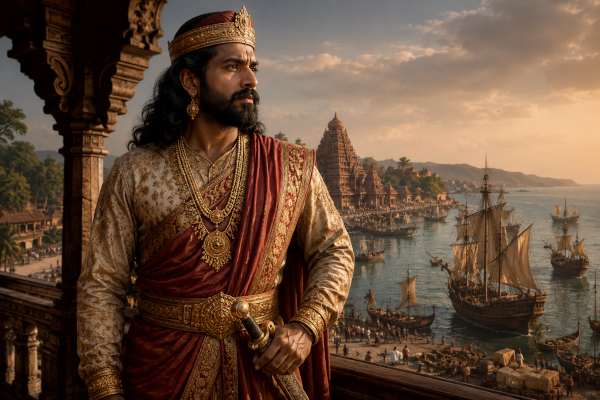
Sthanu Ravi Varma, also known in inscriptions as Ko Tanu Ravi or Sthanu Ravi Kulasekhara, stands at the beginning of Kerala’s clearly visible medieval political history. He was not merely a king sitting behind palace walls at Mahodayapuram; he appears in copper plates, temple records, trade charters and astronomical memory. His reign belongs to the 9th century CE, generally placed around 844/45 to 870/71 CE, though older historical traditions sometimes extend his period slightly later. He is especially important because he is among the earliest Chera Perumal rulers of Kerala known through firm inscriptional evidence rather than only legend or later literary memory.
Unlike many later Kerala rulers whose stories became wrapped in folklore, Sthanu Ravi comes to us through the hard evidence of metal and stone. That makes him historically valuable. His age was the age when Kerala was becoming a recognisable medieval society: ports were rising, merchant guilds were gaining power, temples were becoming centres of wealth and administration, and foreign traders from West Asia were deeply involved in the Malabar coast’s economy. The Chera Perumal kingdom had its capital at Mahodayapuram, usually identified with the Kodungallur region, a place connected with the old trading world of Muziris and the Periyar river system.
Very little is known with certainty about Sthanu Ravi’s birth, parents or childhood. This is important to say honestly because many royal biographies are later filled with decorative claims. The available evidence does not give us a clear birth story, palace genealogy or dramatic childhood episode. What can be said is that he belonged to the medieval Chera Perumal line of Kerala, a ruling house that claimed connection with the older Cheras of early historic South India. His royal title Kulasekhara suggests the prestigious coronation identity used by some Chera rulers, but historians are careful not to treat every later legend attached to the Kulasekhara name as direct biography.
His capital, Mahodayapuram, was a sacred and intellectual landscape. Around Kodungallur stood important temples, Brahmin settlements, royal institutions and port-linked communities. The Chera Perumal state was not a modern centralised empire with bureaucrats everywhere. It worked through layered authority: the king at Mahodayapuram, local chieftains in different regions, temple institutions, Brahmin settlements, merchant guilds and military households. This made Sthanu Ravi’s power different from the later image of an absolute king. He ruled through networks, permissions, ritual authority and alliances.
The most famous document of his reign is the Tharisapalli copper plate grant, also known as the Quilon Syrian Christian copper plates. This record is dated to the fifth regnal year of Sthanu Ravi, around 849–850 CE, and is one of the most important early medieval documents in Kerala history. It was issued at Kollam by Ayyan Adikal Thiruvadikal, the Venad chieftain under Chera authority, in favour of Mar Sapir Iso, a Christian merchant-leader connected with the establishment of a church and trading settlement at Kollam.
The Tharisapalli plates show the real genius of Sthanu Ravi’s age. Kerala was not isolated. It was plugged into the Indian Ocean. Kollam was not simply a coastal town; it was a commercial gateway where local rulers, Christian merchants, West Asian traders, artisan groups, agricultural workers, temple-linked authorities and merchant guilds all met. The grant mentions privileges, land, revenue arrangements, protected rights and the involvement of famous merchant bodies such as Anjuvannam and Manigramam. These guilds were crucial in connecting Kerala’s ports with wider Indian Ocean commerce.
What makes the plates extraordinary is the evidence of foreign signatures and scripts. The witness section includes names written in Arabic/Kufic, Middle Persian/Pahlavi and Judeo-Persian/Hebrew traditions. This is not a small detail. It proves that 9th-century Kerala was already a cosmopolitan maritime society where Christian, Muslim, Jewish and Persianate trading communities operated alongside local power structures. Sthanu Ravi’s Kerala was therefore not a remote corner of peninsular India. It was a western ocean-facing civilisation with its own diplomacy of commerce.
This is why Sthanu Ravi’s reign should be remembered as a period of political maturity. A weak ruler could collect tax from a port. A smarter ruler could turn a port into a protected commercial ecosystem. The Tharisapalli grant shows the second model. By allowing merchant communities legal privileges, religious space and commercial protection, the Chera political order helped make Kollam a trusted destination for long-distance trade. Such trust was essential in the Indian Ocean world, where merchants moved across seasons, monsoon winds, credit networks and cultural boundaries.
Sthanu Ravi’s temple world was equally important. Inscriptions connected with his reign are associated with places such as Kudalmanikyam Temple at Irinjalakuda and Thiruvalla. These records show that temples were also landholding, administrative and social institutions. In medieval Kerala, temples received gifts, supervised resources, employed people, stored wealth, mediated social order and helped define local authority. Sthanu Ravi’s reign belongs to the period when temple-centred society was becoming one of Kerala’s strongest structural features.
His court is also remembered for science, especially astronomy. The scholar Sankaranarayana, associated with his court, composed the Laghubhaskariya-vivarana, a commentary on Bhaskara I’s astronomical work. The text is dated to the 9th century and is linked with the court of a ruler named Ravi Kulasekhara. This connection has been important for historians in identifying Sthanu Ravi with the Kulasekhara ruler mentioned in the astronomical tradition.
The astronomy connection gives Sthanu Ravi a rare place among South Indian kings. Mahodayapuram was not merely a port and royal town; it appears to have housed organised astronomical activity. References to instruments and observations suggest that Kerala’s early medieval courtly world valued mathematical astronomy. This is centuries before the later Kerala school of mathematics became famous. Sthanu Ravi’s court therefore forms part of a longer intellectual arc in Kerala: from royal astronomy and Sanskritic scholarship to the later mathematical traditions that made the region globally significant.
There is also a military and diplomatic side to his career, though it must be handled carefully. Epigraphic traditions link Sthanu Ravi with the wider politics of the Tamil region and with Chola activity in Kongu country. Some historians interpret him as a Chera ally or junior partner in campaigns connected with the early Chola expansion. The exact details are debated, but the larger point is clear: his Kerala was not cut off from Chola-Pandya-Ganga-Kongu politics. It watched, negotiated and participated in the power struggles of southern India.
The question of his family is partly visible but still incomplete. Sources refer to a daughter named Kizhan Atikal Ravi Neeli and to Vijayaraga, a royal prince or important figure connected with the Chera court, who appears in relation to the Tharisapalli grant. But the full structure of Sthanu Ravi’s household, marriages and succession remains uncertain. His successor is generally identified as Rama Rajasekhara, another important Chera Perumal ruler.
There are also later attempts to connect Sthanu Ravi with devotional and literary traditions, especially the name Kulasekhara. Some traditions identify a Chera ruler named Kulasekhara with Kulasekhara Alvar, the Vaishnavite saint, or with a royal playwright. These identifications are attractive but debated. They show how powerful the memory of the Chera Perumals became, but they should not be treated as settled facts unless the context is clearly explained. The safest historical position is that Sthanu Ravi was a 9th-century Chera Perumal ruler with the title Kulasekhara, while later devotional associations remain matters of scholarly discussion.
His death is not clearly recorded. There is no reliable dramatic account of a battlefield death, assassination, renunciation or final illness. This absence itself tells us something about early medieval Kerala history. We do not possess court chronicles in the style of later royal biographies. We possess fragments: copper plates, temple inscriptions, astronomical references and later literary echoes. From these fragments, Sthanu Ravi appears less as a legend and more as a system-builder.
His real achievement was not one single monument or conquest. It was the shaping of a Kerala order where the port, temple, court and merchant guild all worked inside a common political framework. Under his shadow, Kollam became visible as a major commercial centre, Mahodayapuram stood as a royal-intellectual capital, temple society deepened, and foreign communities found legally recognised space within Kerala’s economy. That is a far more important legacy than a romantic battle story.
Sthanu Ravi Varma deserves to be remembered as one of the first great architects of medieval Kerala’s global personality. He ruled at a moment when Kerala was becoming what it would remain for centuries: a land of temples and trade winds, Sanskrit learning and Malayalam inscriptions, local chieftains and ocean merchants, sacred authority and practical commercial intelligence. His reign shows that Kerala’s strength did not come from territorial aggression alone. It came from knowing how to receive the world, regulate it, sanctify it, tax it, protect it and turn it into civilisation.
You may also like
-
Kishkindha — The Boulder Kingdom of Pampa, Rishyamukha and the Tungabhadra
-
Setu — The Sacred Southern Crossing Between Rameswaram and Lanka
-
One Voice – One Resolve – One India: Namami Bharatam Marks 150 Years of Vande Mataram Across the Nation
-
Dravida — The Ancient Tamil Country of Rivers, Temples and the Southern Ocean
-
Pandya — The Southern Kingdom of the Vaigai, Tamiraparani and the Pearl-Rich Sea
