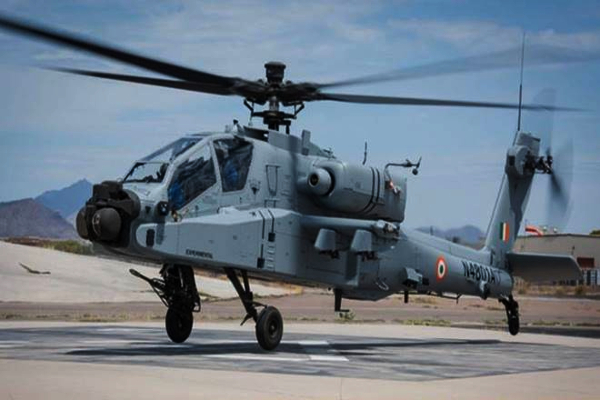
The United States has approved two proposed Foreign Military Sales to India worth an estimated USD 428.2 million, covering long-term support for the Indian military’s AH-64E Apache attack helicopters and M777A2 ultra-light howitzers. The approvals mark another step in the growing defence sustainment relationship between New Delhi and Washington, but they should be understood correctly: this is not a fresh acquisition of new platforms, but a package meant to keep existing high-value systems operational, upgraded, serviceable and combat-ready.
The first package covers follow-on support for India’s Apache helicopter fleet at an estimated cost of USD 198.2 million. According to the U.S. State Department, India has requested AH-64E Apache sustainment support services, along with U.S. government and contractor engineering, technical and logistics support, technical data, publications, personnel training and other programme support elements.
The second package is for the M777A2 Ultra-Light Howitzers, with an estimated value of USD 230 million. This support package includes long-term sustainment assistance, spares, repair-and-return services, training, technical assistance, field service representatives, depot capability and related logistics support. The official State Department notification identifies BAE Systems, Cumbria, UK, as the principal contractor for the M777A2 support package.
The approvals come through the U.S. Foreign Military Sales system, a government-to-government framework used for transferring defence articles, services and training to partner countries. The Defense Security Cooperation Agency explains that FMS is administered by the U.S. government and includes defence services, training, support and long-term programme management, not merely the transfer of hardware.
For India, the significance lies in battlefield availability. Advanced platforms such as Apache helicopters and M777 howitzers are only as useful as their maintenance chain. Engines, avionics, fire-control systems, mission computers, radar, sensors, technical manuals, spares, software support, depot-level repair and trained personnel together determine whether a platform remains ready for combat or spends time waiting for parts. The new support packages are therefore aimed at operational readiness rather than symbolic procurement.
The Apache is one of the most capable attack helicopters in Indian service. India inducted the AH-64E into the Indian Air Force in 2019, with the Ministry of Defence noting its Hellfire missiles, Hydra rockets, Stinger air-to-air missiles, 30 mm chain gun, fire-control radar, 360-degree coverage and advanced night-vision target acquisition systems. The PIB release at the time described the helicopter as an important step in modernising India’s combat aviation capability.
The M777A2 occupies a different but equally important role. It is a 155 mm ultra-light howitzer suited for rapid deployment in difficult terrain, especially mountains. India’s Ministry of Defence had earlier described the system as versatile, lightweight and heli-liftable, giving the Army flexibility across varied terrain. The guns were procured from the United States through the government-to-government FMS route and assembled in India by BAE Systems in partnership with Mahindra Defence.
The U.S. Army had earlier stated that the 2016 Letter of Offer and Acceptance covered 145 M777A2 howitzers for India, along with associated engineering support. It also highlighted the howitzer’s light weight and suitability for hilly terrain such as the Himalayas, which explains why the system is strategically important for India’s northern and eastern sectors.
The latest approvals therefore fit into a larger pattern: India is not merely buying weapons; it is building a long-term support ecosystem for imported high-end platforms while simultaneously expanding indigenous alternatives. The Apaches complement India’s attack helicopter capability, including the indigenous Prachand class, while the M777s form part of the Army’s artillery modernisation alongside domestic gun systems.
Strategically, the sustainment approvals also underline the maturing nature of India-U.S. defence ties. Earlier defence cooperation was often measured by big-ticket purchases. The new phase is increasingly about availability, interoperability, training, software, spares, repair networks and lifecycle support. In modern warfare, this matters deeply. A weapon system’s real value is not only in its specifications, but in whether it can be kept functional during a crisis.
The U.S. side has described the proposed sales as supportive of its foreign policy and national security objectives, especially by strengthening the U.S.-India strategic relationship and improving the security of a major defence partner in the Indo-Pacific and South Asia region. That language makes clear that Washington sees these packages not as ordinary commercial transactions, but as part of a wider strategic defence partnership.
For India, the message is practical: the Army and Air Force need their imported systems to remain available during long periods of tension, high-altitude deployment and rapid mobilisation. The Apache and M777 are expensive, specialised platforms. Sustaining them properly is essential if India wants to extract full operational value from past acquisitions.
The proposed USD 428.2 million support package is therefore best understood as a readiness investment. It does not dramatically change the military balance by adding new platforms, but it strengthens India’s ability to keep existing combat assets in service, trained, supplied and mission-ready. In the world of modern defence planning, that can be as important as buying the weapon itself.
You may also like
-
India Advances Project-75(I) and Submarine Modernisation Plans to Strengthen Underwater Warfare Capability
-
Kokasa Launches to Build Indigenous Mission-Critical Systems for Su-30MKI, MiG-29 and T-72
-
Flying Wedge Defence Partners With Portugal’s Keydef to Manufacture Kaal Bhairava and YAMA Drones in Europe
-
ASEAN Diplomats Visit BrahMos Facility as India Showcases Defence Engineering Capabilities
-
India and UAE Agree to Expand Army Cooperation and Desert Cyclone Participation
