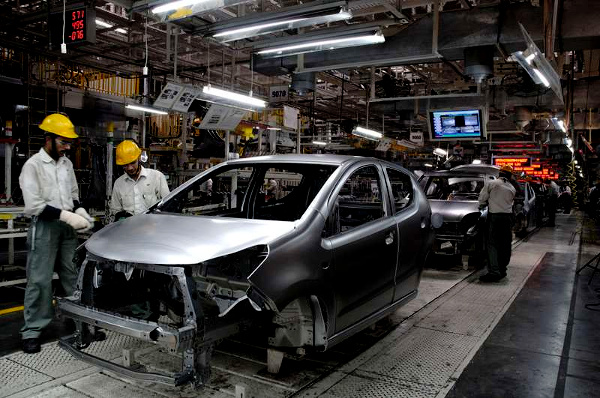
Maruti Suzuki India has started commercial production at the second plant of its Kharkhoda manufacturing facility in Haryana, adding another major block to India’s passenger vehicle production capacity. The new unit has an annual capacity of 2.5 lakh vehicles, taking the total capacity at the Kharkhoda site to 5 lakh vehicles per year. Across Gurugram, Manesar, Kharkhoda and Hansalpur, the company’s overall annual production capacity has now risen to 26.5 lakh vehicles.
The development is more than a routine capacity addition. Kharkhoda is emerging as one of Maruti Suzuki’s most important manufacturing bases and is expected to become one of Suzuki’s largest four-wheeler production locations globally once it reaches its planned capacity of 10 lakh vehicles per annum. The second plant also fits into the company’s earlier plan to add 5 lakh units of production capacity during FY 2026–27.
For India’s automobile sector, the expansion comes at an important time. Passenger vehicle demand is being shaped by rising incomes, better roads, growing urban and semi-urban mobility, stronger export opportunities and increasing consumer preference for SUVs and feature-rich vehicles. By scaling up at Kharkhoda, Maruti Suzuki is preparing not only for current market demand but also for the next phase of India’s automobile growth.
The Kharkhoda facility is already producing the Brezza compact SUV and the Victoris mid-SUV, showing how the plant is being aligned with segments where demand has been especially strong. This matters because India’s car market has moved beyond the old small-car-only image. Compact SUVs, premium hatchbacks, MPVs and mid-sized SUVs are now central to the business strategy of major manufacturers.
The second plant will also strengthen the wider industrial ecosystem around Haryana. Large automobile factories rarely operate in isolation; they create demand for component suppliers, logistics firms, warehousing, tooling, maintenance services, industrial training and local employment. As production rises at Kharkhoda, the surrounding supplier network is likely to gain from higher volumes and deeper integration with Maruti Suzuki’s manufacturing chain.
There is also an export angle to the expansion. Maruti Suzuki has been positioning India as a larger production base for both domestic and overseas markets. Higher capacity gives the company more flexibility to serve Indian buyers while also using India as a competitive export platform for select models. This aligns with the broader national push to make India a stronger global hub for automobile and auto-component manufacturing.
The Kharkhoda project also carries symbolic value because its foundation stone was laid by Prime Minister Narendra Modi in August 2022. Within a few years, the site has moved from a greenfield industrial project to a functioning manufacturing cluster with expanding capacity, reflecting the speed at which India’s large-scale industrial projects are now being pushed forward.
Maruti Suzuki’s latest capacity addition therefore represents a larger story about Indian manufacturing. It shows how the country’s auto industry is moving into a new phase where scale, automation, supply-chain depth, export ambition and product diversification are becoming equally important. The second Kharkhoda plant is not just another factory line; it is a sign that India’s automobile sector is preparing for a bigger role in both the domestic economy and global vehicle supply chains.
You may also like
-
India Advances Trade Diplomacy at G20 Ministerial in Milwaukee
-
Kokasa Launches to Build Indigenous Mission-Critical Systems for Su-30MKI, MiG-29 and T-72
-
Tata Projects and MDS Aero Partner to Build Advanced Aero-Engine Test Infrastructure in India
-
Flying Wedge Defence Partners With Portugal’s Keydef to Manufacture Kaal Bhairava and YAMA Drones in Europe
-
Armenia Conducts Live-Fire Exercise With Indo-French TRAJAN 155 mm Howitzers Manufactured in India
