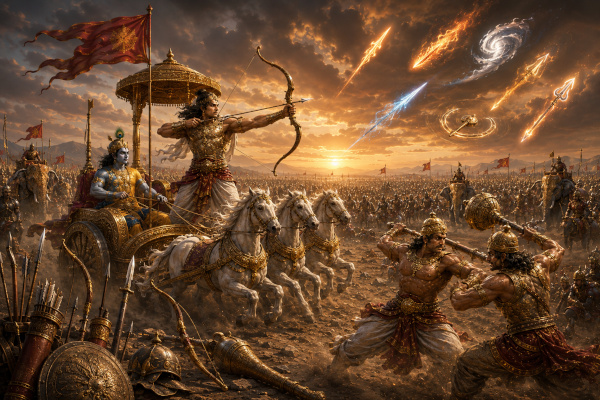
Kurukshetra was a battlefield of sound before it became a battlefield of steel. Conches announced intent, drums carried rhythm, bowstrings cracked through the dust, chariot wheels cut the earth, elephants shook the line, and warriors stood beneath their standards with weapons that reflected both training and temperament. The Mahabharata, centred on the great conflict between the Pandavas and Kauravas at Kurukshetra, gives us a layered picture of warfare: ordinary weapons, elite warrior platforms, close-combat systems, celestial astras, command discipline and the ethics of destructive force.
A careful defence reading of Mahabharata weapons should separate battlefield weapons from celestial astras. The first category includes bows, arrows, maces, swords, spears, lances, shields, chariots and armour. These belong to the ordinary military world of training, formation, logistics and combat skill. The second category includes astras such as Pashupata, Brahmashira and other mantra-invoked weapons described as extraordinary, highly restricted and linked with divine or spiritual authority. The mature modern comparison is therefore conceptual: ordinary weapons may be compared with conventional arms, while astras may be studied as literary and strategic symbols of escalation, deterrence, command authorisation and restraint.
1. Weapons of the Mahabharata: From Bows and Maces to Divine Astras
The Mahabharata’s battlefield world is built around the warrior and his weapon-system. A warrior did not fight as an isolated body. He fought with a bow, quivers, chariot, horses, driver, armour, banner, supporting troops and command role. This is why great warriors are often remembered with their weapons: Arjuna with Gandiva, Bhima with the gada, Karna with Vijaya, Krishna with the discus, Drona with celestial weapon knowledge, and Ashwatthama with dangerous astric power.
The ordinary weapons of the epic represent different combat functions. The bow gave reach, precision and speed. The mace gave crushing power in close combat. The sword served as a secondary weapon when distance collapsed. The spear or lance gave thrusting and anti-cavalry value. The chariot served as a mobile fighting platform. The elephant acted as a shock platform, while cavalry enabled movement, pursuit and screening. Together, these weapons formed the ancient equivalent of combined arms.
Modern comparison: this resembles the way today’s battlefield combines rifles, machine guns, tanks, artillery, drones, missiles, air defence, electronic warfare and logistics. Modern doctrine describes combat power as the result of integrating and synchronising multiple warfighting functions, rather than relying on one arm alone.
The celestial astras belong to another level of imagination. They are depicted as weapons that require knowledge, discipline and eligibility. When Shiva grants Arjuna the Pashupata weapon, he warns that it should be used only with adequate cause because its use against a lesser foe could bring vast destruction. This gives the epic an important defence principle: possession of a powerful weapon creates responsibility, and the warrior’s maturity is measured by restraint as much as capability.
2. The Bow as a Precision Weapon: Why Archery Dominated Ancient Indian Battlefields
Archery dominates the Mahabharata because it combines reach, speed, accuracy and psychological pressure. A great archer could engage from distance, cut down incoming arrows, attack charioteers, disable horses, strike armour gaps, break standards, disrupt formations and protect his own side from advancing warriors. In an age before gunpowder, the bow was the elite long-range precision weapon.
Arjuna’s archery is presented as a system of skill, timing and control. The epic repeatedly shows him cutting arrows in flight, targeting specific parts of enemy chariots and shaping the pace of battle through continuous fire. The Gandiva is therefore more than a famous bow; it represents the union of weapon quality, warrior training, chariot mobility, inexhaustible ammunition and Krishna’s battlefield guidance. In the Khandava episode, Varuna gives Arjuna the Gandiva, two inexhaustible quivers and a chariot equipped with celestial weapons and the ape-banner.
Modern comparison: the bow’s role can be linked with marksmanship, sniper logic, direct-fire precision and standoff engagement. A trained archer did what a modern precision shooter, anti-tank team or missile operator does conceptually: identify, aim, strike, relocate or continue fire under pressure. The weapon itself matters, yet the greater power lies in training, range estimation, target selection, calm nerves and integration with the wider battlefield.
This is why Arjuna’s greatness comes from discipline rather than raw firepower alone. Gandiva gives him reach; training gives him accuracy; Krishna gives him decision support; the chariot gives him mobility; quivers give him sustainment. In modern terms, Arjuna is not merely a shooter. He is a complete combat system.
3. The Gada: Close-Quarter Combat and the Bhima-Duryodhana Duel
The gada, or mace, represents another kind of warfare: close, physical, personal and unforgiving. If archery is distance and precision, gada-yuddha is power, balance, footwork, timing and endurance. The mace duel between Bhima and Duryodhana in the Shalya Parva is one of the epic’s most intense close-combat scenes. Krishna warns Yudhishthira that Duryodhana had spent thirteen years practising mace combat against an iron statue, showing the importance of preparation and specialised training.
The duel itself is described as a clash of terrible force, with both warriors striking each other’s maces and creating sparks and thunderous sound. This is a different battlefield rhythm from archery. The warrior must enter danger, read the opponent’s body, absorb shock, protect balance and strike when a small opening appears.
Modern comparison: the gada can be compared with close-quarter battle, infantry assault, bayonet fighting, riot-control baton training, martial arts, breaching operations and last-metre combat. Even in a high-technology age, soldiers still train for close contact because battlefields can compress suddenly. Urban warfare, trench fighting, bunker clearing and hand-to-hand encounters prove that physical courage and body discipline retain military value.
The Bhima-Duryodhana duel also raises the issue of rules of engagement. Gada-yuddha had an expected code, including limits on where strikes should fall. The breaking of that code gives the episode its moral weight. The modern parallel is direct: combat power must be governed by rules, discipline and command responsibility. International humanitarian law today regulates conduct through principles such as distinction, proportionality and precaution.
4. Astras in the Mahabharata: Strategic Weapons, Deterrence and Escalation Control
Astras are among the most powerful weapon concepts in the Mahabharata. They are not ordinary arrows with bigger effects; they represent knowledge, invocation, discipline and eligibility. Their use depends on the warrior’s training and mental state. This makes them different from conventional weapons in both literary and strategic meaning.
The Pashupata episode is especially important because the weapon is given with a warning. Arjuna is told that it can be used, held and withdrawn, but should be released only with adequate cause. This establishes a key idea: a supreme weapon must remain under supreme restraint.
Modern comparison: astras can be studied as conceptual ancestors of strategic weapons in the language of deterrence, escalation control and command authorisation. This does not mean ancient astras were modern missiles. It means the epic understands a military truth that remains alive today: some weapons create consequences beyond the immediate battlefield. Their possession can deter enemies, yet their use can transform the moral and political meaning of war.
Astra doctrine in the Mahabharata therefore contains three modern lessons. First, powerful weapons require trained operators. Second, command discipline matters as much as destructive capability. Third, restraint can be a form of strength. A weak warrior uses power to prove himself; a mature warrior holds power until necessity, legitimacy and proportionality align.
5. Brahmastra, Brahmashira and the Ethics of Ultimate Weapons
The Brahmastra and Brahmashira episodes are the Mahabharata’s deepest meditation on ultimate destructive force. In the Sauptika Parva, Krishna tells Yudhishthira that Drona had given Ashwatthama the Brahmashira weapon, while warning him against using it even in extreme danger, especially against human beings. The same passage describes the weapon as capable of consuming the whole world.
This is one of the clearest examples of escalation ethics in the epic. The weapon exists, the warrior knows it, the teacher issues a restriction, and the moral danger lies in the gap between capability and self-control. Ashwatthama’s later conduct becomes a warning about what happens when rage, grief and humiliation control a warrior who possesses extraordinary destructive knowledge.
Modern comparison: the natural modern parallel is the ethics of nuclear weapons and other weapons of mass destruction. Nuclear weapons are treated globally as uniquely catastrophic because their effects can destroy cities, cause mass death and damage the environment. The United Nations describes nuclear weapons as the most dangerous weapons on earth, with the ability to destroy a whole city and create long-term environmental and humanitarian consequences.
The Mahabharata’s lesson is powerful because it places the ethical discussion inside the warrior’s mind. It asks: who is worthy to hold such a weapon? Who has authority to release it? What emotional state should disqualify a warrior from use? What happens when personal revenge gains access to strategic power? These questions remain central to modern deterrence, nuclear command-and-control, strategic stability and military ethics.
The civilisational fear embedded in the Brahmashira story is also highly modern. The weapon is terrifying because it threatens the world beyond the battlefield. The International Committee of the Red Cross has argued that nuclear weapons carry catastrophic humanitarian consequences and that their use raises extreme concerns under law, ethics and humanity. The Mahabharata reaches a similar moral instinct through epic language: ultimate weapons demand ultimate restraint.
6. Arjuna’s Gandiva: Weapon, Skill and Warrior-System Integration
Gandiva is one of the most famous weapons in Indian memory, but its real military value lies in integration. Varuna gives Arjuna the bow, two inexhaustible quivers and a celestial chariot with the ape-banner. This is a complete combat package: weapon, ammunition, platform, symbol, mobility and battlefield identity.
Arjuna’s performance shows that a weapon becomes decisive only when matched with the right warrior and doctrine. Gandiva in the hands of an untrained fighter would be a burden. In Arjuna’s hands, it becomes a precision instrument because he has training, calmness, tactical awareness, physical conditioning, battlefield experience and Krishna’s guidance. The warrior, weapon, platform and advisor form one operational system.
Modern comparison: this is exactly how modern military technology works. A fighter aircraft is powerful only with a trained pilot, sensors, weapons, data links, maintenance crews, airbases, mission planning and command networks. A tank is effective only with crew coordination, fuel, recovery vehicles, infantry support, artillery cover and repair systems. A drone is valuable only with control links, intelligence processing, target validation and rules of engagement.
Gandiva therefore offers one of the finest modern defence lessons from the Mahabharata: technology cannot replace training, doctrine or command clarity. The best weapon becomes decisive when it is part of a larger system of skill, sustainment, mobility and purpose. Arjuna’s greatness lies in being more than a wielder of a powerful bow. He is the trained centre of a complete warrior-system.
Defence Lessons from Mahabharata Weapon Thought
The Mahabharata’s weapon world is sophisticated because it connects arms with ethics. It celebrates skill, yet warns against rage. It honours power, yet places restraint above reckless display. It gives heroes divine weapons, yet makes the highest warriors accountable for how and when those weapons are used.
For modern defence readers, the epic offers six strong lessons. Conventional weapons require training and integration. Precision weapons demand discipline. Close-combat systems preserve the importance of courage and body control. Strategic weapons require command authority and emotional restraint. Ultimate weapons create civilisational responsibility. A weapon system becomes truly powerful only when joined with doctrine, logistics, leadership and moral purpose.
This is the positive strength of the Mahabharata as a defence text. It does not merely describe a war. It teaches that a mature civilisation studies weapons with both admiration and caution. Power must be mastered, technology must be integrated, and the warrior’s mind must remain greater than the weapon in his hand.
Reference:
Britannica — Mahabharata overview
https://www.britannica.com/topic/Mahabharata
The Mahabharata, Book 1: Adi Parva, Khandava-daha Parva — Varuna gives Gandiva, inexhaustible quivers and chariot to Arjuna
https://sacred-texts.com/hin/m01/m01228.htm
The Mahabharata, Book 3: Vana Parva, Kairata Parva — Shiva grants Pashupata to Arjuna with warning on its use
https://sacred-texts.com/hin/m03/m03040.htm
The Mahabharata, Book 9: Shalya Parva, Section 33 — Duryodhana’s mace training and Krishna’s warning
https://sacred-texts.com/hin/m09/m09033.htm
The Mahabharata, Book 9: Shalya Parva, Section 57 — Bhima and Duryodhana mace duel
https://sacred-texts.com/hin/m09/m09057.htm
The Mahabharata, Book 10: Sauptika Parva, Section 12 — Brahmashira weapon and Drona’s warning to Ashwatthama
https://sacred-texts.com/hin/m10/m10012.htm
U.S. Army ADP 3-0 Operations, March 2025 — warfighting functions and integrated combat power
https://armypubs.army.mil/epubs/DR_pubs/DR_a/ARN43323-ADP_3-0-000-WEB-1.pdf
ICRC — What is International Humanitarian Law?
https://www.icrc.org/sites/default/files/document/file_list/what_is_ihl.pdf
United Nations — Disarmament and nuclear weapons
https://www.un.org/en/global-issues/disarmament
ICRC — Catastrophic humanitarian consequences of nuclear weapons
https://www.icrc.org/en/statement/icrc-president-mirjana-spoljaric-we-must-continue-raise-awareness-catastrophic
You may also like
-
Structural Optimisation Reportedly Cuts HAL LUH Vibration by Up to 50%
-
Rare Stone Features Emerge as Kerala Archaeology Department Restores Megalithic Kudakkals at Karivellur
-
IAF Opens Race to Develop Indigenous High-Altitude Pseudo Satellite for Persistent Surveillance
-
BDL Confirms ASRAAM Missile Facility Fully Operational as Major IAF Requirement Looms
-
DRDO’s Junput Missile Test Facility Back on Track as Bengal Clears 8.73-Acre Coastal Range
