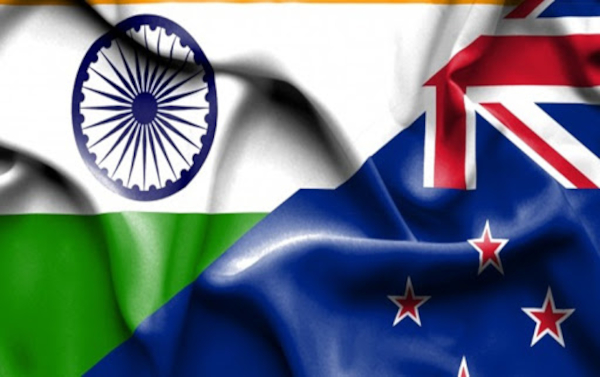
New Delhi, April 26: Indian exporters are looking at a new trade opening in the Pacific as India and New Zealand prepare to formally sign their Free Trade Agreement on Monday, April 27, 2026, in New Delhi. The agreement, which completed legal verification earlier this month, is expected to deepen bilateral trade, improve market access and give Indian businesses stronger entry into the New Zealand market.
The pact comes after negotiations that began in March 2025 and were concluded in December 2025, making it one of India’s faster recent trade agreements. New Zealand’s Trade and Investment Minister Todd McClay has described the agreement as a major opening for exporters, while New Zealand Prime Minister Christopher Luxon has projected it as a gateway to India’s 1.4 billion-consumer market.
For India, the agreement is significant because New Zealand is expected to provide duty-free access for Indian goods, creating opportunities for sectors such as textiles, apparel, leather, footwear, engineering goods, pharmaceuticals and agricultural products. Indian exporters see this as a timely opening at a moment when global trade is being reshaped by tariff pressures, supply-chain realignments and rising demand for trusted trade partners.
The deal is also expected to carry benefits beyond goods trade. Services, professional mobility, education, tourism, information technology, construction, telecom and other service-linked areas are likely to gain from improved commitments. Reports indicate that provisions for Indian professionals, students, AYUSH practitioners, yoga instructors, chefs and other categories may also become part of the broader economic framework.
New Zealand, meanwhile, is expected to gain reduced or eliminated tariffs on a large share of its exports to India. According to New Zealand government details, the agreement will eliminate or reduce tariffs on 95% of New Zealand’s exports, with nearly 57% becoming duty-free from day one, rising to 82% when fully implemented. Key New Zealand sectors such as forestry, wool, sheep meat, coal, seafood, fruit, honey and some dairy-linked products are expected to benefit.
However, India has kept its domestic sensitivities in mind. Sensitive areas such as dairy, sugar, spices and edible oils have been protected from direct market-opening commitments, a crucial point for Indian farmers and small producers. This gives the agreement a more balanced character, allowing trade expansion without exposing politically and economically sensitive sectors to sudden import pressure.
The agreement also carries an investment dimension. New Zealand has committed to facilitating investment into India over the coming years, while both sides are targeting a major expansion in bilateral trade. Earlier reports noted that the two countries aim to double bilateral trade to about USD 5 billion within five years, with New Zealand-linked investment commitments projected over a 15-year horizon.
The signing will mark another step in India’s wider FTA strategy, as New Delhi works to diversify trade partnerships and improve market access for exporters in trusted economies. For Indian industry, the New Zealand pact may not be the largest trade agreement by volume, but it is strategically important because it opens a high-income, quality-conscious market and strengthens India’s presence in the Indo-Pacific trade architecture.
Sources:
https://www.beehive.govt.nz/release/legal-verification-india-fta-complete-and-date-signing-agreed
https://www.beehive.govt.nz/release/new-zealand-secures-landmark-free-trade-agreement-india
https://www.reuters.com/world/india/new-zealand-opposition-support-india-free-trade-deal-2026-04-22
https://www.reuters.com/world/india/new-zealand-concludes-free-trade-agreement-with-india-2025-12-22
https://apnews.com/article/c7c6935528509aaaad00dbd79f1a583e
You may also like
-
India Strengthens Trade Ties with Netherlands as Piyush Goyal Visits Port of Rotterdam
-
India to Train 600 Nigerian Army Soldiers in Specialised Jungle and Mountain Warfare
-
India and Russia Strengthen Parliamentary Diplomacy as Om Birla Meets State Duma Chairman Vyacheslav Volodin
-
India Seeks South Korean Shipbuilding Partnerships as Sarbananda Sonowal Begins Four-Day Visit to Busan
-
Koraput Kalajeera Rice of Odisha: The GI-Tagged Aromatic Heritage of India’s Ancient Rice-Growing Region
