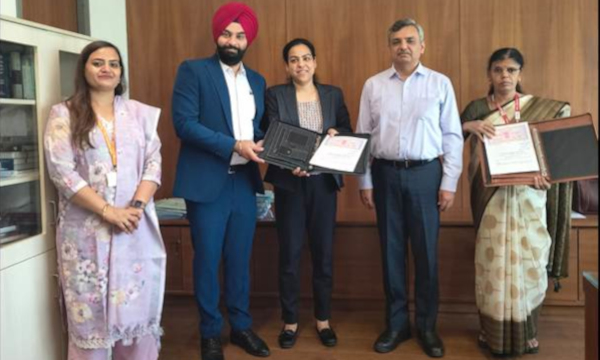
New Delhi, April 24, 2026: The National Institute of Pharmaceutical Education and Research, Hajipur, has signed a Memorandum of Understanding with Boehringer Ingelheim India Pvt. Ltd. to strengthen industry-academia collaboration and accelerate pharmaceutical research in India. The agreement was signed at Kartavya Bhawan, New Delhi, in the presence of Manoj Joshi, Secretary, Department of Pharmaceuticals, Ministry of Chemicals and Fertilizers.
The partnership is aimed at bringing academic research closer to real-world pharmaceutical development. According to the Department of Pharmaceuticals, the collaboration will help build stronger research capacity at NIPER Hajipur, provide students with hands-on training, and generate early-stage proof-of-concept data that can later be scaled into preclinical development.
A key feature of the MoU is Boehringer Ingelheim’s decision to provide researchers access to its opnMe open science platform. This platform is expected to enable wider scientific exchange, support collaborative drug discovery, and help researchers work on healthcare innovation with industry-grade research tools and scientific resources.
The agreement is significant because India’s pharmaceutical sector is now moving beyond large-scale manufacturing towards innovation-led drug discovery, translational pharmacology, biologics, biosimilars and emerging therapies. The government said the collaboration between NIPER Hajipur and Boehringer Ingelheim is expected to contribute to the development of next-generation therapies and support the broader goal of building a robust, innovation-driven healthcare ecosystem in the country.
Speaking at the signing, Manoj Joshi said academia-industry partnerships are essential for bridging the gap between research and commercialisation. His remarks underline a key challenge in India’s pharma ecosystem: while the country has strong scientific talent and manufacturing capacity, more institutional bridges are needed to convert laboratory discoveries into clinically useful and commercially viable therapies.
The Boehringer Ingelheim MoU also came alongside another important agreement signed by NIPER Hajipur with the Indian Pharmacopoeia Commission. That separate partnership focuses on pharmaceutical standards, regulatory science, impurity profiling, safety correlation of drugs, quality control protocols, and reference standards for complex biologics, biosimilars, cell therapies and gene therapies.
Together, the two agreements place NIPER Hajipur at an important point in India’s pharmaceutical innovation chain. On one side, the Boehringer Ingelheim collaboration supports research, training, scientific exchange and early-stage therapy development. On the other, the IPC partnership strengthens drug standards, patient safety and regulatory science. This combination is important because modern healthcare innovation requires both discovery capability and strong quality-control architecture.
For India, the development fits into a larger policy push to make the country not only the “pharmacy of the world” in terms of affordable medicines, but also a serious centre for high-value pharmaceutical research. By linking students, scientists, industry platforms and national regulatory institutions, the latest MoUs could help create a stronger pipeline from academic research to safe, effective and globally relevant therapies.
Reference:https://www.pib.gov.in/PressReleasePage.aspx?PRID=2255261®=3&lang=2
You may also like
-
Centre Caps Cancer Drug Trade Margins at 30%, Patients Expected to Save ₹2,500 Crore Annually
-
India Establishes First High-Altitude Health Research Centre in Himachal Pradesh
-
Women Make Up 43% of India’s Ayush Workforce as Sector Grows to ₹3.12 Lakh Crore
-
Jihva Nirlekhana in Ayurveda: How Tongue Hygiene Connects Oral Health with Heart and Lung Health
-
Ayurveda on Fresh Food Versus Reheated Food: Why Freshly Prepared Meals Are Preferred for Healthy Digestion
