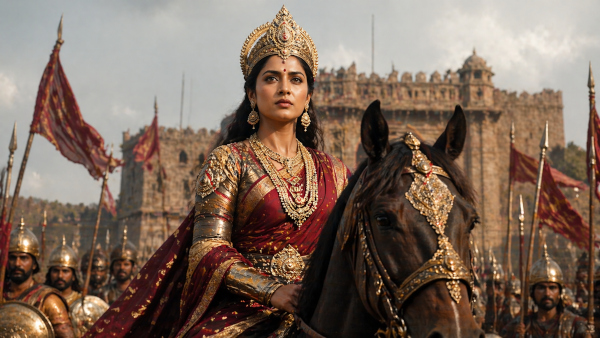
Rudrama Devi stands among the most extraordinary rulers of medieval India because she did not simply inherit a throne—she had to compel a warrior aristocracy to accept that a woman could hold it. Born into the Kakatiya royal house in the 13th century, she was the daughter of the powerful emperor Ganapati Deva of Orugallu, today’s Warangal. With no accepted male heir available, Ganapati chose Rudrama as successor, and the transition was framed in consciously royal, masculine terms: she was projected in courtly and political life as Rudradeva Maharaja, not as a ceremonial queen-consort. Evidence from later historical writing and inscriptional compilations indicates that she first functioned alongside her father and then emerged as sovereign in her own right in the early 1260s, a remarkable act of statecraft in a deeply patrilineal age.
Her lineage was illustrious and politically strategic.She belonged to the Kakatiya dynasty, the great Telugu power that had risen from feudatory status to imperial authority in the Deccan. A record cited in the National Book Trust volume on her life notes that Virabhadresvara/Virabhadra of the Chalukya line married Ganapati Deva’s daughter Rudrama Mahadevi, showing how marriage too was used to secure frontier loyalty and noble support. Rudrama had daughters rather than a surviving son, and the succession was stabilized through the adoption of her grandson Prataparudra, who would later inherit the throne. That family arrangement mattered politically: it linked the continuity of the Kakatiya state directly to Rudrama’s person, not merely to the memory of her father.
What made Rudrama formidable was not lineage alone, but performance. She ruled from a capital whose defenses were strengthened under her reign. Official Telangana tourism material states that Warangal Fort, begun by Ganapati Deva, was further developed by Rani Rudrama Devi, while the Ministry of Tourism’s Incredible India page says the fort’s first great concentric defensive ring was constructed during her rule. Other historical work linked to her inscriptions associates her with the Raya-Gaja-Kesari title and with additions at the Svayambhu temple complex, where victory imagery and commemorative architecture seem to have celebrated her military prestige. A Malkapuram inscription from her period is especially striking: it records her formal grant of villages connected with an institutional complex created by her guru Visvesvara Sivacharya, including a temple, Sanskrit college, feeding house, and even a maternity hospital—evidence that Kakatiya statecraft under Rudrama was not only martial but administrative, religious, and civic.
Her reign was repeatedly tested by war. From the west came the challenge of the Seuna Yadava king Mahadeva of Devagiri, whose invasion threatened Warangal itself. The surviving record is layered: later literary tradition dramatizes the campaign, but inscription-based interpretations still point to a real Kakatiya recovery and a counter-success under Rudrama. The Bidar inscription tradition summarized in the NBT volume presents her as pushing the enemy back toward Devagiri, exacting indemnity, and even extending Kakatiya authority into Bidar’s surrounding zone for a time. From the northeast, the Kakatiya frontier also faced pressure from Kalinga/Gajapati forces under Bhanudeva I; records linked to the reign indicate that her commanders Poti Nayaka and Proli Nayaka defeated the invaders and restored Kakatiya strength in coastal Andhra. These were not symbolic victories. They showed that Rudrama could survive the two great tests that often unmade medieval rulers: invasion from outside and doubt from within.
The darkest chapter of her career came from inside the Kakatiya world. The most dangerous enemy of her later reign was the rebel Kayastha chief Ambadeva, who steadily carved away southern Kakatiya authority. By the 1280s, the southern frontier had become unstable, and later reconstructions connect Ambadeva with the chain of events that ended Rudrama’s life. The single most important piece of evidence is the Chandupatla inscription, dated 25 November 1289, which records that after Kakatiya queen Rudramahadevi had “departed to the world of the gods,” a servant made a gift to Chandupatla Somanathasvami so that both the queen and Mallikarjuna Nayaka might attain Sivaloka. Epigraphic analysis in Epigraphia Telanganica interprets this to mean that Rudrama and her general died around the same time, very likely only days earlier, and probably during a military campaign. The inscription itself does not narrate the battle, but modern historians commonly connect the deaths to the struggle against Ambadeva, placing her end in the second week of November 1289. In other words, the clearest evidence suggests that Rudrama did not die in retirement, palace intrigue, or gentle decline—she died with war still around her.
That is why Rudrama Devi endures so powerfully in memory. She was a ruler who inherited an empire in tension, wore the authority of kingship in a society that distrusted female sovereignty, defended Warangal against major enemies, strengthened its fortifications, supported institutions that reveal a serious governing mind, and likely met death in the field while trying to hold her kingdom together. After her, Prataparudra succeeded to a throne still marked by her struggle and later had to confront the political aftershocks of the Ambadeva rebellion himself. Rudrama’s life is therefore more than the story of a “woman king.” It is the story of a Deccan sovereign who turned legitimacy into action, action into endurance, and endurance into legend.
Reference:
https://www.mcrhrdi.gov.in/images/epigraphia/Vol-III.pdf
https://www.nbtindia.gov.in/writereaddata/freebooks/pdf/Rani%20Rudrama%20Devi.pdf
https://tourism.telangana.gov.in/destinations/hanmakonda
https://www.incredibleindia.gov.in/en/telangana/warangal/warangal-fort
https://www.livehistoryindia.com/story/people/rudramadevi-a-king-like-no-other
You may also like
-
Mekala in the Mahabharata: The Ancient Highland Kingdom of Amarkantak and the Maikal Hills
-
Anupa in the Mahabharata: The Ancient Narmada Kingdom of Mahishmati and the Maheshwar Region
-
Sarnath Joins UNESCO World Heritage List as India’s Civilisational Legacy Gains Global Recognition
-
Ancient Bazira-Barikot of Gandhara Gains UNESCO Recognition as 3,000 Years of Urban History Emerge From Swat
-
Vaidisha in the Mahabharata-Era Geography: The Ancient Vidisha Region of Central Madhya Pradesh
