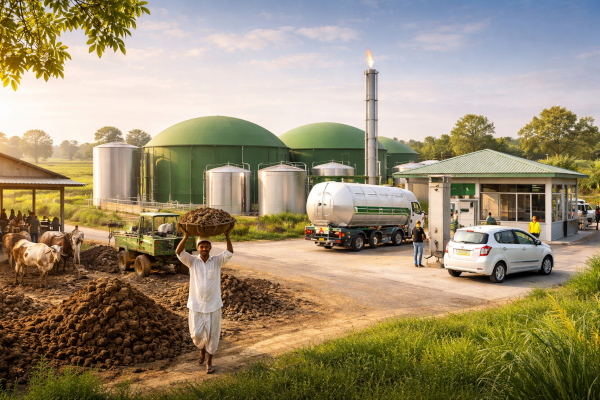
What looks at first like an unusual headline is actually the visible face of a much larger industrial and energy experiment unfolding in India. Suzuki’s biogas push is now past the concept stage: after signing a September 2023 agreement with the National Dairy Development Board (NDDB) and Banas Dairy, the company opened its first BANAS SUZUKI BIOGAS PLANT at Agthala in Gujarat on December 6, 2025, and its second at Bhukhala in Banaskantha on January 18, 2026. Both plants are designed to process up to 100 tonnes of cow dung a day and produce about 1.5 tonnes of compressed biogas daily, which Suzuki says is roughly enough fuel for around 850 CNG vehicles per day. The same facilities also turn the post-digestion residue into organic fertiliser, making the model a fuel-and-fertiliser loop rather than a single-product plant.
In December 2024, Suzuki R&D Center India signed an agreement with NDDB to expand biogas plants across India through NDDB Mrida Ltd., with NDDB saying the partnership is meant to create more value for dairy farmers by converting dung into clean energy and organic fertilisers. The same release said additional plants were being planned not only with Banas Dairy but also with Amul Dairy, Dudhsagar Dairy and other cooperatives. Suzuki’s own investor material frames the effort as a way to promote low-cost, locally produced, locally consumable carbon-neutral fuel while creating jobs, additional income through dung procurement, improved energy self-sufficiency and wider use of organic fertiliser.
Suzuki and its affiliates have repeatedly stressed that biogas can be used in CNG vehicles, and Suzuki’s January 2026 release says CNG vehicles account for about 20 percent of India’s passenger car market. In other words, this is not a side experiment designed for a tiny niche. It is an attempt to plug a carbon-neutral gas into a transport ecosystem that already exists at scale. The project also received an international boost in July 2025, when UNIDO adopted Suzuki’s India biogas initiative under its industrial cooperation programme funded by Japan’s Ministry of Economy, Trade and Industry, giving the effort a stronger technology-transfer and demonstration dimension.
Suzuki’s India biogas page says methane from cow dung has a greenhouse effect 28 times larger than CO2, so the company is trying to treat rural livestock waste as both a climate problem and a feedstock opportunity. That is what gives the model its unusual strength: It tries to suppress methane emissions, formalise waste collection, create rural income and produce organic fertiliser in the same chain. The approach is beginning to influence policy thinking in Gujarat as well. In March 2026, the state said it had allocated ₹60 crore in the 2026-27 budget to set up 10 new bio-CNG plants through milk cooperative societies, adding that the Banas bio-CNG model was being adopted by nearly 15 states.
The broader national backdrop explains why Suzuki is moving now. A June 2025 PNGRB paper says India has around 860 registered compressed biogas plants, with about 120 operational and about 200 under construction, while the government’s long-term aim is 5,000 plants with a total output of 15 million tonnes. The same document says India has already moved from encouragement to mandate, with phased blending of CBG into CNG and PNG starting at 1 percent in FY 2025-26, rising to 3 percent in FY 2026-27, 4 percent in FY 2027-28 and 5 percent from FY 2028-29 onward. It also notes that the government approved ₹994.5 crore under the DPI scheme for pipeline infrastructure connecting CBG plants to city gas networks.
Suzuki’s cow-dung-to-fuel story is really a story about India’s multi-fuel transition. Instead of waiting for one perfect clean-mobility solution, the company is aligning itself with India’s dairy economy, cooperative networks, city-gas infrastructure and expanding CBG policy regime. The result is a model that tries to connect village waste, farmer income, clean cooking, organic fertiliser and automotive fuel in a single industrial loop.
You may also like
-
Tata Power Renewables Commissions 72.5 MW Solar Project in Rajasthan to Support Tata Steel’s Decarbonisation
-
NTPC Targets 244 GW by 2037 With ₹16.86-Lakh-Crore Expansion Across India’s Energy Sector
-
UPI Completes a Decade as Transaction Value Surges More Than 4,000-Fold
-
AGNIT Semiconductors: Building India’s Gallium-Nitride Chip Capability for Radar, Communications and Power Electronics
-
India and Canada Target Comprehensive Trade Agreement by End of 2026
