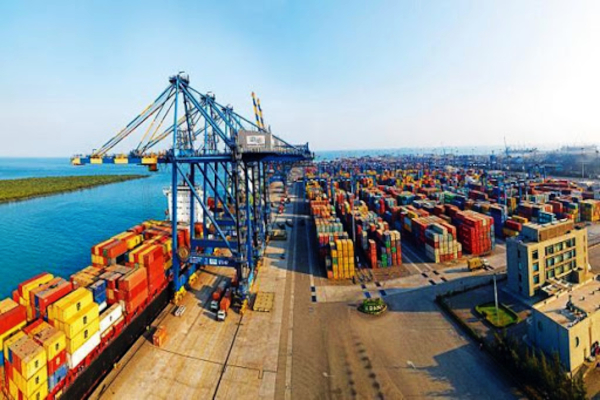
India’s maritime development programme, Sagarmala, has emerged as a central pillar of the country’s port-led growth strategy, with 845 projects worth ₹6.06 lakh crore taken up so far. Of these, 315 projects valued at ₹1.57 lakh crore have already been completed, while 210 are under implementation and 320 remain in the planning stage, according to the Ministry of Ports, Shipping and Waterways.
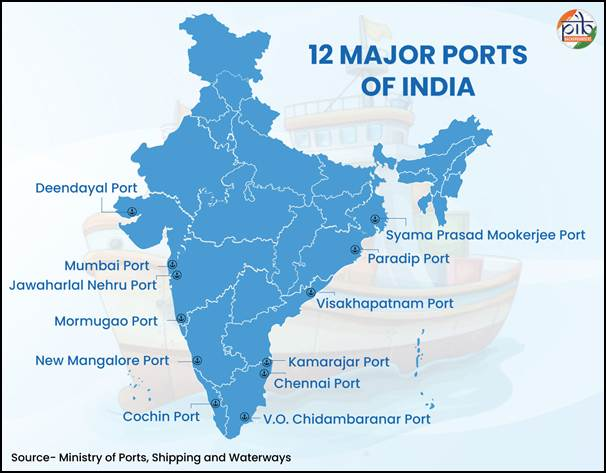
The programme, launched in March 2015, was designed to modernise ports, improve port connectivity, promote port-led industrialisation, support coastal communities, and expand the role of coastal shipping and inland waterways in India’s logistics network. With India’s 11,099-kilometre coastline and nearly 14,500 kilometres of potentially navigable waterways, the maritime sector continues to play a critical role in national trade, handling around 95 per cent of trade by volume and about 70 per cent by value.
The government said the programme has already delivered major infrastructure gains. Seven coastal berth projects worth ₹494 crore have been completed, adding 9.84 million tonnes per annum of cargo-handling capacity. Eleven fishing harbour projects costing ₹1,057 crore have also been completed, benefiting more than 30,000 fishermen. Other works under implementation include the restoration of the historic Bascule Bridge at Syama Prasad Mookerjee Port in Kolkata and the strengthening of firefighting facilities at Mumbai Port’s Pir Pau Terminal.
India’s major ports also posted a record performance in FY 2025–26, collectively handling 915.17 million tonnes of cargo, surpassing the annual target of 904 million tonnes. The ministry said this reflects a year-on-year growth of 7.06 per cent. Operational efficiency has improved sharply as well, with average vessel turnaround time dropping from 96 hours in 2014 to 49.5 hours in 2025. Indian ports have also gained stronger global visibility, with nine ports now ranked among the world’s top 100.
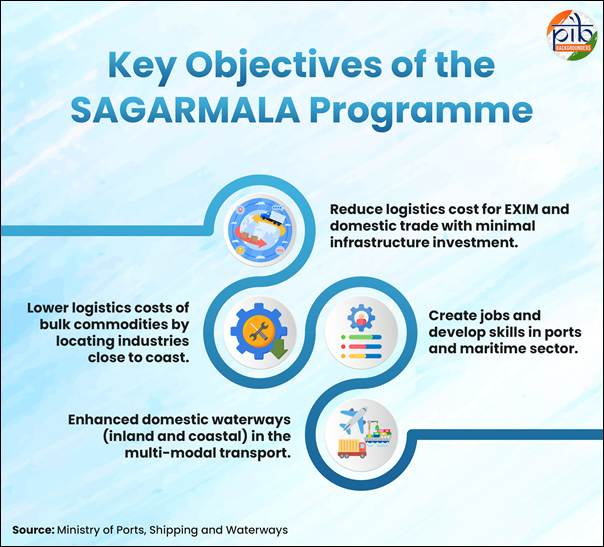
Passenger and vehicle connectivity through waterways has also expanded under Sagarmala. A total of 29 Ro-Pax and passenger ferry projects worth ₹1,233 crore have been taken up, with 17 projects valued at ₹706 crore already completed. These projects have benefited more than 35 lakh passengers. Services such as the Ghogha–Hazira Ro-Pax route and the Mumbai–Mandwa ferry have significantly reduced travel time while easing road congestion.
The programme has also focused on livelihoods in coastal regions. Through convergence with the Deen Dayal Upadhyaya Grameen Kaushalya Yojana, over 7,600 candidates have received skill training and more than 3,100 have been placed in maritime and allied sectors. Overall, Sagarmala is estimated to generate around one crore jobs, including 40 lakh direct and 60 lakh indirect employment opportunities.
Looking ahead, the government has proposed Sagarmala 2.0 as the next phase of the initiative. Backed by budgetary support of ₹85,482 crore, the new phase is expected to catalyse total investments of ₹3.6 lakh crore across ports, inland waterways, coastal infrastructure, maritime services, research, and institutional strengthening. The broader aim is to position India as a global maritime hub in line with Maritime India Vision 2030, Maritime Amrit Kaal Vision 2047, and the larger goal of Viksit Bharat 2047.
Reference: PIB
You may also like
-
Tata Power Renewables Commissions 72.5 MW Solar Project in Rajasthan to Support Tata Steel’s Decarbonisation
-
NTPC Targets 244 GW by 2037 With ₹16.86-Lakh-Crore Expansion Across India’s Energy Sector
-
UPI Completes a Decade as Transaction Value Surges More Than 4,000-Fold
-
AGNIT Semiconductors: Building India’s Gallium-Nitride Chip Capability for Radar, Communications and Power Electronics
-
India and Canada Target Comprehensive Trade Agreement by End of 2026
