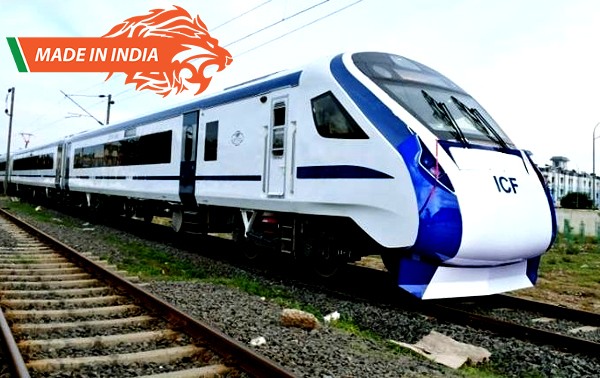
India’s Vande Bharat Express network recorded a major jump in passenger traffic in FY 2025–26, with nearly 3.98 crore passengers travelling on the service during the year, up about 34 percent from 2.97 crore in FY 2024–25. The numbers underline the growing public shift toward faster, more comfortable, and modern rail travel as the semi-high-speed train continues to strengthen its presence across the country.
Since its launch, the Vande Bharat network has carried more than 9.1 crore passengers through about 1 lakh trips, showing how quickly the service has moved from flagship experiment to a widely accepted part of India’s railway system. First introduced on the New Delhi–Varanasi route in February 2019, the train has since become a major symbol of indigenous rail modernisation under the Make in India push.
Among the busiest routes, New Delhi–Varanasi has served over 73 lakh passengers, while the New Delhi–Shri Mata Vaishno Devi Katra route has handled around 56 lakh. In southern India, the Secunderabad–Visakhapatnam service has carried over 48 lakh passengers, and the Chennai–Mysuru corridor has served more than 36 lakh, reflecting strong demand across business, tourism, and pilgrimage circuits.
The expanding Vande Bharat network has also become an important enabler of regional tourism and connectivity, linking major metros with religious centres, heritage destinations, and coastal cities. According to the PIB release, the trains are helping improve access while also giving a boost to local economic activity and visitor movement in key regions.
Indian Railways has also begun widening the concept beyond daytime premium travel. The Vande Bharat Sleeper service, introduced in January 2026, carried 1.21 lakh passengers in its first three months across 119 trips, while registering over 100 percent occupancy. That early response suggests strong demand for premium overnight rail travel as well.
With its focus on higher speed, passenger comfort, improved safety features, and indigenous design, Vande Bharat is steadily becoming the face of a new era in Indian rail transport. As the network expands further, Indian Railways is positioning the service as a central pillar in its effort to deliver faster, safer, and more efficient journeys across the country.
Reference:
https://www.pib.gov.in/PressReleasePage.aspx?PRID=2250963®=3&lang=1
You may also like
-
India Introduces New CBG Pricing Framework to Strengthen Bioenergy Producers While Shielding Gas Consumers
-
Tata Power Renewables Commissions 72.5 MW Solar Project in Rajasthan to Support Tata Steel’s Decarbonisation
-
NTPC Targets 244 GW by 2037 With ₹16.86-Lakh-Crore Expansion Across India’s Energy Sector
-
UPI Completes a Decade as Transaction Value Surges More Than 4,000-Fold
-
AGNIT Semiconductors: Building India’s Gallium-Nitride Chip Capability for Radar, Communications and Power Electronics
