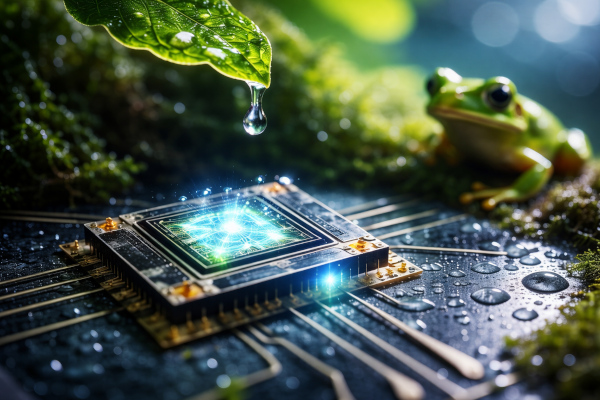
Indian researchers have developed a new neuromorphic sensor that behaves in a brain-like way by sensing humidity, processing that signal and retaining a memory of it within a single device. Announced by the Ministry of Science & Technology on April 9, 2026, the development is being seen as a step toward low-power electronics that could reduce energy use and data-processing load in conventional systems.
The work was carried out by researchers at the Jawaharlal Nehru Centre for Advanced Scientific Research, an autonomous institute under the Department of Science and Technology. Unlike many existing neuromorphic systems that depend on separate sensing and memory components, this device integrates sensing, synapse-like processing and temporary information storage in one platform, drawing inspiration from the way biological sensory systems operate.
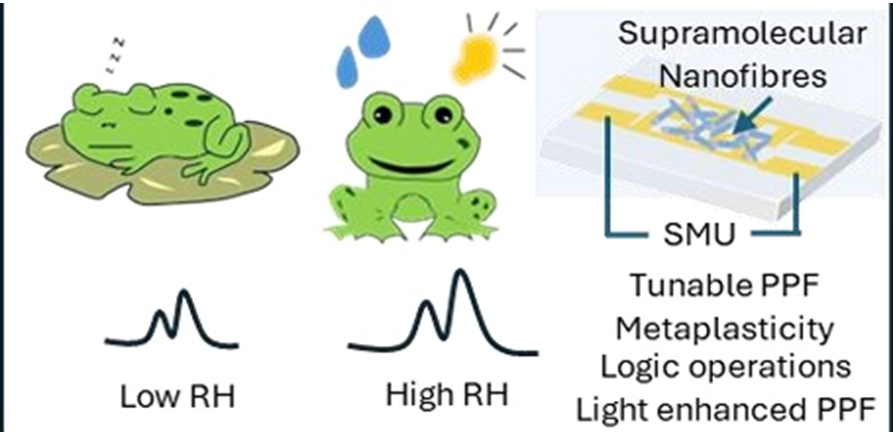
What makes the research especially interesting is its biological inspiration. The sensor was modeled on amphibian behaviour, particularly that of cricket frogs, whose activity changes sharply with moisture and daylight conditions. The researchers used one-dimensional supramolecular nanofibers to build the active layer of the device, then tested its responses under controlled humidity conditions. According to the release, the device showed behaviours analogous to synaptic facilitation, depression and metaplasticity, while also demonstrating basic logic operations.
The sensor’s response changes with surrounding humidity, and it can also retain a temporary memory of earlier humidity exposure. Its behaviour can further be influenced by light, making it closer to a biologically inspired adaptive system than a conventional passive sensor. The researchers said this is the first time humidity has been used as the primary stimulus to emulate synaptic behaviour in a neuromorphic device.
The implications could extend well beyond the laboratory. The ministry said the technology may support future smart environmental monitoring systems, wearable healthcare devices and energy-efficient edge-computing applications used in artificial intelligence and the Internet of Things. The study has been published in the Journal of Materials Chemistry C, signalling broader scientific interest in environmentally responsive and sustainable electronics.
Publication link: https://doi.org/10.1039/d5tc03980k
Reference:
https://www.pib.gov.in/PressReleasePage.aspx?PRID=2250462®=3&lang=1
You may also like
-
IIT Guwahati Develops Affordable Technology to Remove Arsenic and Fluoride From Drinking Water
-
BITS Pilani Goa Develops Pharmaceutical Bioink for 3D-Printed Skin Scaffolds and Customised Medicines
-
New Smart Technology can Make Diagnosis of Alzheimer’s disease (AD) More Accessible
-
Study Identifies Uniqueness of South Asian Gut Microbiome, Critical for Lifestyle Disease Treatment
-
GENESIS EIR 3.0 Offers Up to ₹10 Lakh to Turn Young Indian Innovators Into DeepTech Entrepreneurs
