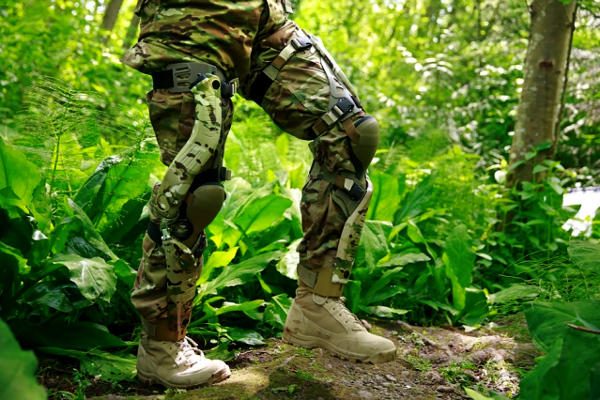
India’s push toward human performance augmentation in combat environments has taken a pragmatic and field-oriented turn with the development of the PEARL (Passive Exoskeleton for Augmenting Load) system by the Defence Bio-Engineering & Electro Medical Laboratory (DEBEL), under the Defence Research and Development Organisation (DRDO). Unlike powered exoskeleton programs that depend on actuators, control systems, and energy sources, PEARL adopts a purely mechanical, passive architecture designed specifically for Indian operational conditions—high altitude, long patrol cycles, and rugged terrain.
At its core, PEARL is a load redistribution system engineered to transfer the weight of a soldier’s backpack from the upper body to the ground through a structural linkage integrated with the lower limbs. The system can offload up to 75% of the payload load path, meaning the majority of the vertical load vector is rerouted away from the spine, shoulders, and hips, which are typically the primary fatigue and injury zones in infantry operations. This is achieved through a combination of frame structures, load-bearing joints, and ground-interface linkages that maintain mechanical continuity between the payload and the terrain.
From a technical standpoint, PEARL operates on biomechanical load path optimization. In a conventional soldier load carriage scenario, forces are transmitted vertically through the spine and distributed across shoulder straps and hip belts. This results in cumulative strain, especially during prolonged movement. PEARL alters this by introducing an external load-bearing pathway, effectively creating a parallel structural system. The exoskeleton frame channels forces downward through articulated joints aligned with the natural kinematics of the human leg, ensuring that load transfer occurs without disrupting gait cycles.
One of the most critical engineering challenges in exoskeleton design is maintaining kinematic compatibility with human motion, particularly during dynamic activities such as walking on uneven terrain, climbing, crouching, or rapid directional changes. PEARL addresses this through passive joint alignment and compliant mechanisms, allowing degrees of freedom that mirror human joint movement. This ensures that while load is transferred, mobility remains unrestricted, a key requirement for combat deployment.
The absence of motors or batteries gives PEARL several operational advantages. First, it significantly reduces system weight and logistical complexity, making it suitable for long-duration missions where resupply is limited. Second, it eliminates electromagnetic and thermal signatures, which can be critical in stealth operations. Third, the system offers high reliability with minimal maintenance, as there are fewer failure points compared to powered systems.
In terms of combat integration, PEARL has been designed to be fully compatible with standard infantry equipment, including ballistic vests, tactical harnesses, and weapon systems. This compatibility ensures that soldiers can adopt the system without altering their combat configuration. The design also allows for rapid donning and doffing, an essential feature in dynamic operational scenarios where flexibility and response time are critical.
The operational implications of PEARL are particularly significant in high-altitude warfare and extended patrol missions, such as those conducted along India’s northern borders. In such environments, reduced oxygen levels amplify fatigue, and heavy loads can drastically limit endurance and operational reach. By reducing the effective load borne by the body, PEARL enhances march efficiency, reduces energy expenditure, and extends mission duration. It also has the potential to reduce long-term musculoskeletal injuries, a persistent issue in infantry forces worldwide.
Globally, military exoskeleton development has largely focused on powered systems such as the US TALOS concept or industrial exoskeletons adapted for defence use. However, these systems often face challenges related to power supply, weight, and field reliability. PEARL’s passive design philosophy reflects a shift toward deployable, scalable solutions that prioritize usability over technological complexity. This aligns with emerging trends where militaries are increasingly exploring hybrid and passive augmentation systems for real-world deployment.
Beyond infantry applications, the underlying technology of PEARL has potential extensions in logistics, disaster response, and paramilitary operations, where personnel are required to carry heavy loads over long distances. The system could also be adapted for load-bearing roles in engineering units, ammunition transport, and casualty evacuation scenarios.
In strategic terms, PEARL represents a doctrine-level enhancement rather than just a technological upgrade. By improving the physical endurance of soldiers without increasing cognitive or logistical burden, it directly contributes to combat effectiveness, survivability, and operational tempo. It embodies a key principle of modern warfare: enhancing the human element through intelligent engineering rather than replacing it.
Ultimately, PEARL demonstrates that innovation in defence does not always require complexity. By leveraging biomechanics and mechanical design, DRDO has delivered a solution that is field-ready, scalable, and aligned with India’s operational realities, marking a significant step forward in soldier modernization.
Reference:
https://www.drdo.gov.in/drdo/labs-and-establishments/defence-bio-engineering-electro-medical-laboratory-debel
https://www.drdo.gov.in/technology-focus/area/human-performance-enhancement
https://idrw.org/drdos-pearl-passive-exoskeleton-to-boost-soldier-endurance/
https://www.defence.in/threads/drdo-debel-develops-passive-exoskeleton-for-soldiers.18645/
https://www.army-technology.com/features/exoskeletons-in-the-military/
https://www.nature.com/articles/s41598-020-61580-0
https://ieeexplore.ieee.org/document/9099090
https://www.sciencedirect.com/science/article/pii/S1877050919313917
You may also like
-
India’s Indigenous Sonar Ecosystem Powers New Generation of Indian Navy Warships
-
Murshidabad Becomes First West Bengal District to Complete Land Handover for India-Bangladesh Border Fencing
-
India’s LR-AShM Family Could Reach 3,500 Km as DRDO Develops Extended-Range Hypersonic Variants
-
Indian Composite Manufacturing Gets BrahMos Boost With ₹60-Crore Order to Allen Reinforced Plastics
-
HAL-Samtel Opens New Gurugram Facility to Expand Indigenous Defence Avionics and Display Manufacturing
