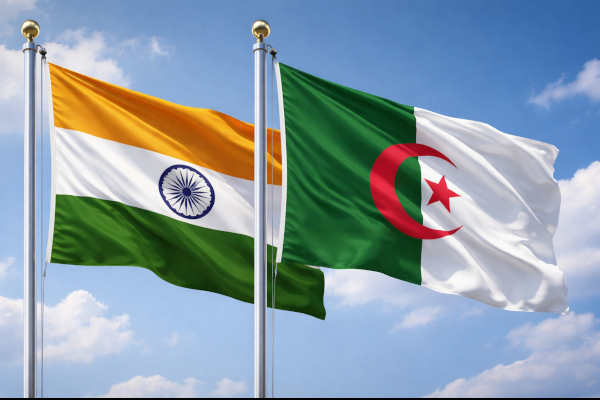
India’s engagement with Algeria is beginning to reveal a quiet but important strategic logic that goes far beyond the formal language of diplomatic consultations. The 7th round of Foreign Office Consultations between the two countries, held in Algiers on March 29, 2026, may appear on the surface to be another routine bilateral meeting, but in reality it reflects India’s deliberate effort to widen its strategic footprint across North Africa at a time when energy security, counterterrorism, supply chain resilience, and Global South diplomacy are all becoming deeply interconnected. Co-chaired by Dr. Neena Malhotra, Secretary (South) in India’s Ministry of External Affairs, and Lounes Magramane, Secretary General of Algeria’s Foreign Ministry, the consultations reviewed the full spectrum of bilateral ties, including trade, energy, mining, fertilisers, pharmaceuticals, higher education, parliamentary cooperation, and multilateral coordination, while also reaffirming a shared commitment to counterterrorism and regional stability. Together, these themes point to a relationship that is slowly but steadily evolving from diplomatic cordiality into strategic relevance.
At the centre of the India–Algeria relationship lies energy, and in today’s world energy is no longer just an economic concern but a national security variable. Algeria is one of Africa’s most important hydrocarbon producers, and for India, which remains heavily dependent on imported energy, stronger engagement with Algeria offers more than a new commercial partner. It offers the possibility of diversification at a time when traditional energy routes remain exposed to geopolitical shocks, maritime disruption, and conflict-driven volatility. For Indian strategic planners, a country like Algeria carries value precisely because it broadens the range of options available in a crisis. Dependence on a narrow basket of suppliers or vulnerable chokepoints can quickly become a strategic liability in wartime or during prolonged regional instability. Algeria, with its Mediterranean access and major oil and gas reserves, gives India another lever in building a wider and more resilient external energy architecture. In that sense, what appears as an energy dialogue is also a conversation about strategic endurance.
The security dimension of the consultations becomes even more pronounced when viewed through the lens of terrorism and regional instability. Both India and Algeria explicitly reaffirmed their commitment to combat terrorism in all its forms, and that convergence carries real significance. Algeria sits in a region shaped by the aftershocks of Sahel instability, extremist violence, trafficking networks, and fragile state environments. India, meanwhile, has long viewed terrorism as one of its core national security concerns and has consistently sought stronger international support for a zero-tolerance approach. When these two states align on counterterrorism, the importance lies not only in diplomatic language but in the potential for long-term cooperation in intelligence exchanges, law-enforcement coordination, training, and multilateral advocacy. Even in the absence of a headline-grabbing defence pact, such alignments often create the political trust necessary for deeper future cooperation. What begins as consultation can gradually mature into a framework for practical security coordination.
Trade and economic cooperation, though currently below potential, also form part of this wider strategic picture. Bilateral trade remains modest relative to the size and possibilities of the two economies, but the sectors identified for further expansion are revealing. Pharmaceuticals, agriculture, fertilisers, higher education, and mining are not random areas of engagement. They are exactly the sort of sectors that strengthen national resilience, industrial depth, and supply chain security. Fertilisers matter to food security. Mining matters to industrial and strategic materials. Pharmaceuticals matter to healthcare sovereignty and export capacity. Education and training build long-term human capital linkages. When seen together, these sectors suggest that India is not merely seeking transactional trade growth with Algeria; it is attempting to build a broader base of interdependence that can support a durable strategic partnership. In modern geopolitics, national power rests not only on missiles and warships, but on resources, technology access, production chains, and the reliability of external partners.
Another significant aspect of the consultations was the emphasis on coordination at the United Nations and other multilateral forums. This fits squarely into India’s larger effort to consolidate influence across the Global South by developing relationships with states that possess regional weight, political credibility, and diplomatic autonomy. Algeria occupies such a position. Its history in the Non-Aligned Movement, its standing in Africa and the Arab world, and its traditional emphasis on sovereignty and anti-colonial solidarity make it a useful and potentially influential partner for India in debates over global governance reform, energy equity, counterterrorism frameworks, and strategic autonomy. For India, which increasingly presents itself as a voice of the Global South while also pursuing major-power ambitions, these relationships are crucial. They help create diplomatic density. They build issue-based coalitions. They reduce strategic isolation. And they allow India to project its interests into regions where it may not yet have overwhelming economic or military presence, but where sustained political engagement can produce long-term dividends.
The consultations also touched on institutional mechanisms such as the India–Algeria Parliamentary Friendship Group, and though such developments can sound procedural, they often matter more than they appear to. Institutions create continuity. They reduce dependence on episodic high-level visits. They allow a relationship to survive domestic political change, bureaucratic turnover, and temporary fluctuations in priority. In strategic terms, institutionalisation is what converts goodwill into durability. For countries trying to expand ties in sectors as sensitive as energy, security, and multilateral coordination, these stabilising mechanisms are not ornamental; they are part of the architecture of trust.
What makes India’s Algeria outreach especially interesting is the larger geographical pattern into which it fits. India has in recent years invested heavily in the Indo-Pacific, deepened its engagement in West Asia, and expanded its partnerships across Africa. Algeria gives New Delhi an additional anchor in the North African and Mediterranean space. That matters because strategy is increasingly about corridors, not just bilateral ties. Energy corridors, trade corridors, diplomatic corridors, and influence corridors now overlap. A stronger India–Algeria relationship helps India stitch together a wider western arc of engagement, linking the Gulf, the Red Sea approaches, North Africa, and potentially Europe through a more diversified network of partnerships. This is not the sort of development that produces dramatic headlines, but it is precisely the kind of long-term positioning that serious states pursue when they are thinking beyond the crisis of the week.
Seen in this light, the 7th India–Algeria Foreign Office Consultations were not merely a formal review of bilateral ties. They were part of a broader Indian strategy of building layered partnerships that enhance national security through diplomacy, energy diversification, institutional depth, and issue-based alignment. Algeria offers India value as an energy partner, as a counterterrorism ally, as a diplomatic collaborator in the Global South, and as a North African gateway in a region whose importance is likely to grow rather than diminish. The relationship is still developing, and it remains far from the level of India’s major strategic partnerships elsewhere, but its direction is increasingly clear. In an era where resilience matters as much as raw strength, and where strategic influence is built through steady accumulation rather than dramatic spectacle, India’s engagement with Algeria represents a measured and quietly important expansion of its geopolitical reach.
Reference:
News On Air
https://www.newsonair.gov.in/india-and-algeria-hold-7th-round-of-foreign-office-consultations/
Ministry of External Affairs
https://www.mea.gov.in/press-releases.htm?dtl=40992/7th+India++Algeria+Foreign+Office+Consultations
GKToday
https://www.gktoday.in/india-algeria-talks-strengthen-bilateral-cooperation/
You may also like
-
India and Kuwait Hold Inaugural Joint Defence Committee Meeting in New Delhi
-
India-Canada Economic Partnership Gains Momentum as Both Sides Target C$70 Billion Trade by 2030
-
India-Russia Partnership Broadens Across Energy, Industry and Technology as Both Sides Pursue $100 Billion Trade Goal
-
India and Japan Target JPY 10 Trillion Investment as Semiconductor and Advanced Manufacturing Partnership Deepens
-
Sri Lanka Navy Chief Visits India to Deepen Maritime Cooperation, Training and Indian Ocean Security
