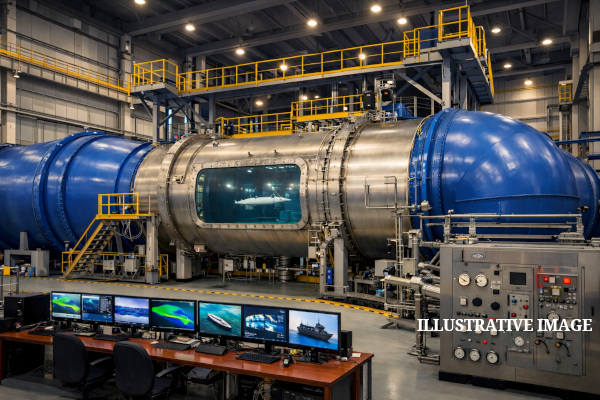
Defence Minister Rajnath Singh on April 3, 2026 laid the foundation stone for a Large Cavitation Tunnel (LCT) facility at the Naval Science and Technological Laboratory (NSTL) in Visakhapatnam, a key DRDO laboratory focused on naval systems. The project is aimed at significantly strengthening India’s indigenous naval research, design and testing ecosystem, especially for next-generation ships, submarines and underwater platforms.
Addressing scientists and researchers at NSTL, Singh said the new facility would allow India to design, develop and test critical naval equipment, systems and sub-systems within the country, reducing dependence on overseas testing infrastructure. He described the LCT as more than just a new installation, calling it an enabling backbone for advances in propulsion, noise reduction and stealth technologies that are central to modern naval engineering.
The Defence Minister said the project reflects the broader push for self-reliance under Aatmanirbhar Bharat, linking indigenous defence capability directly to national security. During the visit, he was also briefed on NSTL’s ongoing programmes by DRDO Chairman and Defence R&D Secretary Dr Samir V Kamat.
Singh also visited the Seakeeping and Manoeuvring Basin at NSTL, where he saw demonstrations of advanced underwater systems including torpedoes, naval mines, decoys and autonomous underwater vehicles. A live display of man-portable AUV swarm operations highlighted India’s growing focus on autonomous maritime warfare and future-ready underwater combat technologies. He also reviewed spin-off products developed by Naval Systems Materials cluster laboratories after Operation Sindoor and praised ongoing work in swarm systems and lithium-ion battery technologies.
According to the PIB release, the Large Cavitation Tunnel has been conceived as a strategic national asset for hydrodynamic research. The facility is expected to be globally distinctive because it will combine closed-loop simulations for submarine studies and free-surface simulations for surface ship research in a single integrated setup. Once operational, it is expected to support hydrodynamic validation and propulsion testing for major naval platforms, including destroyers and aircraft carriers, while giving a wider boost to India’s shipbuilding ecosystem.
Reference: PIB
You may also like
-
India’s Indigenous Sonar Ecosystem Powers New Generation of Indian Navy Warships
-
Murshidabad Becomes First West Bengal District to Complete Land Handover for India-Bangladesh Border Fencing
-
India’s LR-AShM Family Could Reach 3,500 Km as DRDO Develops Extended-Range Hypersonic Variants
-
Indian Composite Manufacturing Gets BrahMos Boost With ₹60-Crore Order to Allen Reinforced Plastics
-
HAL-Samtel Opens New Gurugram Facility to Expand Indigenous Defence Avionics and Display Manufacturing
