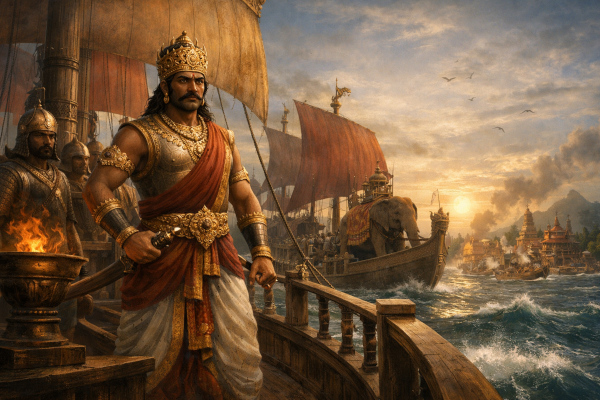
Rajendra Chola I was one of the most formidable rulers in Indian history, and yet his maritime achievement is still far less appreciated than it deserves to be. He ruled the Chola Empire in the early 11th century CE, broadly from 1012/1014 to 1044 CE, and transformed an already powerful South Indian kingdom into a vast imperial force whose influence stretched across the Indian Ocean. He was the ruler who proved that an Indian empire could think in continental as well as maritime terms at the same time. Under him, the Cholas dominated much of South India, campaigned deep into eastern and northern India, consolidated control over Sri Lanka, and launched the famous naval expedition against Srivijaya in Southeast Asia, demonstrating that the Bay of Bengal was not a barrier but a highway.
Rajendra was the son of Rajaraja I, the great Chola emperor who had already laid the foundations of Chola imperial expansion. Rajaraja I was one of the most celebrated rulers of the dynasty, and Rajendra inherited from him not only a large and disciplined state but also a political culture that valued military organisation, temple patronage, administrative order, and long-distance ambition. Rajendra did not suddenly appear as king after his father’s death; he had already been deeply involved in warfare and governance during Rajaraja’s reign, functioning effectively as heir and military commander before formally taking the throne. Britannica notes that Rajaraja I was succeeded by his son Rajendra Chola I upon his death in 1014 CE.
As with many early medieval Indian rulers, the exact details of Rajendra’s birth year are not securely documented in the way a modern biography would record them. Historians can place him in the late 10th century, but the evidence does not allow a precise modern-style birth date. His father is securely known as Rajaraja I, while his mother is commonly identified in Chola genealogical tradition, though the surviving widely accessible summary sources are far clearer about his paternal lineage than about a fully documented domestic biography. What is beyond doubt is that Rajendra grew up in an imperial household shaped by expansion, military discipline, Shaiva temple culture, and intense statecraft, all of which left a deep mark on the ruler he became.
Rajendra’s family position was strengthened by the Chola practice of associating the heir with power before full accession. He appears first as a prince and commander, learning kingship not from a sheltered court existence but from campaigns. This matters because Rajendra’s later military confidence did not emerge from theory. It was forged in the field while he was still acting on behalf of his father. By the time he became emperor, he was already an experienced campaigner with direct familiarity with the Deccan, the eastern coast, and the strategic logic of Chola warfare.
One of the first things to understand about Rajendra is that he was not only a naval ruler. He was first a powerful land emperor. Before and after accession, he campaigned against the Western Chalukyas, asserted Chola strength in the Deccan, and reinforced Chola authority over contested frontier regions. He also continued and deepened Chola intervention in Sri Lanka, where Chola power had already advanced under Rajaraja. These were not peripheral operations. They were central to securing the empire’s western and southern flanks before projecting power farther abroad.
Rajendra’s celebrated northern campaign was another defining episode of his reign. Chola forces pushed northward across the eastern Indian mainland, and the campaign was remembered as having reached the Ganges. This triumph became so central to his royal image that he adopted the title “Gangaikonda Chola”, meaning “the Chola who took the Ganges.” This was not just boastful ornament. In early medieval kingship, titles mattered because they turned conquest into enduring political identity. Rajendra’s northern expedition proclaimed that a Tamil emperor from the far south could intervene in the politics of the subcontinent at astonishing range.
To commemorate this achievement, Rajendra founded a new capital, Gangaikonda Cholapuram. This was one of the most important symbolic acts of his reign. Founding a capital was not merely a matter of administration; it was a declaration that his victories had created a new phase of Chola greatness. The city became the Chola capital for roughly the next two and a half centuries, and its great temple to Shiva, built by Rajendra, remains one of the monuments of Chola civilisation. UNESCO identifies the Brihadisvara temple at Gangaikondacholapuram as a work built by Rajendra I and part of the Great Living Chola Temples World Heritage grouping.
If Rajendra had done only this, he would still rank among the great kings of medieval India. But what makes him exceptional is that he also understood the strategic and commercial value of the sea. Around 1025 CE, he launched the famous Chola naval expedition against Srivijaya, the major maritime power controlling vital routes through Southeast Asia, especially around the Straits of Malacca. The campaign struck places associated with the Srivijayan sphere, including Kadaram and other important ports and nodes in what is now linked to parts of Malaysia and Indonesia. This was the moment when Chola power was displayed not simply as coastal strength, but as organised blue-water imperial force.
This expedition is historically important for several reasons. First, it demonstrated that the Cholas possessed the naval organisation, shipping capacity, logistical planning, and political confidence to mount a campaign far across the Bay of Bengal. Second, it showed that Indian Ocean trade politics in the 11th century were not dominated only by Arab, Southeast Asian, or Chinese actors; a South Indian empire could intervene decisively. Third, the attack appears to have weakened Srivijaya’s maritime hegemony, even if it did not result in permanent Chola occupation of Southeast Asia. In other words, Rajendra was not creating a colonial empire overseas in the modern sense, but he was absolutely asserting that the Cholas could punish, disrupt, and redirect the politics of maritime Asia.
It is also likely that the naval campaign had a strong commercial dimension. The Chola world was deeply connected to merchant guilds, port networks, and overseas trade. Control over maritime routes meant access to wealth, prestige, customs, and diplomatic influence. Rajendra’s campaign against Srivijaya was therefore not a random adventure. It was a strategic intervention in a commercial system linking South India with Sri Lanka, Southeast Asia, and China. His reign stands as one of the clearest examples in premodern Indian history of a ruler understanding sea power as an instrument of statecraft.
Rajendra’s reign also had a major cultural and religious dimension. Like his father, he was a strong patron of temple building and Shaiva religious culture. The temple at Gangaikondacholapuram was both a sacred institution and a statement of imperial power. Chola temples were not only places of worship; they were also political theatres, landholding institutions, centres of artistic patronage, and engines of local administration. Through such monumental building, Rajendra projected the image of a ruler whose victories were divinely sanctioned and permanently inscribed in stone.
In family terms, Rajendra also mattered as a dynastic link. He was succeeded by his son Rajadhiraja I, and the Chola succession after him continued through his line. This means Rajendra was not simply a spectacular individual ruler; he stood at the centre of an ongoing imperial house whose political structure outlasted him. The Cholas after Rajendra remained major players in South India, though the exact balance of power shifted over time. His reign therefore marks both a peak of conquest and a stabilising midpoint in dynastic continuity.
As for his personal image, Rajendra was remembered through titles that reflected conquest. After the northern expedition he was celebrated as Gangaikonda Chola, and after the Southeast Asian campaign he was associated with the title “Kadaram Kondan,” or “he who took Kedah/Kadaram.” These titles mattered because they compressed entire campaigns into memorable political language. They also reveal how Rajendra wanted posterity to remember him: not as a passive inheritor of Rajaraja’s greatness, but as a ruler who added new geographies to Chola prestige.
The exact circumstances of Rajendra’s death are not preserved in dramatic detail in standard summary sources. What historians can say with confidence is that his reign ended around 1044 CE, after which he was succeeded within the Chola line. There is no securely established popular narrative of a theatrical battlefield death comparable to that of some later kings. Instead, he appears to have died after a long and successful reign at the height of imperial power. In some ways that is fitting: Rajendra’s legacy lies less in a dramatic ending than in the scale of the world he reshaped.
Rajendra Chola I deserves to be remembered as one of the rare Indian rulers who mastered both land empire and sea power. He inherited a strong state, expanded it with relentless energy, marched north to the Ganges, built a new imperial capital, and then projected Chola strength across the Bay of Bengal into the heart of Southeast Asian maritime politics. His naval expedition against Srivijaya remains one of the boldest demonstrations of Indian maritime capability in the premodern world. The Cholas are famous, yes, but Rajendra’s full achievement is still not appreciated widely enough. He was not merely a Chola king. He was the emperor who showed that South India could think and act on an Indian Ocean scale.
References:
https://www.britannica.com/biography/Rajendracola-Deva-I
https://whc.unesco.org/en/list/250/
https://www.drishtiias.com/daily-updates/daily-news-analysis/1000-years-of-rajendra-chola-1s-maritime-expedition
https://en.wikipedia.org/wiki/Rajendra_I
You may also like
-
Mekala in the Mahabharata: The Ancient Highland Kingdom of Amarkantak and the Maikal Hills
-
Anupa in the Mahabharata: The Ancient Narmada Kingdom of Mahishmati and the Maheshwar Region
-
Sarnath Joins UNESCO World Heritage List as India’s Civilisational Legacy Gains Global Recognition
-
Ancient Bazira-Barikot of Gandhara Gains UNESCO Recognition as 3,000 Years of Urban History Emerge From Swat
-
Vaidisha in the Mahabharata-Era Geography: The Ancient Vidisha Region of Central Madhya Pradesh
