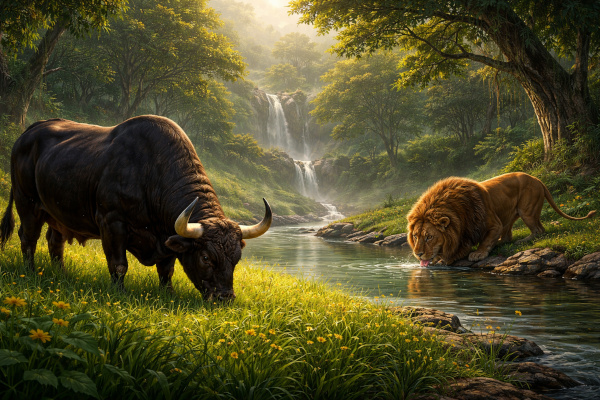
The forest in those days was not a gentle green world of birdsong and filtered sunlight. It was an empire of shadows and gold, where every leaf seemed to listen and every creature moved as though under the gaze of destiny. Vast sal trees rose like pillars in an ancient temple. The wind dragged its fingers through the tall grass with the sound of whispered conspiracies. Rivers moved like molten bronze beneath the evening sky. And at the heart of that great wilderness ruled Pingalaka, the lion king, terrible as thunder and magnificent as a god who had chosen claws instead of commandments.
When Pingalaka walked, the forest adjusted itself around him. Deer stopped breathing. Monkeys went silent. Even the old wolves lowered their eyes. He was power made flesh, a monarch whose mane caught the sun like a burning crown. Yet as with many rulers, the majesty everyone saw concealed a quieter truth. Strength does not abolish fear. It merely teaches fear to dress itself in dignity.
Far from the lion’s court, on the edge of the forest where trade routes kissed the wild, there had once been a merchant caravan. Among its animals was Sanjeevaka, a bull of uncommon size and beauty, broad of chest, dark as rain-soaked earth, with horns curved like polished crescents. He had the patient strength of those noble beings upon whose backs the ambitions of lesser creatures are carried. He was not born for drama, only for work, loyalty, and the steady dignity of endurance.
But fate, which delights in overturning the plans of the practical, dealt him a cruel hand. Injured and believed lost, Sanjeevaka was abandoned near the river by a merchant who no longer thought him useful. There in the loneliness of mud, reeds, and silence, he lay between life and death, hearing only the distant cries of strange birds and the merciless indifference of the world.
And yet he did not die.
The river nursed him. The grass restored him. Dawn after dawn, the forest stitched muscle back onto his bones and breath back into his chest. What had been cast off returned stronger. His neck thickened. His hide gleamed. His eyes grew steady with the hard wisdom of one who has learned that survival is not a gift but a conquest. One evening, when the monsoon clouds were piled like dark mountains above the horizon and the air trembled with coming rain, Sanjeevaka stood upon the riverbank in the full force of his recovered life and bellowed.
It was not a sound. It was an event.
The cry rolled across the forest like a war drum struck by the hand of heaven. It thundered through the trees, crashed against the hills, and entered the heart of Pingalaka himself.
The lion had come to the river to drink. But when that vast unknown voice broke over the jungle, he froze. The water rippled beneath his unmoving reflection. His ears twitched. His golden eyes widened, just for an instant, with something no courtier had ever seen in them before: uncertainty. He had faced tusked boars, maddened elephants, rival predators drunk on blood and rage. But this sound was different. He did not know what beast could produce it. And in the kingdom of power, nothing is more terrifying than the thing one cannot name.
So Pingalaka stepped back from the river.
He did it slowly, with all the outward composure of a king making a tactical decision. But the truth moved beneath that composure like a serpent beneath grass. He was afraid.
Watching from a prudent distance were two jackals: Damanaka and Karataka, former attendants of the lion’s court, creatures thin of limb, sharp of eye, and infinitely practiced in the art of surviving near power without ever possessing any. Karataka, older in instinct, saw danger and wished only to remain unnoticed. But Damanaka’s mind lit up like a torch in dry brush. He had the rare and poisonous talent of recognizing not merely fear, but opportunity inside fear.
Damanaka approached Pingalaka with the perfect mixture of humility and usefulness. His voice was soft, respectful, almost tender with concern. But behind that velvet lay steel. “My lord,” he seemed to say, “why should the sun retreat because of a sound? Let me discover what dares shake your forest.”
Pingalaka, still pretending his retreat was strategy rather than alarm, allowed it.
So Damanaka went into the deep green silence toward the source of the roar and found Sanjeevaka by the river meadow: splendid, recovered, enormous, but unmistakably a bull, not a demon. At once the jackal understood both the truth and its value. Here stood no supernatural threat, only a lonely creature whose strength could be turned into leverage. Damanaka did not see a survivor. He saw a ladder.
He spoke to Sanjeevaka first with the authority of one who borrows importance from proximity to a throne. He described Pingalaka not as a ravening monarch who could tear flesh from bone, but as a king open to noble friendship. To Pingalaka he returned carrying a different version of truth: the mysterious being was mighty, yes, but respectful, and perhaps a useful ally rather than an enemy. Thus did he build a bridge between lion and bull, not out of goodwill, but out of calculation.
When they first met, the forest itself seemed to pause.
Pingalaka emerged from the trees like incarnate royalty, every step measured, every muscle heavy with restrained violence. Sanjeevaka stood by the river, vast and immovable, his horns bright in the slanting light, his gaze calm with the confidence of one who had already survived abandonment and pain. Predator and herbivore, king and exile, claw and hoof, hunger and patience—by every law of nature they should have been enemies. And yet something unexpected passed between them.
Recognition.
Pingalaka found in Sanjeevaka not servility, not flattery, but gravity. The bull spoke plainly. He had no talent for courtly perfume. His words were solid, useful, clean of the sticky sweetness that clings to sycophants. He knew hardship. He knew recovery. He knew how quickly fortune changes and how empty pomp can sound beside suffering. Pingalaka, surrounded always by fear and obedience, encountered in Sanjeevaka the rarest of luxuries: sincerity.
Sanjeevaka, in turn, found in the lion not merely terror, but grandeur. Pingalaka was dangerous, yes, but there was intelligence in him, and loneliness too—the loneliness of those so elevated that everyone kneels but no one speaks honestly. Between them, against all expectation, friendship took root.
And what a friendship it was.
The lion and the bull spoke at length beneath moonlit branches while the jungle listened. Days passed when Pingalaka neglected the hunt to remain in counsel with Sanjeevaka. They spoke of fortune, loyalty, statecraft, danger, the fickleness of life, the duties of strength, the burden of power. The king’s fierce mind, long dulled by constant praise, sharpened in the presence of the bull’s grounded wisdom. Sanjeevaka, once abandoned like broken property, now sat at the heart of the forest beside a sovereign. It was as though two very different solitudes had found shelter in one another.
But no great bond forms in a vacuum. The moment trust creates a private world between two beings, someone outside that circle begins to resent the warmth.
Damanaka watched his own handiwork with growing bitterness. He had introduced them intending to become indispensable. Instead, he found himself displaced by the very friendship he had arranged. Pingalaka no longer needed interpreters when Sanjeevaka sat beside him. Access had become direct. Influence had become personal. The old jackal’s place near power began to shrink.
And Damanaka, being what he was, decided that if he could not stand inside their friendship, he would feast on its ruin.
He did not strike crudely. That is not how such destruction works. He began as all elegant poison begins: in whispers. To Pingalaka he spoke with reluctance carefully performed. “My lord, I may be mistaken, but the bull’s confidence grows large.” “He speaks boldly these days.” “Sometimes closeness to power breeds dangerous thoughts.” Nothing outright. Nothing enough to challenge directly. Only the planting of shadows.
Then he went to Sanjeevaka and sowed the mirror image. “The king has changed.” “Courtiers resent you.” “Your honesty is being read as ambition.” “Be careful; thrones are affectionate until they are not.” Again, never enough to expose himself. Only enough to tint the air.
Thus suspicion entered not like a sword, but like smoke.
Pingalaka began to watch Sanjeevaka differently. Harmless words acquired edges. Silences seemed deliberate. A pause became insolence. A difference of tone became a challenge. The lion, who once found rest in the bull’s presence, now found questions.
Sanjeevaka too began to feel the chill. He noticed the altered glance, the unusual distance, the strange restraint in the king’s manner. Fear, once introduced, becomes a gifted dramatist. It can make ordinary weather feel like prophecy. He started reading danger in moments that had once been nothing.
This is how many bonds die in the world of men as well. Not by betrayal of fact, but by manipulation of meaning. A friend becomes a threat because someone narrates him that way. A lover becomes suspect because a third person translates every word into offense. A marriage grows cold because two people begin listening sideways instead of speaking face to face. Offices, families, courts, circles of friends—all are forests where Damanaka still walks.
The tension deepened until the air between lion and bull seemed stretched like a bowstring.
At last Damanaka delivered the final blow. To Pingalaka he implied that Sanjeevaka now meant to seize the throne. To Sanjeevaka he warned that the king had resolved to kill him. Pride did the rest. Fear completed what cunning began.
The day of their ruin dawned under a copper sky. The wind moved strangely, as if the forest itself knew it was about to witness something irreparable. Pingalaka emerged in full wrath, mane aflame in the harsh light, claws digging into the earth. Sanjeevaka stood firm, though his heart thundered. He had once come to this forest abandoned and half-dead. He would not now crawl.
For a suspended instant they faced one another across the clearing, and tragedy stood visible between them—not merely the possibility of violence, but the unbearable knowledge that two beings who had once healed something in each other were about to meet as enemies.
Then the world broke.
Pingalaka roared, and the trees shook. Sanjeevaka lowered his horns like twin spears. They collided with a force that seemed to strike sparks from the air itself. Claw against hide, horn against muscle, dust rising in red-gold clouds, the battle raged with the savage grandeur of myth. Pingalaka was speed, fury, predatory wrath. Sanjeevaka was weight, endurance, defiance. The bull’s hooves tore trenches into the earth. The lion’s mane flew like a banner in a storm. Birds fled the canopy. The river seemed to recoil.
Yet in the end, power and pain carried the day. Pingalaka, bloodied and blazing with battle-rage, brought Sanjeevaka down.
The bull crashed to the earth.
Silence followed.
Not victory. Silence.
Pingalaka stood above his dead friend, chest heaving, claws wet, eyes burning not with triumph but with the first dreadful hint of recognition. The clearing that should have resounded with conquest instead felt like a temple after sacrilege. He had won back his safety, his throne, his old hierarchy—and lost the one voice that had ever spoken to him without fear. What remained was not peace. It was emptiness dressed as authority.
Damanaka, of course, regained his place.
Such men often do.
That is why the story endures. Because it is not really about a lion and a bull in some vanished jungle. It is about kings who distrust too easily, friends who fail to verify, lovers who listen to spectators, families destroyed by interpreters, workplaces where incompetence survives by poisoning trust, relationships that collapse because one manipulator profits from confusion. Pingalaka is every powerful person too proud to ask directly, “Is it true?” Sanjeevaka is every loyal heart that believes sincerity alone is enough protection. Damanaka is the smiling voice that says, “I’m only telling you this for your own good,” while quietly lighting the fuse.
And so the forest keeps repeating itself, in boardrooms and marriages, in friendships and politics, in homes and courts and digital whispers. The names change. The claws and horns disappear. But the pattern remains eternal:
Two souls find truth in one another.
A third cannot bear it.
Suspicion enters.
Silence replaces speech.
Love becomes caution.
Trust becomes theater.
And by the time the truth is finally visible, something beautiful is already dead.
That is the grandeur and the sorrow of Pingalaka and Sanjeevaka. It is not merely a fable of betrayal. It is an epic of how easily the noble can be separated, how vulnerable even great affection is to well-placed poison, and how the loudest enemy is not always the most dangerous one.
Sometimes the most fatal blow is delivered by a whisper.
You may also like
-
Durga versus Mahishasura: Weapons, Battlefield Tactics and the Triumph of Shakti
-
Yudhishthira’s Counter-Diplomacy With Shalya: Working With an Ally Who Has Joined the Other Side
-
Duryodhana Wins Shalya Through Hospitality: Gifts, Obligation and Political Leverage Before the Kurukshetra War
-
Krishna’s Private Meeting With Karna: Back-Channel Diplomacy Before the Kurukshetra War
-
Krishna’s Last Peace Mission: The Five Villages That Could Have Prevented Kurukshetra
