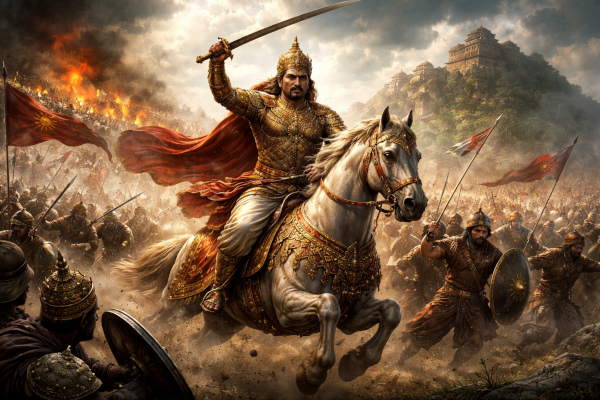
Skandagupta stands among the most formidable rulers of ancient India, a king who rose at a moment when the Gupta Empire was no longer expanding in effortless majesty but straining under pressure from both internal instability and foreign invasion. He is generally placed between 455 and 467 CE, and many historians regard him as the last great emperor of the Gupta dynasty. If earlier Gupta rulers represented the empire at its cultural and political zenith, Skandagupta represented something equally important: its power to endure. He did not inherit a calm and shining world. He inherited a realm under threat and, for a time, held it together by force of arms, administrative will, and imperial resolve.
Skandagupta was a son of Kumaragupta I, though the identity of his mother is not clearly stated in the surviving major inscriptions, which has led historians to debate his exact place within the royal household. This uncertainty has also encouraged the view that his accession may not have been entirely smooth. He seems to have emerged as ruler during a period of dynastic strain, and the inscriptional record suggests that he had to restore the fortunes of his family rather than merely step into an undisputed inheritance.
That image of struggle appears vividly in the Bhitari pillar inscription, one of the most important records of his reign. It presents Skandagupta as a prince who restored the fallen glory of his lineage after his enemies had become powerful. The inscription uses dramatic and poetic language, saying that he spent a night on the bare earth before defeating his foes and then approached his mother in triumph like Krishna returning to Devaki. Such language is not mere courtly ornament. It strongly suggests that Skandagupta’s rise came in the middle of crisis, and that the throne of the Guptas had to be defended before it could be securely occupied.
Before he became famous for facing the Hunas, Skandagupta appears to have first dealt with another grave threat, usually identified from the Bhitari inscription as the Pushyamitras or a similarly read hostile force. The inscriptional reading has been debated, but the core historical point remains clear: one of his earliest achievements was to defeat a dangerous enemy and stabilize the imperial position. This victory was crucial, because it restored confidence in Gupta authority at a time when the empire could easily have begun to fragment from within.
Yet it is his resistance to the Hun invasions that made Skandagupta a figure of lasting historical importance. During the 5th century CE, waves of Central Asian pressure began moving toward the Indian subcontinent, and the Hunas represented one of the most serious dangers the Gupta Empire had faced. These were not minor raiders to be dismissed in a line or two. They were part of a larger geopolitical storm that had shaken regions across Asia. Skandagupta’s inscriptions celebrate his victory over them in exalted terms, suggesting that the earth itself trembled beneath the force of battle. While the poetic imagery is typical of royal epigraphy, the political reality behind it was immense: Skandagupta managed to repel a force that might otherwise have broken northern India much earlier.
This achievement must be understood in full historical weight. Without his resistance, the disintegration of Gupta power may have begun sooner and with far greater violence. The Hunas would indeed return later and play a major role in reshaping northern India, but under Skandagupta they were checked. His reign therefore marks a crucial pause in the collapse of imperial stability. He did not permanently eliminate the threat, but he delayed disaster, and in the history of empires, delaying disaster can itself be an extraordinary accomplishment.
The chronology of his reign is supported by several inscriptions dated in the Gupta era. The Junagadh inscription is dated in years 136, 137, and 138, the Kahaum pillar inscription in year 141, and the Indore copper-plate in year 146. These records help place him securely in the mid-5th century CE and show that his authority extended across a broad imperial geography. He was not a king remembered only through legend or literary nostalgia; he is firmly visible through the hard evidence of inscriptions and administrative records.
Skandagupta’s greatness, however, was not only military. One of the clearest signs of his quality as a ruler is visible in the Junagadh rock inscription, which records his administration in Surashtra, a strategically significant region in western India. There he appointed Parnadatta as governor, and the inscription goes on to praise the work of Parnadatta’s son Chakrapalita. This reveals an important side of Skandagupta’s kingship. He was not simply a battlefield monarch reacting to invasion; he was also a ruler capable of maintaining provincial administration, selecting capable officials, and preserving the machinery of empire even under strain.
His most notable contribution in public works was the restoration of the Sudarshana Lake at Junagadh. This reservoir had a long and prestigious history, stretching back to earlier centuries, and it had already required repair under previous dynasties. During Skandagupta’s reign, heavy rains breached its embankment once again. Under the supervision of his provincial administration, the structure was repaired with remarkable speed and scale. The inscription records dimensions of 100 cubits in depth, 68 cubits in breadth, and seven men’s height in elevation, and notes that the work was completed in two months. These are not decorative details; they show the material seriousness of the project.
The restoration of Sudarshana Lake was far more than an engineering event. In ancient India, irrigation and water management were tied directly to agriculture, revenue, social order, and the legitimacy of rule. A king who could defeat invaders but fail to preserve water systems would still preside over ruin. By ensuring the repair of this reservoir, Skandagupta demonstrated that imperial duty included the maintenance of life-sustaining infrastructure. This practical, administrative dimension of his reign often receives less popular attention than his wars, but it is one of the strongest indicators of his importance as a ruler.
In matters of religion and royal piety, Skandagupta followed the broader Gupta pattern of Vaishnavite kingship while also expressing imperial duty through endowments and sacred patronage. The Bhitari inscription records that he caused an image of Sharngin, a form of Vishnu, to be established and endowed a village for the spiritual merit of his father. This shows him acting not merely as conqueror and administrator, but also as a dynastic guardian linking kingship, religion, and memory. Gupta imperial culture often fused political power with sacred legitimacy, and Skandagupta clearly operated within that tradition.
Architecturally, he is not associated with one towering surviving monument in the way some later rulers are, yet his reign is still connected with meaningful construction and restoration. The Vishnu image mentioned in the Bhitari record points to religious patronage, while the Junagadh inscription preserves one of the clearest examples of large-scale civic and hydraulic repair under his authority. In that sense, his architectural legacy is less about one grand temple and more about the two pillars of Gupta kingship: sacred endowment and public utility.
His coinage also tells an important story. Skandagupta issued gold and silver coins, continuing established Gupta imperial traditions of royal imagery and titulature. These coins help confirm his authority and geographic reach, but they also belong to a period when the Gupta Empire was beginning to show signs of fiscal pressure. The brilliance of Gupta coinage still survived, but the political and economic background was becoming less secure than in the days of Samudragupta or Chandragupta II. Thus, even in numismatics, Skandagupta appears as a ruler defending inherited grandeur in a changing world.
His broader contributions to India can therefore be seen under several headings. First, he defended northern India against the Hunas, delaying a major geopolitical upheaval. Second, he stabilized the Gupta Empire during a succession crisis or internal disturbance, preserving dynastic continuity at a highly vulnerable moment. Third, he maintained effective provincial administration across important regions. Fourth, he supported public works and irrigation infrastructure, demonstrating that statecraft was not only about war but also about sustaining the agrarian and economic base of society. Finally, he preserved the prestige of Gupta kingship long enough for his reign to become the final strong blaze of one of India’s greatest imperial houses.
Skandagupta is often called the last great Gupta emperor, and the phrase is justified. The dynasty did continue after him, but not with the same force, coherence, or confidence. Later rulers inherited a weakened structure, and the empire gradually lost its earlier command over northern India. Provincial assertion increased, the Hunas returned, and the old Gupta order began to fray more visibly. Skandagupta thus occupies a tragic but magnificent place in history: he was not the founder of the age, but its final defender.
The details of his death are not described in dramatic narrative sources, and no grand battlefield end survives in the record. Historians generally place his death around 467 CE, after which the Gupta succession entered a less stable and less luminous phase. There is something fitting in the quietness of that ending. Some rulers leave behind tales of spectacular final gestures; Skandagupta seems to leave behind the harder legacy of a man who spent his strength in holding an empire upright. After his death, the structure he had steadied no longer possessed the same resilience. The tide he had checked began to move again.
That is why Skandagupta remains such a compelling figure in Indian history. He was not merely a king of ceremony or prosperity. He was a ruler forged by emergency. He defended his realm against one of the greatest threats of his age, kept alive the authority of a dynasty already under pressure, repaired the physical foundations of governance, and delayed the political transformation of northern India. He stands, therefore, not just as a Gupta monarch, but as one of the great imperial defenders of ancient India — a man who met the storm, and for a while, made it stop.
Refrence:
https://www.britannica.com/biography/Skanda-Gupta
https://www.britannica.com/topic/Gupta-dynasty
https://archive.org/stream/in.ernet.dli.2015.108395/2015.108395.Corpus-Inscriptionum-Indicarum-Vol3-inscriptions-Of-The-Early-Gupta-Kings_djvu.txt
https://archive.org/details/in.ernet.dli.2015.119570
https://people.bu.edu/ptandon/KG%20Succession.pdf
https://www.sahapedia.org/realm-written-words-indian-epigraphic-records-c-third-century-bce-thirteenth-century-ce
https://www.worldhistory.org/Gupta_Empire/
You may also like
-
Mekala in the Mahabharata: The Ancient Highland Kingdom of Amarkantak and the Maikal Hills
-
Anupa in the Mahabharata: The Ancient Narmada Kingdom of Mahishmati and the Maheshwar Region
-
Sarnath Joins UNESCO World Heritage List as India’s Civilisational Legacy Gains Global Recognition
-
Ancient Bazira-Barikot of Gandhara Gains UNESCO Recognition as 3,000 Years of Urban History Emerge From Swat
-
Vaidisha in the Mahabharata-Era Geography: The Ancient Vidisha Region of Central Madhya Pradesh
